| Home Made Soap |
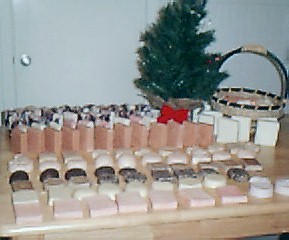
| Now, let it be said that making homemade soap is not a hobby you can master the very first time you do it....unless of course your an experienced crafter or get extremely lucky. It's a trial and error process but it's well worth it. It's a great way to save some money and also make some money if your so inclined. So with that said, let's learn how to make soap. First of all, there are some supplies that you really do need to have on hand to add to the success of a batch of soap. They include but are not limited to: *A stainless steel pot (of the lobster variety...do not use aluminum ANYTHING when making soap.) *2 candy thermometers that show exact temperature *Rubber gloves & safty glasses *A soap mold (I have used shoe boxes, cardboard shipping boxes, but now have graduated to a 4x4x8 wooden bod with hinges on one side) *A plastic or glass container with a lid to mix and pour the lye/water solution *A scale that weighs to the ounces ***VERY IMPORTANT! A batch of soap with missing ounces of oil, water, lye or other ingredient can easily fail! It's best to have a scale up to 5 lbs, but I have used a 2 lb postal scale with much success. *Important note...once you've used a utensil for making soap, it becomes official soap equiment. LOL...you don't want to use it again for food or anything else that will come in contact with your mouth. Basic Castile Soap (makes a nice hard bar for face & Body) Ingredients: 56 oz. olive oil 30 oz vegetable shortning 9 oz Castor Oil 12 oz Red Devil Lye 28 oz COLD water 2 Tbsp salt disolved in a tiny bit of water and added to lye solution In the pitcher measure out your cold water to the ounce. Measure your lye to the ounce in a seperate container. Slowly while stirring constantly, add the LYE to the WATER......never water to lye. Turn your face away and have a window open because the fumes are terrible.....but once the lye is absorbed into the water, and it becomes clear again, the odor dissipates. The water will become VERY hot once the lye is added. It may well reach 300 degrees. Disolve your salt in a tiny bit of water and add to the lye solution. Cover the container and put in the fridge. Meanwhile, measure out your fats and add them to the stainless steel pot. Melt any hard fats first (the shortening) and then add your liquid fats and oils. Heat them until all the hard fat is melted and then set aside. The object from here on out is to get the oils and the lye to cool to the same temperature similtaniously. You want them to both cool down to about 95-100 degrees. If you mix the two substances before that temp, you will ruin your soap. This process of cooling can take 30 minutes or so. To speed this up, you can submurge each container seperately in a cold water bath in the sink, just cooling the outside of the containers to bring the temp down rapidly. And don't worry about cooling too much. If you get it too cool, you can always heat it up again in a warm water bath. Once your lye and oils solutions are both at 95-100 degrees, you can mix them together. Always pour your LYE into your FATS.....never the fats into the lye. Stirring constantly. Now it's time to stir. If your stirring by hand, plan on standing there for about 15-30 minutes stirring until you get a "trace". (Trace is a term that means you can raise the spoon out of the soap and see traces of patterns in the soap. Kind of like the consistancy of warm pudding) If you plan on making soap all the time, invest in a stick blender (about $13.00 at Kmart)....it cuts the stirring time HUGELY! With a stick blender, I get trace after as soon as 5 minutes. Once you reach trace stage, you can then add any fragrance you want or additives. Usually a batch of soap will take an entire bottle, sometimes two of a good quality fragrance oil or essential oil. Then you pour it in the primary mold. You can use several things for molds. I've used shoe boxes, old litter boxes, etc. Just make sure they are lined with freezer paper. Now is time to cover and insulate your soap. Do this quickly or else your soap might "catch cold"...cover with a peice of cardboard or a peice of wood and then insulate your mold with towels or blankets. Leave this undisturbed for the initial 24-48 hours. After the initial setting period is up, uncover your mold and you can cut your soap into bars and prepare for them to cure. Be careful and wear your gloves, as there is still a high content of lye. It will still burn. After they are cut into bars, set them upright, uncovered and not allowing them to touch one another and leave them alone for 2-4 weeks. After 2 weeks, test a bar by washing your hands with it. If it still burns, then it's not ready and try again in one more week. Soap is super fun to make and you have an endless array of essential oils or fragrance oils as well as herbs and goodies to add into them. So have fun with them and be sure to email me with your successes! I love to hear about them! Blessings to all the soapmakers out there, old and new! Spirit Chakra email me |
 |
 |