Re-Creational Uses 11
Another important change in the attitudes toward LSD that occurred by then was open recognition of the fact that this drug could create ecstatic experiences. This was an effect already much noted in the literature, but mainly evident from anonymous anecdotes by patients and only hinted at in most researchers' reflections. An example is Sidney Cohen's account (1962) of his glorious first experience, described in his book The Beyond Within as that of "a doctor," but later acknowledged as personal in the volume titled LSD, coauthored with Richard Alpert.
At the early Millbrook center the question whether or not to frankly recognize this ecstatic aspect was a significant debate. Such recognition might well raise uncalled-for images of orgies in the public's imagination. Late in 1966, however, Leary -- busted just before for smuggling a small amount of marijuana through Laredo, Texas, as he tried to enter Mexico, and becoming something of an LSD martyr in the process -- decided to speak openly. Until then, researchers mainly skirted the issue, but Leary declared ecstasy (not to be confused with MDMA) to be a major effect of LSD. And on top of that, he described sexual implications in the pages of Playboy.
In the late 1960s, the novel element of group-tripping resulted in multiple experiences of synchronism and of psi-type events. Until this time such LSD-inspired feelings had cropped up regularly, but had been treated rather offhandedly because usually only a few participants were involved. Osmond, for example, recorded an earlier LSD experiment in which there was "a major, witnessed thought transference." He also described how this came to an end: "Unluckily we had no recording equipment and our observer became acutely panicky because he said it was uncanny." This was much less the feeling of the late-1960s LSD exploration.
This period became the first wave of the so-called psychedelic revolution. Young people were mostly involved, although their mentors, to a large extent, were well into their fifties. Yet these young people had found in LSD something to which they could give allegiance. Unquestionably the continuing war in Vietnam, the relative affluence then of the American middle class, and student dissatisfaction with educational goals were among the factors having to do with such a development. But when Leary concocted the slogan "Turn on, Tune in and Drop out" -- conceived by most of his contemporaries to be shocking -- millions, nonetheless, followed his advice.
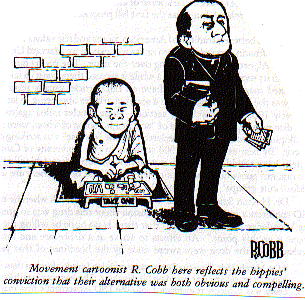
What resulted was the establishment of an alternative culture, a counterculture in which new notions -- largely derived from LSD experiences -- flourished. Much of this would have been unacceptable to arbiters of taste in the media that previously had transmitted cultural feelings. However, this new, energized group soon conveyed catalytic information that was significant to the major social movements of the 1970s.
Changed attitudes toward consciousness, sexuality and ecology were part of the lingering consequences of these millions of LSD trips. This revised perception was conveyed forcefully in the form of newspapers that arose in the underground press and particularly in the popular music of that era.