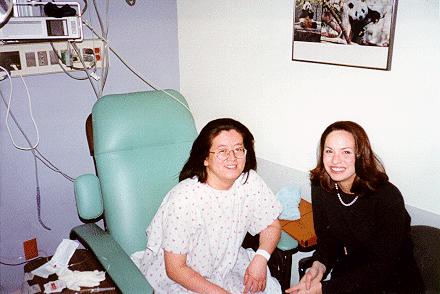
Journey into Silence and Back
The Initial Hookup and First Mapping
Second and Third Mapping Session
Sixth Month Evaluation
Fall Happenings
Speech Processor Adjustments
March 27, 1996 at a Maryland hospital
"So how does it feel to be deaf?", my friend Bonnie
asked me, voicing and signing the question at the same time. I
frowned at her. "You really don't want to know."
Nearly a week ago, on Thursday, March 21, I awoke in the
morning to a slight cold and a headache and I thought after I put
my hearing aid on, sounds were slightly distorted. I thought
maybe my hearing aid were acting up again. Nevertheless, I went
to work as usual and hoped the situation would get better by the
end of the day. I also called the audiology clinic I normally go
to and made an appointment to see Elaine (my audiologist) the
following Monday morning which was the first available slot
possible. Friday morning however, I noticed I was experiencing
increasing difficulty in hearing on the phone. I kept saying
"What?" and asking people to repeat. I had to cover the
reference desk at a branch library and I found myself straining
to read the lips of those who came into the library for reference
help.
Over the weekend, the situation didn't really improve. We went down to North Carolina to celebrate my mother's birthday. More straining to read everyone's lips followed. I felt very uncomfortable and somewhat stressed out. By the time we came back to Maryland I was getting desperate and even went to an urgent care clinic to see if getting my ears cleaned of wax would improve the situation. I couldn't wait for Monday to find out what was wrong with my hearing aid. I assumed the problem was with my aids since that has always been the case whenever my aids start getting static or distorted sounds.
Monday morning, on March 25, I went to the hearing clinic. I like this particular clinic very much; the audiologists there all sign and I've been going there since I moved to Maryland in 1988. Elaine was out sick that day so Solveig, the director of the clinic, took my case. When she checked my hearing aid and pronounced it in good condition, I knew I was in trouble. Pure tone audiometry tests revealed that in my good (left) ear, I was now hearing the beeps at very high intensity levels only and I scored only 20% (normally I score 95% to 100%) on the speech audiometry test. I was beginning to realize I could only hear vowel sounds with my aid and not consonant sounds. And even then I could only hear the vowel sounds if the person was standing at very close range. Solveig said if I have been able to use the phone on last Thursday but now couldn't use the phone now plus these hearing test results, she was ready to diagnose this as a case of sudden deterioration in hearing and wanted me to see a ENT specialist right away. So I went across the hall where the ENT clinic was and waited for Dr. Epstein to see me.
I did a lot of crying while in the waiting room. I had anticipated that my hearing might deteriorate sooner or later, but not so soon. And not so fast either. In the past my hearing in my left ear had deteriorated VERY slowly and in the last ten years it had steadied itself at 75 dB in all frequency ranges which still made it easy for me to hear a great deal with hearing aids. Now the loss in my only good ear was closer to 95 or 100 dB. Part of me tried to say, "Not my will, Lord, but yours." Nevertheless, I found myself crying as I contemplated having to reduce or stop my violin studies and cancel my participation at the string quartet workshop I was planning to attend in three weeks. [I did stop my violin studies about a week later and canceled my attendance at the workshop.]
The next few hours were a blur. Dr. Epstein insisted that I check into Shady Grove hospital where he would attempt to stop further deterioration with steroids and respiratory therapy. I went home and typed the following e-mail message to Paul, my husband:
I'm at home now, packing to go to Shady Grove Hospital. My audiogram results show a sudden marked decrease in hearing and Dr. Epstein thinks the cold I have may have cause viral cochlitis and inflamed the inner ear in my left ear. So he wants me to check into Shady Grove Hospital and receive intravenous administration of some medication which is supposedly to bring the inflammation down. I'll fill gas for the car, then stop by Epstein's office to pick up admission and then stop by the office to pick up some papers. Then I can give you the car and check in to Shady Grove.
While packing to go to the hospital, I heard the phone ring. Paul is on the line but I tell him I really can't hear him and ask him to e-mail me back. Five minutes later, I get the following message:
Don't forget to get a referral!
Not to worry, I wrote back. Dr. Epstein is already talking with my primary care provider about this hospitalization. I had not yet left for the hospital, but I felt my lifestyle was already changing.
An Encouraging Word
The hospital stay was stressful. I had to wait a while to get
captioned television and a TTD (telecommunications device for the
deaf) for my room. The staff was nice but not all the nurses were
easy to lipread. And although Dr. Epstein is really patient about
writing or repeating phrases for me I couldn't help wishing that
a sign language interpreter was around. Worst of all, I was a
nervous wreck, wondering if my hearing was going to come back.
I did more crying but also made a TTD call to my friend Carol, who is a sign language interpreter and professor at a community college in Baltimore.
"Hi Carol, this is Wendy Cheng calling. Is Bill home? GA." Bill is Carol's husband and one of my few contacts in the deaf community.
"Hi Wendy... Bill is out and won't be back until later this evening. Anything I can do for you? GA"
"I'm in the hospital, looks like I have a viral infection in my cochlea. I'm basically deaf right now and don't know if I will get my hearing back. GA"
"Sorry to hear about this. But
Wendy, don't forget that you know sign and you do have some
familiarity with the deaf community. You do have a head start
than most people in your situation. GA"
"Thanks for the encouraging
words. Tell Bill I've called and remember me in your prayers. GA
to SK."
"Ok, will do. Bye for now. SKSK."
I knew I could count on Carol to find the silver lining in this situation. Still, I was preoccupied with trying to figure out new coping strategies for dealing with this at work. I spent a lot of time in the hospital thinking about how to deal this sudden hearing loss on the job.
[On Thursday, March 28, I was discharged from the hospital with prescriptions for prednisone and niacin. I still didn't have an interpreter when Dr. Epstein arrived to give me discharge instructions and I really didn't understand how the prednisone and niacin was to make my hearing better. As a matter of fact, the worst happened the following week----I could no longer hear vowel sounds in addition to consonant sounds. After two weeks at home, I had another audiogram, at which point Dr. Epstein told me not to take the niacin and prednisone any more.]
As soon as I got back to the office that afternoon after being discharged, I took my TTD out of storage (I had gotten it sometime ago courtesy of the departmental EEO office). I would get sign language interpreters for all staff meetings. My coworkers could take phone calls for me and I would return the calls. We decided it was not worth trying to obtain a dedicated TDD line for me to answer phone calls since the library was in the process of planning for a big physical renovation. One thing that really got to me in regard to TTD use was the fact no one in any of the EEO offices at the Departmental, agency, or center level knew how voice carryover (VCO) worked. I had vaguely heard of this technique in which my voice could be piped over to the other party and I would not have to type my responses over the TDD. (I realized very quickly that being able to voice for myself really speeds phone calls, compared with typing everything.) In April, the SHHH National Office sponsored a communications forum at a local community library so I attended the forum and got several copies of the Maryland Relay Service's brochures on voice carryover. I gave one brochure to both the center and agency EEO office.
I decide that attempting to lipread everyone, especially in meetings, was too stressful on the top all of the stresses of the job so with the exception of one person I could lipread fairly well, I told my colleagues to write down what they had to say. And within a week, I had arranged for myself to get on-call interpreting services in the morning as an experiment. It was hard to have to read signs at first . . . the last time I used an interpreter was about 8 years ago, when I was in graduate school. Believe it or now, I still have problems reading fingerspelling. The first time I used an interpreter for a staff meeting, I was discouraged . . . . I understood only about 70% of what went on. But as Paul said, 70% was better than nothing. Many times in the last few months, I've realized how lucky I am that I already know sign language, and that sign language interpreters are fairly easy to obtain in the Washington DC metro area. I don't know how I would have coped otherwise since real time computer notetakers are harder to obtain.
I was prepared to not hear my violin any more, but I was NOT prepared to not hear voices anymore. One of the first questions I had was how culturally deaf parents can live with not being able to hear their hearing children learn to talk. An old deaf friend of mine said that most deaf parents either live with it or don't consider it that important. But it would be a big loss for me because I had heard and enjoyed Abigail's babbling before. I had not really focused on teaching Abby sign language because I couldn't get used to the idea of holding Abby in my right hand while signing with my left hand; I had always signed with two hands. Also, I think the most effective way to teach sign to a young child is to have BOTH parents just sign and not voice. This I wasn't really willing to do because for one thing, I already know Abby is a hearing baby and secondly, I personally like to voice when I'm around hearing people.
Another thing that changed was how I communicated with Paul. The first few weeks after I got back from the hospital communication between us were difficult, because Paul had only a very rudimentary knowledge of sign language. I almost wanted to put heavy pressure on him to take a class or do something quick to bring his vocabulary up to my level . . . . unfortunately he does not absorb new languages as quickly as I can. Sometimes he got frustrated trying to getting his message across and would resort to writing. One thing I did change though---I started sitting next to him in the front seat so I could see his lips when talking in the car. (I had been sitting in the back seat so it would be easier to tend to Abigail's needs.) But now Paul is learning more signs so he is slowly getting better each day.
The last thing that changed was how I communicated with my Mom and sisters. I could no longer just pick up the phone and dial my mother's number. We decided to use an interactive Internet talk software called Wintalk. Paul already had gotten an Internet account with an Internet service provider; my mother borrowed my sister's internet account. Together, we typed a conversation once a week. For Mother's Day though, I decided to voice my Mother's Day wishes via the telephone relay service. [We didn't like the idea of using the relay services to facilitate the conversations because my mother's written English skills is better than her speaking skills. Plus we were a little concerned that something could get lost in the translation if we used a relay operator]. So for now, we (my Mom and sisters) primarily use Wintalk and electronic mail when communicating to me. Communicating in person is a little hairy still. I went to North Carolina again in June to celebrate my father's birthday. I still had to do a lot of lipreading, although my youngest sister Judy is improving slowly and steadily on her signing skills (she took an elementary sign language class in college).
Within two weeks, things had settled down a bit. There were
times when out of sheer frustration, I would go to Bill's office
around the corner and ask how in heaven's name he'd dealt with
the inconveniences of deafness all these years. (And he would
look sympathetically at me and sign, "Now you know.")
For example, my TTD broke so I borrowed another one from the
agency EEO office. Two weeks later, that one also broke, so the
center EEO office kindly loaned me theirs. Also, I really
appreciate the availability of interpreters to facilitate
communication, but there are some disadvantages to using contract
interpreters. (FDA
has an excellent staff interpreter but she cannot serve 10 deaf
employees all at once so we get contract help.) Contract
interpreters vary widely in their signing and interpreting
styles. My eyes can focus like a laser beam on an interpreter's
lips and some have more readable lips while other interpreters'
lips are not as readable. (I'm using my peripheral vision to see
the signs.) Some will tend to give me a summary when my preferred
method is verbatim transliteration of what goes on. I can state
my preferences to the contract agency but I cannot always get my
preferred interpreters. Lastly, it does get tiring to read sign
for more than an hour, especially during long staff meetings.
By mid-April 1996, I was living an uncomfortable existence as a
deafened individual. At the best moments, when my interpreters
were present or I was on a (working) TTD troubleshooting problems
via relay, I could almost feel being deaf was a minor annoyance.
At the worst moments, when I couldn't hear Abby talk or follow
conversations at home, at work or at the sitter's house without
interpreters....or see a string quartet play on television, I was
acutely aware of how much I was missing. When our Abby was
diagnosed as having a slight delay in speech development and
referred to an early infant-toddler intervention program, I
really bemoaned my loss because it meant only Paul could reliably
observe Abby's speech development. Reluctantly, I began thinking
about getting evaluated for a cochlear implant.
I used to think in my hard of hearing days that if I did become deaf, I would never consider an implant. For one thing, I was not thrilled with the idea having an electrode surgically and permanently placed inside one of my ears. I did not know what the side effects or long term effects of the surgery would be. And, had I been heavily involved in the deaf community and deaf culture, I would not have considered this option. However, by deciding some years ago to immerse myself in musical studies and marry a hearing person, my world now was really full of hearing people. . . my husband and daughter, my parents and sisters, my co-workers. (Even some of the culturally deaf people I know since becoming deaf felt sorry for my loss and suggested that a cochlear implant might make my life easier.) Medically speaking, Dr. Epstein felt I was a good candidate for an implant.
So I started doing research on cochlear implants. I went through some 300 messages on America Online about the topic and joined the Beyond-Hearing Internet mailing list, which has a sizable contingent of adult cochlear implant users. I had no difficulty finding material about the medical aspects of cochlear implants, but what I was really looking for was personal anecdotes to make me feel more at ease with this option. And in Bill Graham's keynote speech at the 1995 ALDA convention, I found what I was looking for. (His speech moved me to tears because like me he has adapted somewhat to being deafened and signs well, yet recognized the need to better his own situation.) I knew one person who had gotten their implant at Johns Hopkins University so I set up an initial consultation on June 28, right after coming back from the SHHH annual convention
The consultation took place early in the morning of June 28. The speech and hearing clinic at Hopkins graciously provided a sign language interpreter so I could easily understand Ginger Grant, the audiologist assigned to my case. Ginger provided me with a copy of the letter she wrote to NYLcare (my health insurance carrier) requesting pre-authorization for a cochlear implant evaluation and fitting. She also observed that I was not wearing any hearing aids in my right ear and advised me to get a earmold in my right ear. (Now, I have never wore an hearing aid in my right ear because as far as I can remember, I have always given vibrotactile responses when audiometry tests were done on the right ear. Hearing aid dispensers did not think it was worthwhile for me to be fitted with an aid in the right ear.) Ginger explained to me that as part of the evaluation for the cochlear implant candidacy she would test me on both ears with several powerful aids to be sure I cannot benefit from hearing aids at all. In addition to that I would be tested on my balance, get a CAT scan of both ears and probably get a psychological evaluation to determine if I was "emotionally" ready for an implant. It should be stated here that Hopkins is one of the top three cochlear implant centers on the east coast and they are very thorough about these evaluations.
A few days later after the consultation, a letter from NYLcare arrived in the mail. The letter cryptically said . . ."We have denied your request for a cochlear implant fitting because of a non-participating provider." This letter did not make any sense because I knew Dr. Niparko (the cochlear implant surgeon at Hopkins) and Johns Hopkins Medical Center were listed in NYLcare's directory. A phone call on the following Monday clarified NYLcare's position: they were denying the pre-authorization because Hopkins was not in their network for outpatient surgery. My primary care provider was able to find that Georgetown University hospital would be approved, but I was leery about going to Georgetown. All the research I've done told me I should be going to Hopkins because Dr. Niparko at Hopkins has the most amount of experience. And besides, I was already comfortable with Hopkins, having met the staff and the patients from their cochlear implant support group. So I got Dr. Epstein to write a letter appealing the decision. Basically his letter stated I could get the best results only if I go to Hopkins. Now NYLcare is awaiting documentation from Dr. Epstein and Elaine for my medical records and audiological records.
Meanwhile, I got an earmold and used an old hearing aid for my right ear. The results has been interesting. [I'm thinking that some of the medication I took in the hospital must have helped my right ear, because at present I seem to have more residual hearing in my right ear than my left.] But even with an aid in my right ear, I still have vibrotactile responses. Over last few weeks, the environmental noises (door slamming, my typing on the computer keyboard, closing the dishwasher, etc.) still sound distorted but less vibrotactile and more like sound. I can detect voices only at very close range and it's extremely faint and not at all clear. I experimented with the controls on my hearing aid and decreased the intensity (sound pressure level) fromt 138 to 130 dB in an effort to reduce the "vibrotactile" sensation. The vibrotactile sensation is less perceivable now. However I still can't hear consonants and all vowels sound the same.
September 5, 1996
After two and half months of hounding the health insurance
carrier, I finally got NYLcare to approve my getting evaluated
for a cochlear implant. Two appointments were set up for me for
evaluation at Hopkins: October 7 to talk with Dr. Niparko and
undergo three hours of audiological testing, October 14 for CAT
scans of both cochleas and a psychological assessment.
October 7, 1996 - 12:30 pm
I arrived at Johns Hopkins Outpatient Center around 12:25 pm and took the elevator to the sixth floor. After giving my insurance authorization forms to the receptionist, I went to the waiting room. A nurse waved me into an examination room some five minutes later.
A young Chinese-American resident, Dr. Yeh, came in to take my medical history. I couldn't lipread him and sometimes I asked him to write down his questions. I got anxious; where was the sign language interpreter I was supposed to have for this initial visit with the surgeon? Dr. Yeh was kind enough to extract wax from my ears while we waited for Dr. Niparko, to arrive.
A little while later, Dr. Niparko came in, looking somewhat tired and harried. Still no interpreter. When Dr. Niparko started speaking, I knew I wasn't going to be able to lipread him either. At this moment, Maureen Kristofco (the staff interpreter at Hopkins) rushed in and apologized for being late. Now the consultation could proceed.
Initially, Dr. Niparko seems somewhat unsure of how to communicate with me. He started speaking very slowly, until he realized Maureen was signing as slowly as he spoke. Then he asked her if she was using sign English. When she said yes, he spoke more rapidly. Then he said to Maureen, "Tell Wendy that . . .''
At this point, I interrupted, firmly and politely. Turning to Dr. Niparko, I said, "You can address me in the first person." From that point on, conversation flowed quickly and easily between the two of us.
"Wendy, we've done over 200 hundred cochlear implant procedures successfully here and would like to keep our success rate up. Cochlear implantation is a highly complex procedure, and I hope we can build some sense of trust between ourselves."
I nodded, while thinking in disbelief, Heavens, I've spent the last two months trying to get my insurance carrier to allow me to be evaluated here and not elsewhere. Doesn't that say something about my confidence in you as a doctor? But I did not voice this thought because I figured he was giving me the standard introductory statements he gave to all new patients.
"Have you been scheduled for a CAT scan yet?" the
doctor asked. "Yes, next Monday."
"Where?"
"Here."
"Good. Wendy, we don't know yet if you are a candidate for
this procedure. We are going to insert a electrical probe inside
your ears and run some tests."
It took a moment for his words to sink in. Somewhat stunned, I asked, "Is this the prom stim test?" "Yes." I gulped.
The electrical promontory stimulation test is done by inserting a tiny electrode into the ear all the way to the base of the cochlea (also known as the promontory). The purpose of this test is to determine how well the auditory nerve in the "deaf" ear is responds to electrical stimulation (which is how the cochlear implant stimulates the auditory nerve). Since both of my ears are profoundly deaf, I knew I would need to take this test sooner or later.
Unfortunately no one had told me in advance that I would be taking this test today.
I tried to gather my wits about me as I followed Dr.
Niparko and Ginger Grant into an adjoining examination room. I
laid down on the examining table and then Dr. Niparko slowly and
gently inserted the electrode into the promontory into the left
ear. How the doctor could see where the promontory is located is
still a mystery to me. (They had a video monitor on so I could
watch him do the insertion but I couldn't see the promontory.)
They tested the left ear first. Insertion of the electrode was a
bit painful but once it was in, it didn't hurt at all. Then Dr.
Niparko left while Ginger administered the test. She stood right
above my head, her lips obscured by the "electrical
tablet" she was holding. Maureen moved to a position next to
her well within my line of vision. It was so good to have Maureen
there! I don't think this portion of the evaluation would have
gone as smoothly as it did without her there to "hear"
for me.
"Can you hear anything?"
"No."
A slight pause. "Do you hear anything yet?"
"No, but I feel something though."
The test results on the left ear was somewhat disappointing
and anticlimatic. I felt something---but no sound. Was I supposed
to to be hearing something?.
Then we had to repeat the test with the other ear. While we
waited for Dr. Niparko to come back to insert the electrode into
the right ear, I talked with Maureen. "Have you had to
interpret for other patients who come to the cochlear implant
center here?" She smiled. "We get enough requests such
that if a deaf person is here as a prospective cochlear implant
candidate and requests an interpreter, I know I should send an
interpreter who knows sign English and can transliterate."
This information basically left me with the impression that the number of prospective CI candidates who choose to use sign language interpreters during their visits should have been enough to help Dr. Niparko remember the cardinal rule of communication when an interpreter is present---address the deaf patient in the first person. I tell myself though, that he sees many patients during the day and most of them don't use sign interpreters as a coping strategy like I do. But I couldn't help feeling rather peeved about it for a long time afterwards.
Ginger asked me how Paul was doing and where were my
hearing aids? I told her Paul was ok, and I showed her that I was
wearing both aids today. And I also mentioned that I was hearing
more environmental sounds from the right ear, which was news to
her. Soon after, Maureen excused herself for a moment and Ginger
and I were alone.
"Wendy, I would like to try not using an interpreter during
the audiological evaluation. Is that ok with you? We can bring
her back if communication gets difficult."
I watched Ginger's lips closely. Her lips are somewhat readable and notwithstanding the heavily distorted speech sounds I'm hearing, I somehow figured out what she is saying. I thought for a moment. Yes, there might be a need to discuss the test results and my choice of implant devices (which I consider rather detailed information that I am leery about speechreading) but for the most part, three hours of pure tone testing and open set speech tests don't really require an interpreter to be present. I decided maybe I can chance it without an interpreter. "Okay, we can try it without Maureen present."
Dr. Niparko and Maureen came back into the examining room.
I felt the same twinge of pain as the electrode goes in. And not
only that, I felt something else too . . . the right side of my
tongue seems to be going numb.
"Can you hear anything?" Ginger asked me.
Yes...notwithstanding the partial numbness of my tongue, I
can hear a beep.
"Is this one or two beeps?"
"One beep."
Another slight pause. "Is this one or two beeps?"
I decided to be creative with my responses.
"Beep-beep."
From that point on, anytime I heard one or two beeps, I would say "beep" for one and "beep-beep" if there were two beeps, without them asking. Ginger was pleased with the results from the right ear. She said based on the prom stim test, she would recommend that I be implanted in the right ear.
About the two and half hours of audiological evaluations
which followed . . . well, it was EXTREMELY boring and I
personally felt they went overboard with all the open set speech
tests. (An open set speech test generally consists of you
listening to a tape or a voice without lipreading and writing
down what was said.) I mean, scoring 0 percent on the first two
tests (one was a list of two syllable words or spondees, while
the other test determine how well you could understand spoken
sentences) should have been enough evidence that I did not
understand speech with powerful hearing aids. But somehow two was
not enough and they had me take FOUR of those tests. It was sheer
torture to sit there and guess with so few clues. To top it off,
I had to take a test to see if I could hear on the phone too.
The nice part about it though, was when Ginger and I had a
short discussion about the test results and the available implant
devices that Hopkins had. Based on my results, Ginger said that I
was definitely an audiological candidate. As for the devices, I
found out that two new devices were undergoing clinical trials at
Hopkins: the new behind-the-ear RSP7 implant from Cochlear
Corporation and COMBI-40 from Med-El corporation. The COMBI-40
device intrigued me so much I asked Ginger for a copy of the
brochure Med-El gives to prospective candidates and I ended up
faxing some questions to Med-El during the week. And I was given
a questionnaire (regarding communication difficulties for
profound hearing loss) to fill out at home and be returned to her
when I return Hopkins the following week.
A few days later, I got Ginger's report from the October 7th testing session. That report confirmed to me what can happen when I attempt to speechread detailed information without any contextual clues. In her report, she said she was encouraging me to rely "more on the auditory channel". I did have some problems with that statement because first I have no recollection of her telling me that. I did remember that she said she wanted me to rely more on lipreading but to me, that is completely different from asking me to rely on the auditory channel. Secondly, if I did follow the implant team's recommendations that the right ear be implanted, I would not have any auditory channel to depend on for a month. (The implant procedure basically destroys all remaining residual hearing in the implanted ear.)
October 14, 1996, 10:30 am
I arrived at the Hopkins Outpatient Center around 10:25 am and went straight to the radiology department on the third floor for the CT scan. It was strange . . . my appointment was set at 10:30 but I had to wait to close to an hour before they motioned me to enter the exam room. They asked me to take off my watch and the barrette which held my hair off of my face. This was a CT scan for the cochleas only, so I laid down on my tummy on the examining table, and then my head was placed on a slightly elevated u-shaped surface. I was also asked to remain still as the machine scanned my head. They first did the left ear and then the right. I got tired of being so still at the very end and started wiggling my toes.
I finally left the radiology department at around 12:30 and then had to find my way through the huge hospital complex to reach the psychologist's office. I got there in time for my 1:00 pm appointment with Dr. Leslie Heinberg. Maureen, the Hopkins staff interpreter I met the previous week, arrived a few minutes later. The interview for the psychological evaluation took about an hour. Dr. Heinberg asked me all sorts of questions. How long had I had my hearing loss? How was it affecting my life? Why am I considering the cochlear implant and what are my expectations with the implant? Having Maureen there really made communication easy . . . Maureen signed Dr. Heinberg's questions while I voiced for myself. At the end, Dr. Heinberg said she thought I was a good candidate and my expectations seemed to be reasonable . . . I told her I expected anything from hearing just the vacuum cleaner to better speech discrimination of vowel sounds. She also noted that I wisely made use of other coping strategies such as utilizing interpreters at work and remarked that the cochlear implant would probably become another item in my collection of coping strategies. I had not thought of a CI as a coping strategy but now I think she is right about that. As to dealing with less than optimal outcomes of the implant, she felt I would be better prepared than most adult CI patients because I use other strategies (sign language interpreters) to cope with sudden deafness.
I asked her when did Hopkins start requiring that cochlear implant candidates get a psychological evaluation? It all started in 1993, when the implant team realized that a significant percentage of their implantees were only using the device for a month before stopping to use it altogether. They noticed that some of these implantees had such high expectations for the implant, when the implant failed to give them what they expected quickly, they stopped using the device. This of course was distressing for the implant team since so much time and energy had been spent on testing and mapping the implantees' speech processors. So they asked Dr. Heinberg to develop a set of questions to identify candidates who were not psychologically ready for the amount of adjustment an implant requires. Dr. Heinberg concluded by telling me that since 1993, she had met with every adult cochlear implant candidate that came to Hopkins for their implants.
On November 1, I received a letter from Dr. Niparko's
secretary saying my surgery and first three hook-up dates had
been set. The surgery was tentatively scheduled for December 5
and initial hook up dates in early January 1997. On November 19,
I got an e-mail from Ginger saying that NYLcare has approved the
surgery and the initial three hook-up (or "activation")
appointments. I was so relieved . . . but now two new questions
arose. Which device was I going to get and which ear should I
have the implant surgery done? (You can only have it one in one
ear). One thing I was certain: I would base my choices on what I
felt would give me the best outcomes.
I thought about what Hopkins' implant team said regarding the prom stim test. Basically they had noticed that patients who had selected their ear on the result of the prom stim tests had done very well. In addition, I had also heard reports from CI users that the sound they hear from hearing aids sounds worse with an aid than with an implant. (Many cochlear implant users don't use their aids any more.) So I decided to have the CI surgery done in my right ear, where the auditory nerve seemed to have a better response to electrical stimulation. I did not relish the idea of spending the upcoming Christmas holidays in total silence, but didn't want to postpone the surgery either---after all, it had not been really easy to get approval for this procedure.
A harder decision was to decide which device to get. Originally I had planned to get the Clarion device from Advanced Bionics Corporation (AB). I had friends who had Clarions and they had been very happy with the results. I liked the fact that the Clarion had three programs to choose from and there was was a telemetry feature designed to test the integrity of the electrodes during surgery, just before the incision is closed up. The existing Nucleus device (from Cochlear Corporation) already approved for the market had neither of those features. However, once I heard more details about the new COMBI-40 device now in clinical trials, I wanted very badly to try it. For me, the major difference between the Clarion and the COMBI-40 system was that the COMBI-40 has a longer, soft insertion electrode (to minimize surgical trauma) and would be able to reach the auditory nerve fibers which normally handle the low frequencies as well as the higher frequencies. I made some calls to both Med-El and Ginger, trying to decide what do. I entertained the thought of sneaking an approval past NYLcare for the COMBI-40 but Paul was against the idea. He felt that this would not work and secondly, my late father-in-law worked for the Center in FDA that approves medical devices like cochlear implants. We were worried that it would be about 5 years before this new device could be approved by the FDA. In the end, NYLcare made the decision for me; they emphatically stated that they would not approve devices under clinical trials. So I went with my original choice, the Clarion.
December 5, 1996, Johns Hopkins Outpatient Center, 9:00 am
Paul and I got up really early this Thursday morning to make the hour-long drive into Baltimore. I packed a small bag containing a blouse that opens in the front and purple warmup pants. My parents (bless their hearts) had come up to care for Abby during for the next few days so I wouldn't have to worry about that.
We arrived at the Outpatient Center around 7:05 am and took the elevator to the basement floor, where the surgery would take place. It was quiet and at first I didn't see anyone in the waiting room. A minute later, my sign language interpreter came into view; she introduced herself as Karen. Shortly afterward, Ginger, my audiologist and Hyla, an aural rehabilitationist appeared. I had seen Hyla speaking at the Hopkins cochlear implant support group meeting back in June but this was the first time that we were introduced to each other. I was pleasantly surprised to see Hyla signing to me. (Later, I found out she had received her masters degree in audiology from Gallaudet.)
Ginger gave Paul a beeper and told Paul he was free to wander around the hospital complex; he would be paged when I came out of surgery. Then an orderly took me to a small booth in the surgical prep area where I changed into a hospital gown and wore comfortable terry socks provided by Hopkins. After changing into hospital wear, the orderly took my vital signs and asked me a little bit of my medical history. My high blood pressure concerned him. It seemed to be a little bit high and had to be lower before I could be operated on. I did mention that I normally take my Atenolol pills to control the hypertension I have, but I had been faithfully following pre-op orders not to have anything 12 hours prior to surgery.
While waiting for Dr. Niparko to arrive, Karen and I chatted a little bit. I asked her if this was the first time she had interpreted for patients about to undergo cochlear implant surgery. "No, I interpreted for a little 5-year-old girl when I lived in Boston." I was pleased to hear that whichever hospital in Boston did the procedure, they thought about the child too (not just the parents) and took the effort to get an interpreter for her so she would understand what's going on. I'm not sure all CI centers in the United States utilize sign interpreters even if the pediatric patient could really use one.
Prepping for Surgery, with Karen
Around 8:00, Dr. Bhatti (one of residents in the ENT clinic) arrived. He was quite enthusiastic about wanting me to lipread him as we went over the possible complications of this surgery and the consent forms showing that I had full knowledge of the possible complications. And well, I didn't think his lips were really readable and I tried to explain to him that until I could discriminate vowel sounds with a cochlear implant, I was NOT inclined to rely heavily on lipreading. Plus, I was getting slightly stressed out absorbing all this information about possible complications (nausea, dizziness, etc.) and I was not too keen on having a lipreading lesson just then.
Around 8:30, Dr. Niparko came in. I asked him about the
type of incision he would use for the surgery . . . was it going
to be a Y-shaped incision or a C-shaped incision? He said it
would be neither . . . it would be shaped more like a hockey
stick. This was news to me but well, I am extremely confident
that he knows what he's doing and I was not really concerned.
Around 9 am, Karen finished her interpreting shift and Maureen
Kristofco took over.
The two anesthesiologists now arrived. My high blood pressure was
still a problem. The resident anesthesiologist told me to take
one Atenolol pill, which I did immediately. (It turns out that
pre-op orders not to eat before surgery doesn't apply where
medications are concerned.) An intravenous line of some kind
(saline?) was applied to one of my hands. Shortly afterward the
blood pressure went down to a more comfortable level, and the
surgery could now proceed.
Maureen and I headed toward the operating room with the surgical team. Near the door, she signed: "I can't go in with you; I'm not appropriately dressed for the operating room. But I can tell you what will happen. You'll get on the operating table and they'll put a gas mask on to help you go to sleep. I'll be back here after you are out of surgery." I waved good-bye to her and Paul, then went into the operating room. After I got onto the table, my glasses and hearing aids came off. I laid down, took a few deep breaths through the gas mask and went to sleep almost immediately.
**********************
12:15 pm: I'm finally awake. I can feel a gauze bandage
wrapped around my head; it's securely tied. Where my right ear
would be seems wrapped in a bra-shaped gauze bandage. I'm
impressed to see how skillfully the surgical staff had shaved the
area around the incision. Basically, my hairstyle would remain
unchanged and I won't have to endure questioning stares from
passerby at all. Whew! The other thing I realized was how quiet
everything was: I was now truly and totally deaf.
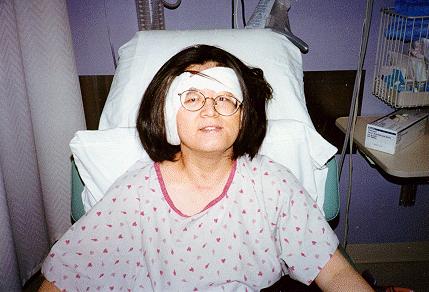
How I Looked Post-op--Not Really Good.....
The next hour was not pleasant-----I vomited bloody phlegm off
and on. This could have been a bad reaction to the anesthesia I
had. I did ask for something to drink and got ginger ale (to this
day, I still like drinking ginger ale). I was quite relieved to
find that my sense of taste had not disappeared after surgery the
way it had disappeared during the prom stim test. Ginger and
Maureen came in during this time. Ginger said that the surgery
had gone really well; they had been able to test the electrodes
before closing the incision and all the electrodes were working.
An hour later, I walked out of the hospital with Paul with
discharge instructions to take Motrin for pain and to remove the
bandage on Sunday, December 8. I spent the next few days
recuperating at home.
Back to the Table of Contents
It was nice to take the heavy bandage off on December 8. We did apply new bandages to the incision area since it was still healing. I did experience drainage for about two weeks afterward though----each day about one teaspoon of blood would drain out from this area. We wondered if a stitch in the incision had popped out. Fortunately, the drainage stopped around December 19.
Psychologically, this period of silence was different from the last time I experienced life in silent motion (March to June of 1996). I think it was different because the previous time, I could faintly hear cars going by and occasionally, hear running water. But since I chose to have the implant inserted in my better ear, I was no longer hearing anything. For a week this total silence didn't really affect me . . . until the night of December 11. On the way to picking up Abby at the daycare provider, Paul turned on the radio and then told me that Christmas music was playing. I suddenly realized I couldn't hear anything--- how silent the world was and how badly I wanted to hear something. For a few brief hours, I understood the despair Beethoven must have experienced when he could no longer hear the music he passionately loved. That night I just concentrated on reading Internet news and my e-mail and soon I felt better. By the next day, I felt well enough to do an oral presentation (as scheduled) to FDA drug reviewers. My sign interpreters did cue me when my voice was getting too loud and they also capably translated any questions the reviewers had so I did fine.
During this waiting time, a few other events still stand out in my memory. First, I simply couldn't imagine a Christmas without making music. On the night of December 23, I pulled out my violin, Paul took out his cello and together we tried playing Christmas carols as we had done in previous years. It didn't go very well because both of us were out of practice and secondly we kept wondering if our instruments were out of tune. I thought our electronic quartz tuner had helped me tune my violin but Paul wasn't so sure.
I knew that spending Christmas at my parents' house in North Carolina would not be easy with all the talking that normally goes on at family gatherings but it actually wasn't unbearable. I did spent a lot of time watching Abby or doing chores around the house though. (This was more of an avoidance strategy as to an effective coping strategy, but it worked.)
Around the last week of December, I watched two Tchaikovsky ballets on television: "Sleeping Beauty" and "Nutcracker on Ice". I have never heard the music for "Sleeping Beauty" but somehow I enjoyed this ballet more. Just by watching the dancers, I could make some guesses as to the speed of the music being played and I had a deeper awareness and appreciation of the scenery, the sets and the elaborate pantomime that went on during the first act. In contrast, "Nutcracker on Ice" was harder to enjoy----I'm very well acquainted with Tchaikovsky's Nutcracker Suite and know several passages by heart. Because my memory of the accompanying music is so deeply ingrained, I couldn't help but try to match the ice skating I saw to the music I heard in my head; this turned out to be a frustrating task.
January 2, 1997, 9 am
Hook-up day at last. I was a bundle of nervous energy this morning. For a while, I kept jumping up and down like a little girl about to go to the toy store and clapping my hands in anticipation. Paul took the morning off as well so he could observe the hookup and mapping process.
Shortly after arriving at Hopkins' audiology department, Ginger Grant ushered us into the cochlear implant programming room. Almost immediately, we ran into an annoying problem: trying to find a magnet which wouldn't fall off. My thick hair has grown back quickly after the surgery so the nurse still had to shave the spot where the implant was, behind my right ear. We finally had to use the strongest magnet Advanced Bionics (AB) manufactured and even then it took a while before the magnet finally stuck well to the implant. This was not the usual magnet headpiece; the little green magnet on the headpiece didn't have a cover adhering it to the headpiece. Ginger did call AB and asked them to ship more maximum strength headpieces so they would have more of these magnets in stock.
Then she showed me my new Clarion speech processor. The outer case has a light beige color and it was quite light without the batteries in it. Ginger already had started Advanced Bionics' programming software; she now plugged a tiny, black cable into a tiny port inside the battery compartment. (The other end of the cable was already connected to the computer.) For the next thirty minutes, we worked on setting the volume levels for threshold (the softest volume at which I could perceive a sound) and comfort (the most comfortable level I could tolerate as the volume was turned up). These two volume levels, commonly known as the T (threshold at which I can just perceive sound) level and M (most comfortable loudness) level, has to be set for every one of the eight electrodes at each mapping session. Then Ginger had to balance the electrodes. She would give me pairs of beeps and asked me to tell me if the each beep sounded the same compared with each other. And finally, she did a sweep of all eight electrodes to ensure the beep from each electrode had the same intensity/volume.
After all eight electrodes had been individually configured, Ginger turned them on all at once. My first impression was that everyone's voices sounded like they were underwater. What was worse, my own voice sounded so HORRIBLE, I burst into tears. It was kind of loud and had too much bass in addition to sounding like I was under water. So I asked my audiologist to reduce the bass to see if it could sound more bearable for me. The other thing we tried today was connecting my processor to the auxilliary microphone (aux mic for short). Voices in addition to my own was easier to listen to with the aux mic on. [For Clarions, sound from the regular mic gets turned off when the aux mic is used.] I quickly realized that I could hear my audiologist's voice (medium alto register) better than Paul's voice (bass register). I was able to understand about 60% of what my audiologist said by combining the sound I got from the CI with lipreading. We also tried a little open-set speech test in which she gave me pairs of words and I had to tell her if the pairs were the same or different. This test basically confirmed I knew how many syllable each word had and could tell where the stress fell on the word.
Near the end of this first mapping session, Ginger showed me all the other things which came with my Clarion. In addition to the auxillary mic, there was a telephone adapter, six packs of rechargeable batteries, two battery chargers and a special cord that allowed the battery to be charged from the cigarette lighter in a car.
And so we left the Hopkins audiology clinic around 1 pm. For the first time, I was aware that the hospital had a PA system and secondly, this PA system was annoyingly and surprisingly loud. And I felt more secure being able to hear the traffic as we walked out of the hospital. Driving out of Baltimore, Paul turned the radio to a classical music station. At first, nothing made sense. Then I heard the violins play the melody line alone, and it began to sound familiar. True, I had no discrimination of pitch---all the notes sounded the same---but the timbre, rhythm and duration of each note were clearly there. Could this be the overture to the "Barber of Seville"? Yes, it was. I wasn't able to identify all the instrumentation playing at a given point during this overture, but I could definitely tell it was higher or lower and in some cases made a good guess about whether it was the lower woodwinds or lower brass playing. I don't think I was able to do this before the CI surgery so that's a hopeful sign. I worked for a few hours this afternoon and asked a few of my colleagues to speak into the aux mic. I wanted to see what people's voices sounded like. I had problems understanding deep male voices. For some reason deep male voices sound more distorted than female voices. And everyone noticed immediately that I was modulating my voice better and speaking at a more normal volume.
My sister Patty is visiting in town so tonight we treated her to dinner at a Chinese restaurant. For tonight I didn't use the aux mic but with the CI and some lipreading, I could make out what she was saying about half of the time. I also played with the sensitivity control on the speech processor in the restaurant and discovered that the restaurant was piping background music. Paul and Patty said that the music was soft but it didn't sound soft to me when I had the sensitivity control turned up.
Lastly, I tried listening to a multimedia CD-ROM titled "Preschool with Elmo". (Elmo is the name of a character on the "Sesame Street" television program.) We didn't purchase this CD until after I became deaf. It was interesting to hear all the sounds coming from the CD. It dawned upon me that since Sesame Street characters don't have readable lips, it could become a good tool for understanding speech without lipreading. And yet, the voices of these characters don't sound like the people's voices I hear at work and at home. So it remains to be seen as to how helpful the CD is.
Second and Third Mapping Session
January 3, 1997
For this mapping session, I drove into Baltimore alone. I also got another magnet, since the one I originally had still wasn't sticking well. Then we checked my T and M levels again for each of the eight electrodes and it seems that they had gone up a bit. For some reason, it's considered a good sign if the T and M levels continue to improve. Checking the T and M levels for the 8 individual electrodes is essential but tedious enough; I can't imagine how Nucleus device users can sit through having to check their corresponding T and C (comfort) levels for each of 22 electrodes without taking a break in the middle of this procedure.
For this mapping session we tried to reduce the bass without turning off any of the electrodes. And I had another one of those informal closed-set speech tests. Ginger gave me a list of 5 spondees (two syllable words like "ice cream" and "sunshine"). Then she covered her mouth, said one of the spondees and then I had to tell her which word she said. I think I got "sunshine" right (basically because I can hear the "sh" sound well with this new map), but not much else. My new map became program #1 and my map from the day before was now program #3. (The practice at Hopkins is that the map most frequently used from the previous mapping session becomes program #3 when a better map is set.) For program #2 she gave me a variation of the new map.
Dr. Niparko came by to checking on the swelling behind my ear and to see how I was doing. Lipreading him was much easier since I had vowel discrimination now.
Back at home, I found that Paul's voice was just slightly less distorted with this new map. Voices in general still had a slight "underwater quality" though. I was all set to start my own aural rehab program, but I ran into a troublesome problem the following day. On a trip to a home improvement store, the little green magnet from the temporary headpiece I had flew off into God knows where and neither Paul or I could find it. It was very inconvenient to have to hold up the headpiece with one arm. So I sent Ginger a frantic e-mail about this problem. (It was interesting that within 72 hours of hookup, I had become very attached to the CI.) In the meantime, I went to the SuperCrown book store and bought three audio books. Two of them were children's tapes with accompanying text and the third one was titled "Dark Side of the Game" by Tim Green. I already have the printed version of the third title; I had a feeling that the audio version of this particular title may have less background noise and would easier to hear the voice.
On January 6, I went back to Hopkins for a new headpiece---this time the little green magnet was securely attached to the headpiece with a tan cover and I no longer have to worry about it falling off. Now it was full steam ahead for my aural rehab. During that week, I tried several listening activities. First I listened to one of the children's tapes I bought. I initially couldn't follow it at all and Paul had to help me out. On subsequent tries, was able to follow it all the way through to the end. I also listened to a captioned video of baby songs. At first, nothing made sense. Then all of a sudden, the rhythm and duration of the sung music fell in place. From then on, it was easier to follow the music along with the captions. Last, I tried playing piano scales on our keyboard; every key seems to be slightly off pitch. For example, middle C sounded like the D above it.
Abby seemed to have taken it well that I now have a new thing attached to one ear. Before the surgery, she would always retrieve my hearing aids from the night stand and give them to me first thing in the morning. Now she realized Mommy needed her new "See-Eye" during her waking hours and on several occasions, has retrieved it from the dresser and given it to me. She was and still is quite fascinated by the red light on my speech processor.
January 10, 1997
I went in for the third mapping appointment in the afternoon. My T and M levels have gone up substantially. I asked Ginger to try turning one of the lower electrodes off in an attempt to cut out some of the bass. So my two new programs each has one electrode turned off. I think program 1 has electrode #1 off and program #2 has electrode number #2 off. We also attempted to make the consonants more audible but kept getting static.
Paul's voice sounded much better with this map and so did the voice of my colleague David, whom I had extreme difficulty understanding immediately after hookup. The "underwater" quality had lessened as well. In the next few weeks, I tried more "listening activities". I tried to listen to the children's tape that had no accompanying text and could make out words about one percent of the time. I recognized familiar music on the radio, like Beethoven's Fifth Symphony and Tchaikovsky's Swan Lake Suite.
I got bold one week and attempted to use the telephone, with less than spectacular results. I tried called the time and weather service---nothing made sense. Then I tried to call someone in another office. When a male voice came on the line and droned on and on, I realized immediately that I was listening to voice mail and listened for keywords like "name" "phone number" and the beep. I was able to voice my message immediately after I heard the beep, so I consider that call a small measure of success in using the phone. But a more typical call was like the time I tried to call Paul at work. The first time I tried this, I got someone else but thought the voice sounded like Paul and didn't realize it wasn't him until later during the day, when he said he never took the call. I am tabling further exploration of the telephone until my open set speech discrimination gets better. I've started listening the audio tape, "The Dark Side of the Game". I think this a fairly good tape to improve open-set speech discrimination. I followed the text the first time I listened to the tape but right now am trying to listen and pick out words without looking at the book.
At work, I am cutting down on my use of sign language interpreters. I've never liked using the relay system over a single phone line so I ask my interpreters to voice what the other party says. But I do not use them for face to face interaction with other staff unless a low, incomprehensible male voice is involved. On February 5, 1997, I attended a staff meeting without an interpreter for the first time in 10 months. There were about 6 other people at the meeting and I had to switch to the aux mic immediately to hear David better. I think I was able to follow about 70% of the conversation. Most of my interpreters understand I won't look at them all the time now and I may ask them to interpret when only when certain people are talking. For my part, I have to constantly remind myself that I can turn to them only when I need to and am not obliged to see them throughout the entire meeting.
As for music, pitch started to sound more like distinct notes toward the end of January. I heard Paul play on his cello the other day and the notes sounded the way it should sound when he played familiar melodies.
This first month has not been without a few minor problems with the implant. Besides the magnet problem, I experienced some tingling around the area where my cochlea is. (No painful facial twitching though, which is good.) This tingling sensation comes at the most unexpected times---I can't predict when it will come---and I have no idea why I have it. And I get static if I try to turn the volume past twelve o'clock on program #1.
February 6, 1997
There was a slight mixup with determining whether this first month evaluation would take as scheduled. In the middle of January, Hopkins had sent me letters confirming appointments for the first-month, three month, and six-month evaluations. Last week, I had faxed the letters to NYLcare and requested authorization to cover these appointments; they said to expect a call from Hopkins regarding health insurance approval of these appointments. It wasn't until this morning that I received the word all was set for today's appointment. Once there, Ginger apologized for the mixup and I was delighted to hear that NYLcare had issued an authorization to cover the entire year. I thought that was wonderful; it would save me a lot of hassle should problems develop with my speech processor between the next few evaluations.
For today's mapping session, we first did a quick warble-tone audiometry test. With the program #1 selected, my responses were as follows: at 500 hz, 30 dB, at 1000 hz, 35 dB and at 2000 hz, 30 dB. (However, in the higher frequencies of 3000, 4000, and 6000 hertz, I tested at 45 dB, 40 dB and 50 dB respectively. ) I don't recall testing like this on a comparable pure-tone test since I was a little girl.
I learned two important things from today's mapping session. With regards to setting the M level, the Most Comfortable Level is NOT the same thing as the level you can tolerate sound for only a short time. I didn't understand this before and we had to set the M levels twice. The first time wasn't accurate because after Ginger turned all the electrodes on, I kept complaining that her voice wasn't loud enough even after turning the volume control to the max. They have this sheet with circles going from small (threshold) to big (loud such that you can't tolerate it for more than a short time) and medium sized circles in between (Most Comfortable Level and Comfortable but Loud). And I found that sometime I have difficulty trying to decide when to move my thumb from the circle denoting Most Comfortable Level to the circle denoting Comfortable but Loud (the next level after Most Comfortable Level). There were many instances when it took me a long time definitely say that a volume was Comfortable but Loud. But the second time was more accurate. This is one aspect of the programming session in which I have to be very honest, else I'll be setting myself up for frustration and less than satisfactory mappings.
The second thing I have to remember has to do with the balance part of the mapping session, just before the electrodes are all turned on together and I have to tell Ginger if a pair of beeps sound similar or different. The objective here is to listen for differences in loudness/intensity (AND NOT PITCH) between the beeps in each pair. I caught myself focusing on the pitch instead of the intensity several times. And I also noted that a beep from the higher-pitched electrodes (numbered #6, #7, and #8) needed more volume before I could say they sounded the same when compared with a beep from the lower-pitch electrodes. And even after I told her they sounded the same, I privately felt those electrodes could be a notch louder.
In any case, my T and M levels went up again and Ginger had to adjust for that. We were going to try programming me using the compressed analog (CA) speech strategy but my M level was just too high for what this strategy required and we decided to go back to the good old CIS (continous interleaved sampling) strategy. I left around 12:30 pm with two new programs. I groaned inwardly at the thought of having to adjust to the two completely new programs, especially since both gave voices a hollow sound. (My own voice sounds okay, though.) To complicate the matter, electrode #1 had been turned back on.
The major problem so far has been that I have to get used to listening to Paul again; I had to ask him to repeat words and phrases several times. But turning electrode #1 back on has not amplified the bass as much as I had feared. And musical pitch perception continue to improve, albeit very slowly.
March 30, 1997
About a week after I got the new programs, I decided that I didn't like program #1; it was no longer loud enough. I tried program #2 and it sounded louder and voice quality was better. This experience simply confirms that I did the right thing in choosing a device that allows more than one program to be put in the speech processor---it saved me from having to rush back to Hopkins to have my program adjusted.
I continued to use the auxiliary mike in a variety of communication situations and got mixed results. In small staff meetings, where 6 to 10 people are grouped around a small table, the mike helped a great deal. In restaurants, the mike also helped a great deal when combined with the sensitivity on the speech processor set at a very low level. In larger staff meetings, the mike was inadequate. The first time I attended a book club meeting for team leaders in our office (here in our Center in FDA, the office level is the next larger level above the smaller division level) there were 20 people seated in a semicircle. Everything was fine as long as the group leader faced me and I had the mike near her. However when she faced others, I felt nervous. I had problems hearing people sitting further away from me. Also, the auxiliary mike was of limited use when I attended work-related training offsite. Because it was hard-wired to my speech processor, the instructor could not stand too far away from the auxiliary mike. For now, I still use a sign language interpreter in these situations.
My open-set (e. g., without lipreading or other visual cues) speech comprehension is improving slowly. For the most part, female voices are easier to hear and understand over the phone. Sound quality on the phone is just a bit better with Advanced Bionics' phone adapter than with the headpiece microphone. It sems that if context is very clear, I can get through a phone call sucessfully. Starting on March 15, I tried to make at least one phone call a day. As long as I kept the calls short and simple, I was mostly successful. Also, once in a while, I could pick out a few more words on the radio . . . like "WGMS weather forecast" or catch bits and pieces of the traffic report "I-66", "395", etc.
With regard to listening to music, music I've heard before becoming deaf (the slow movement in Beethoven's "Emperor" Piano Concerto, for example) now has more melody. That could be an indication that pitch discrimination is *slightly* better. On the other hand, that could also be because I know *exactly* what to listen for. Bass instrumentation still has that "garbage truck" sound quality, but it's less noticeable now. There doesn't seems to be a good balance between the bass and treble instrumentation: in some passages, the bass harmony is louder than the melody in the treble clef. It's strange, I can hear the upper strings quite well but not the flutes if both are playing the same melody line.
On March 24, I went to visit my good hard of hearing friend who happens to be an amateur violist. Kathy and I had an enjoyable chat (with voice only) and I listened to her playing the viola. She kindly offered to let me try her viola and I tentatively played a few scales. Kathy remarked that I was playing the lower octaves (131 to 262 Hz) quite in tune but it got out of tune above that. Although I am chomping at the bit to resume playing the violin, I'm still not too happy with my pitch perception ability as it currently stands; that activity will have to be tabled a bit longer.
On March 30, I was received into the Catholic church. The patch cord I currently have behaved during this ceremony. It's really nice to hear music and the speakers much more clearly with this patch cord and the FM system the church provides. At the beginning of the ceremony, those of us who were to be received into the church had to go outside. It was dark and I was really glad I had my CI in addition to my interpreter who had to get herself near a street light.
April 2, 1997
I had my three-month evaluation at Hopkins this afternoon. First I had warble tone audiometry and then a speech test consisting of two syllable spondees. The results showed a jagged audiogram with peaks and valleys. 25 dB at 500 hz, 45 dB at 1000 hz, and 30 dB at 2000 hertz. And speech audiometry showed that I had good vowel sound discrimination, which I already figured I had.
We spent some time trying to readjust the T and M levels for all 8 electrodes during this programming session. I concentrated hard on telling Ginger accurately where the M level was by telling her exactly when the intensity was getting uncomfortable. We had no problems finding a good M level for electrodes 1-4 but for 5-8, I kept telling Ginger that I could stay at the highest intensity level she was giving me for a long time. We tried random firing of electrodes (which I understand to mean electrodes firing in pairs, like electrodes 1 bouncing to electrode 8 or electrode 2 to electrode 7) but I didn't like that too much. I also didn't really like a program firing sequentially from electrode 8 to electrode 1 (highest to lowest). I ended up with two very similar program firing from electrode 1 to electrode 8 (lowest to highest), and a third program which was supposed to be used to cut out background noise in noisy environments. Then we did some more open-set speech audiometry of the CID Overlearned Sentences, which I found are common sentences used every day (like 'how are you" and "I want sugar in my coffee". ) I scored about 45% on this test today. Lastly we did another warble tone audiometric test. The jagged peaks has evened out a bit: 25 dB at 500, 25 dB at 1000, 20 dB at 2000, and strangely, a dip to 30 dB at 4000 dB.
April 5-7, 1997
My parent and sister were in town because my cousin Alex was here from Taiwan on a business trip. Strangely enough, it's easier to listen to Taiwanese now, especially when combined with lipreading. Shortly I was hooked up, I tried to lipread my cousin Ellen talking in Taiwanese to her little boy, but couldn't tolerate it. Now it seems easier for some reason. Alex is soft spoken, so before my folks got here, I had him talk to me while he was wired to my auxiliary mike.
April 13, 1997
This afternoon, I attended a support group meeting at Hopkins for current and prospective cochlear implant users. We had a discussion on how assistive listening devices (ALDs) can be used with cochlear implants and I explained how I was using ALDs with my speech processor at church. A friend loaned her patch cord for the Clarion to Phonic Ear FM system connection so I could try it out. Turns out that the rechargeable battery on my own Phonic Ear transmitter is no good, even thought I charged it the night before. (I knew the charging worked because the other battery was fine…) I decided to order a new battery and Phonic Ear Patch cord for the Clarion from Elaine Wilson. The cord and battery arrived in mid-May. Now I just have to find an opportunity to use it.
In early May, I decided to purchase a patch cord from an engineer out in California for use with the Williams Sound System at church. (The patch cord I had been using was purchased from someone in Virginia and it just stopped working within two weeks.) I also bought a phone adapter (Phone Mate) from the California engineer as well.
Both items arrived around May 20. The new Williams sound patch cord has been really good and has not given me any problems so far. I find that I prefer the Phone Mate to the phone adapter that Advanced Bionics included in my cochlear implant patient kit; the direct audio input (going directly from the handset to the speech processor) seem to give it a better sound quality. Paul says that I seem to hear better with it. However, I'm still leery of using the phone and am still more comfortable making but not taking phone calls.
May 21, 1997
Today I attended an all-day FDA panel hearing on the approval of the Clarion cochlear implant device for children ages 2-17. It was very interesting . . . my own views on pediatric cochlear implantation continues to evolve.
After I left the hearing, I readied myself for the first violin lesson I've had in a long time. I had made an appointment to see Marty (my private violin teacher) this evening because for the last two months, I've been experiencing this growing desire to play violin again. I wrote to my quartet teacher in mid-March asking for her advice as to whether it would be a good time to try private instruction and she had been too busy to really answer me. So I talked to Marty over the phone instead and we made an appointment for tonight.
I told Marty not to expect too much so far as intonation was concerned. I knew I could hear several things, but absolute pitch and even good relative pitch was NOT to be expected. I knew I could now distinguish between consonance and dissonance when two (open) strings are played together. I knew on the lower three strings, I could now hear individual notes to a certain degree, and the sound quality was not too bad. Notes on the highest string (E string) sounded awfully tinny. As for relative pitch . . . I have no idea what I'm doing by the time I play anything higher than A5 (880 Hz) and am working almost from my own memory of where my fingers should be. So some pluses and some minuses to starting again at this point. Marty asked me to play a scale, and I did the G major scale (notes are at 196, 220, 247, 262, 294, 329, 370, and 392 Hz respectively). After I finished the scale, Marty was surprised at how well I sounded. Then we picked a new piece out of an old duet book and I found myself having to sightsing mentally while playing the new music. I think I had to sing because given the imperfect pitch perception I was perceiving, singing the notes helped to make the new music more understandable quickly.
By the time the hour long lesson was over, I had three new assignments and arranged to have lessons every other week.
The other day, Marty had a chance to talk to Paul over the phone. He told Paul that he was surprised that I was playing almost at the level before I became deaf, but both of them agreed that I was hearing differently and that pitch perception was definitely not as good or the same as before. At least he's the kind of teacher who understands that intonation is only one aspect of a musical experience, so we work well together. (The inadequate feeling I have regarding my intonation is a bit more stronger than it was before I became deaf. but try not to dwell too much on this. )
June 26, 1997, 10 pm
At my mother's request, Paul and I went to pick up my maternal aunts and uncles at National Airport this evening. They only know Taiwanese and Mandarin Chinese. But as long as I could see their lips I could understand them most of the time. I did have to ask my cousin what the Taiwanese word for "luggage" was, and it took a while for me to say it right. Driving back to McLean, Virginia (where they were staying with my cousin), I sat in the front seat with Paul. I didn't understand most of the Taiwanese chatter in the back but I was able to pick out the words "Wendy is navigating the roads quite well…."
From June 27 to June 30 1997, I attended the CICI (Cochlear Implant Club International) convention in Sturbridge, MA. My two roommates---both are Clarion users as well---showed me their cables (from the headpiece to the speech processor). They said their "right-angle" cable, which I could get from either Hopkins or Advanced Bionics did not fray as much and I should specify that kind of cable if I get more cables. (About two months ago, the original cable I had frayed and I was now using the spare cable that came in my patient kit.) I made a mental note to check into getting the right-angle cables at my next evaluation.
July 10, 1997
Had my six month evaluation at Hopkins this afternoon. First we had warble-tone audiometry and five open-set speech audiometry exams. On the warble tone, I believe I scored about 35 dB across the 500, 1000 and 2000 hz levels. Then I had the CID Everyday Sentence Test and got about 57% correct. This is a bit of improvement compared to the three month evaluation where I scored about 34%. The next two speech tests (NU-6 and the CNC Monosyllabic tests) consisted one syllable words. I didn't think these two tests were easy, since you really don't have a lot to help you guess the word with if your consonant sound discrimination is not good. Surprisingly, I scored about 44% on both.
I groaned when I heard what the next test required me to do. This one was called the Iowa Medial Consonant test. You listen to two-syllable nonsense words and you have to tell what the consonant sound at the beginning the second syllable is. I feel was guessing a lot on this test except when the high frequency consonants (s, sh) were spoken. Somehow I managed to score 56% on this one. I was really surprised. Maybe consonant discrimination has improved more than I think.
The last test ---the Hearing-in-Noise test----was divided in two parts. The first part consisted of sentences spoken in a quiet environment (I scored about 53% in quiet) and the second part consisted of sentences spoken in a noisy environment (I scored about 2% in noise). I think the second part of the test (done with noise) was a little unfair since the signal to noise ratio value was not lowered. (Cochlear implants don't really function like real ears since it can't block unwanted background noise if the sensitivity control cannot be adjusted.)
The second half of the evaluation comprised of making any necessary adjustments to my programs. As it turned out my threshold levels had improved, so I did get new programs. It was difficult to do the programming today because for some reason, I'm hearing the hum of the computer monitor (used for programming the speech processor) while trying to determine if the voice quality was better or worse when comparing one program to the next. (I don't recall it the hum being so loud during previous mapping sessions.) But that could be because Ginger was using the new version of the programming software. According to Ginger, the new version of Advanced Bionics SCLIN programming software was supposed to expand dynamic range of the lower frequencies. Except for being able to hear the hum of the monitor which I didn't hear before, I don't notice a whole lot of difference between the old and the new versions of the programming software.
I came home with three new programs. I believe one of the electrodes was turned off for program one and for program two, all electrodes were on. The last program had the lower and higher frequencies emphasized so that music would be easier to listen to.
July 13, 1997
Within a few days of using programs 1 and 2, I decided that I like program 2 better. Program 1 sounded slightly tinny and there was a buzzing sound in the background. Voices on program 2 sounded nice and more full compared with program 1. The other annoying discovery I made was that batteries now had less power---- they now last six hours per use. Before these new programs were made, the batteries lasted me nine hours. (I think I'm spoiled on nine hours of battery use now. ) Ginger has used the programming software in the past to increase battery power. I know she probably can adjust this again as soon as I can get authorization from NYLCare for one more appointment to adjust the program and the 12-month evaluation this December.
July 20, 1997
I practiced violin in the morning since I have lesson this
coming Tuesday. I tried out programs 2 and 3 while playing
scales. At first I thought the sound quality for program 3 was
"too full"---it was beginning to have an
"underwater" quality--- but after a while it sounded
ok. I think I may use program 3 for music after all.
Fall Happenings
September 10, 1997
This afternoon I got a flyer in the mail from Veronica, my old
orchestra teacher, who now resides in Wilmington, North Carolina.
She is doing her last Adult Orchestra Workshop in the Washington
DC area from September 21 to November 10; rehearsals would be
held on Saturday and Sunday afternoons at area churches in the
metropolitan DC area. This news sends me into inner turmoil.
I can't let Veronica leave permanently without taking the
workshop one last time ---- but am I ready to play in an ensemble
setting again? Could I handle the new challenge of learning to
hear and play in a musical ensemble again with my CI? Also, my
fall schedule was shaping up to be rather packed . . . I had
plans to visit my folks over the Columbus Day, was attending
ALDAcon (national ALDA convention) in North Miami Beach the week
after that and was also involved in planning for the one-day
conference that our local ALDA chapter puts on every year in
November. Still . . . I couldn't ignore the desire to try even
after the first weekend of rehearsals had passed. I think about
just attending the rehearsals but not performing in the final
concert. I think if I do take this workshop, I'll have to cancel
private music lessons for a while since I don't have time to do
both.
On September 26, I drove to Grace Episcopal Church in Silver
Spring 30 minutes before rehearsal was about to begin. Veronica's
eyes widened as I explained how I became deaf and now use a
cochlear implant. I talked to her about what I was doing to get
back into playing and noted that if I had heard the music before
I became deaf, it should be easier to learn the individual
pieces. I also said since the implant was behind my right ear, I
would be more comfortable taking the first violin parts this time
(in the past I normally took the second violin because my hearing
aid and better ear were on the left side). I figured it would be
easier it would be easier to hear music coming from my right side
if I should get lost playing the music. However, I looked over
all the music just to be sure and decide there's no way I can
play the first violin part for the arrangement of Mozart's 25th
symphony, since I can't play higher than third position. So for
this piece I play the second violin part.
Veronica is impressed that I was playing as well as I could eight
months after hookup. She felt my tone was very good and
intonation was not as bad as I thought it would be. During the
middle of that first rehearsal, my batteries gave out and I had
to get up and change battery packs. While I changed battery
packs, Veronica told everyone that I was using an "ear
implant". I found it ironic everyone was impressed with my
attempts to play now. I always thought trying to play in an
ensemble regardless of whether you were wearing a powerful
hearing aid or a cochlear implant was a big achievement in
itself. But now it seemed that my fellow orchestra classmates
were genuinely impressed I was playing with a cochlear implant. I
wonder if it's because CIs are in the news so much or wearing a
hearing aid generally gives the impression the hearing loss is
not serious.
For the first few rehearsals, I sing the melody in my head as I
play. I still have problems hearing Veronica's instructions
sometimes and often ask her to repeat the measure numbers we
would rehearse next. As the weeks passed, I decide that I'll go
for it and play at the concert on November 11.
September 30, 1997
Another piece in the mail catches my attention. This time, my
undergraduate alumni magazine has written an article
about the pediatric cochlear implant program at UNC. I
read the article and find myself very dissatisfied with it. Not
only did the author botch the name of Advanced Bionics
Corporation in the article, the overriding impression I got from
reading it was that as long the implanted children receive aural
and speech therapy after hook up, they'll do fine in mainstreamed
school settings. Not a word was said about the psychosocial
ramifications of hearing loss, about how imperfectly hearing aids
and CIs translate the conversations of classmates in noisy
cafeterias or school dances, about the constant straining to hear
the proceedings of school club meetings. All the ghosts that were
a part of my past life in a mainstreamed school came to me that
night, and I quickly sent a letter to the editor of the magazine.
They published the letter in the November-December 1997 issue.
October 15-19, 1997
I attended my first ALDA convention (otherwise known as ALDAcon)
and felt this convention was like a personal homecoming. (I still
can't believe how easy it was for me to find a place to sit at
meal times and communicate with new friends via speech, sign, or
in writing.) No one disparaged my signing in English syntax or my
decision to get a CI. As a matter of fact, I found myself helping
several other users connect their speech processors to the Audex
assistive listening devices that was available during the
convention and showed my telephone adapter to a new Clarion user.
I'm already dreaming about doing a workshop on how CIs can be
used with ALDs for next year's ALDAcon.
November 1, 1997
As the secretary of the local ALDA
chapter, I helped out with our annual minicon (one day
conference) and volunteered some information about ALDs and CIs
to the disability coordinator at the Smithsonian Institution. I
also have the good fortune to introduce Dr. Niparko to the
audience during the presentation on cochlear implants.
November 11, 1997
The day of the orchestra concert finally arrived. I'm a
little nervous as I leave Gaithersburg to drive to Silver Spring
for the dress rehearsal. I become even more nervous when I
realize that I've left my purse at home after arriving at Grace
Episopal Church. During a break in the dress rehearsal, I call
home and left an urgent message for Paul, asking him to bring my
purse since all my CI battery packs were in there and I wanted to
changed to a fresh battery pack before the actual performance.
About 15 minutes before the performance he came in with Abby in
tow and I got to change to a fresh battery pack.
And so we started the the actual performance. One piece is
finished, six more to go.
Uh oh. Veronica is coming over to me. She whispers something
quickly. What was that about? Something about my E, I think.
What about my E? Is this the E on the D string? Is it fingered
too high or too low? There is no time to ask her.
With some trepidation I play the rest of the pieces but she
doesn't come over any more. I must be doing ok then.
After the concert, I found out my E had been fingered slightly
low on the first piece. How hard it must have been for her to
keep conducting when someone was playing out of tune. I declared
that I'm never going to play in public again. But Veronica and
Marty said all other pieces were played mostly in tune so I
should not agonize too much about this. Still, this incident
doesn't do too much for my confidence . . . sigh.
The only other lingering memory I have from the concert was that
I had a great seat and heard the clarinets and flutes behind me
rather well!
Back to the Table of Contents
Speech Processor Adjustments
November 24, 1997
After about four months of e-mails with Hopkins' implant
coordinator, I finally got authorization and primary physician
referrals to get an adjustment for my speech processor as well as
for the 12-month evaluation in January 1998. I couldn't wait for
Ginger to adjust the speech processor so my battery packs would
last more than six hours.
Ginger was doubtful that she could do anything about adjusting
the amount of electricity from the battery pack. However, as it
turns out, Advanced Bionics new programming software also tries
to determine the optimal current that the speech processor should
be getting from the battery pack. Some days later, I happily
reported to Ginger that I was getting TWELVE hours from the
batteries before having to recharge them! What a relief it was
not to have to worry about changing battery packs at least twice
in a day!
On the cochlear
implant forum I currently subscribe to there
had been some discussion about Advanced Bionics' new headpiece
microphone which can even be used by users with the 1.2 speech
processor which I have; I talked with Ginger about that. So
Ginger is going to arrange for me to get the new headpiece mic at
my one-year evaluation in January. Supposedly this new microphone
has the same strength as the auxiliary microphone I currently
have.
Ginger did some "minor" tuneups with my programs, but
no major adjustment to them. Still, when I got home, Paul
commented that I was asking him to repeat more. So maybe
something's changed but it looks like I'll have to wait until
January to find what exactly what did change. Whatever was
adjusted doesn't seem to really have a bad impact on everyday
communication situations.
Christmas, 1997
It feels good to hear and play Christmas music again. For
familiar Christmas carols, I can recognize it if it's a simple
arrangement. Complex orchestral arrangements of Christmas carols
are still a problem. My favorite memory of this year's Christmas
season is hearing Abby sing "Jingle Bells" in the
backseat while I'm driving the car.
My office decide to have a Christmas party and they ask me to
play violin for the talent show. At first I say no. Two days
before the party, I changed my mind. I think if someone else is
leading everyone in singing Christmas carols, maybe they can
cover any mistakes I make in intonation. And so I sightread the
melody line in the carol books (originally written for piano and
guitar). It seemed that intonation wasn't the major problem this
time---the major problem this time had to do with the speed I
played and the speed everyone wanted to sing the carols
(generally they wanted to sing it a bit faster than I was
playing) . . . .
Back to the Table of Contents