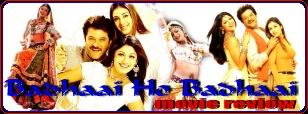
cast: Shilpa Shetty, Anil Kapoor, Kirty Reddy, Amrish Puri, Farida Jala, Govind Namdeo, and Kadar Khan.
Director: Satish Kaushik
Music: Anu Maliik
Lyrics: Javed Akhtar
Producer: Kapoor & Kaushik Ent. Ltd & Mukta Arts Ltd
Kapoor & Kaushik Entertainment Pvt. Ltd.'s Badhaai Ho Badhaai is a comedy that will prove to be a tragedy for all associated with it. A family drama inspired from the Tamil film, Poove Oonikaran, it reminds of Bawarchi.
Raja (Anil Kapoor) is a young man who comes from Delhi to resolve the differences between two families - one, a Hindu and the other, Christian. The families don't have just differences, they are actually sworn enemies. Their enmity dates back to 27 years ago when the son of the Christian household had eloped with the daughter of the Hindu household and the two had got married, obviously after both their families had disapproved of the alliance.
Time, they say, is the best healer. But director Satish Kaushik and his writer - Kavita Chaudhry - seem to be caught in a time warp. Why else would they, in today's times, show two families fighting over an inter-communal marriage as if it were the year 1902, not 2002! Coming to the story, in 2002 - that is 27 years later - the Christian household's daughter (niece of the guy who eloped 27 years ago, played by Kirty Reddy) and the Hindu household's son (nephew of the girl who had eloped, played by Vinay Jain who hardly looks hero material) fall in love. Talk of history repeating itself! Last week, when two Bhagat Singh films released on the same day, history repeated and how! In this week's, film, it takes 27 years for history - and misery - to repeat itself!
Raja tries to cement the differences between the two warring families so that the second generation kids don't have to elope like their uncle and aunt. For this, he comes from Delhi, posing as the eloped couple's son. Actually, he was a silent lover of the Christian girl (Kirty), who sacrifices his love and makes a promise to her to get her parents and her beloved's parents agree to the alliance. The eloped couple, as it turns out, actually have a daughter (Shilpa Shetty) and she too comes on the scene to generally partake in the madness, it would seem.
Some comedy and plenty of boredom later, Raja succeeds in transforming the mindsets of the two families. For this, he also delivers lengthy sermons on communal harmony. At the end of it all, not only do you wonder why the film of 27 years ago was made today, but you also desperately want to know why it is titled Badhaai Ho Badhaai. It wouldn't have made an iota of a difference if it was called, say, Idiot O Idiot!
Coming now to the pluses (few) and minuses (phew! there are too many) of the film: It has a breezy first half. Comic punches, some of them very exaggerated too, make interesting viewing. Of course, the comedy is not universally appealing and while it would be enjoyed by a section of the audience, it could also be found irritating by another section. The track of Kader Khan's poor singing is truly hilarious!
The film drops terribly once the flashback of Raja begins. The track of the over-weight Raja is hardly funny and it does not even strike an emotional chord when he realises, after shedding weight, that the girl he loved and for whom he had lost weight, does not love him.
The viewer would've sympathised with Raja had he been ditched by the girl but the fact is, she is not even aware of Raja's love for her. Rather than one's heart bleeding for Raja, the audience gets a feeling that it was good that he had at least reduced his weight, even if he didn't get the girl. That's because, becoming prim and proper is not considered as much a sacrifice as it is considered a favour to oneself (for health reasons)!
Besides the aforesaid flaw, there are several other defects in the screenplay (Kavita Chaudhry). For example, why are the fathers of the eloped couple so petrified of their sons that they can't override their decision to not forgive and forget? There should have definitely been a solid justification for their fear, considering that the war-like situation between the two families exists for 27 years. Even otherwise, the enmity is so exaggerated that it looks stupid that an inter-communal marriage could make two educated families behave as if they both belonged to the jungles.
Yes, the two families could have been shown as unforgiving and, therefore, not interacting with each other but why show them fighting like dogs? Because of the overtly pronounced differences which could've more advantageously been shown subtly, the entire film looks not just dated but regressive too - so regressive that even the audience in small centres would not approve of it. Which era are the creative people behind the film living in?
The sermonising by Raja about communal harmony on a micro and macro level, in the climax is very boring. While romance is completely absent, emotions fall flat. Had the film been rich in sentiments, it would've made an impact among the womenfolk and family audiences. As it is, it is only the comedy which is the film's plus point.
PERFORMANCE
Anil Kapoor does well as Raja but although he plays the central character, other artistes get meatier scenes than him. As a fat man, Anil's make-up is not upto the mark. His performance as the over-weight Raja is also far from convincing; at times, he behaves as if the fat man was mentally retarded, not just physically unfit.
Shilpa Shetty excels as the Punjabi woman. She evokes laughter in the first half but gets limited scope after interval. Her 'Jogan' dance is fabulous.
Kirty Reddy looks pretty and does a fair job. Her dubbing is not very appropriate. She irritates with her constant screeching.
Suresh Menon, as a Sikh-South Indian, is excellent. Getting great help from the comic punch-lines, he evokes laughter in several scenes. The scene in which he gives Mushtaq Khan a hot chase is superb. Govind Namdev and Anang Desai are too loud but they can't be blamed for that - their characters are such! Farida Jalal is cute. Rohini Hattangady gets less scope and is alright. Kader Khan shines as the besura singer. Amrish Puri is lovable. K. Vishwanath, playing a Christian, talks in a South Indian accent. Hemant Pandey leaves a mark. Mushtaq Khan is also good. Vinay Jain, Zubeida, Bhakti Narula, Panni Chatterjee, Ajitta Kulkarni, master Rohit, Hardik, baby Karishma and Bhavisha lend ordinary support.
As a director, Satish Kaushik delivers good comic punches but fails to make the drama a moving and humane one. He has also not been able to make a film for today's audiences. While he gets a great deal of help from Kavita Chaudhary's fun-filled dialogues, her screenplay is terribly bad. Camerawork (Rajeev Jain) is good. Editing (Sanjay Verma) is sharp. Anu Malik's music comprises three good songs - 'Jogan', 'Teri zindagi mein pyar' and 'Raag ban ke'. Song picturisation of only the 'Jogan' number is good. Production and technical values are fair.
On the whole, Badhaai Ho Badhaai may make the audience laugh in the cinemas but it will also make the distributors weep because it fails miserably in the post-interval portion.
RELATED TO BADHAAI HO BADHAAI
Web Site