Parts and Software
Let's start with the software. I chose to use a DOS based program since I had a 386-25MHz sitting around. (Yeah, yeah, I know, the Smithsonian was looking for one of those!) The 386 is running clean, that is to say, no Windows, just DOS. It is amazing how fast it appears to be when Windows isn't installed. Anyway, the software is free and you can get a copy here.
The hardware is very easy and I'm not gonna make the explanation difficult either. The layout is from SlotRace.Com.
Click on "Schematic" to see the layout.
 DB9 Female |
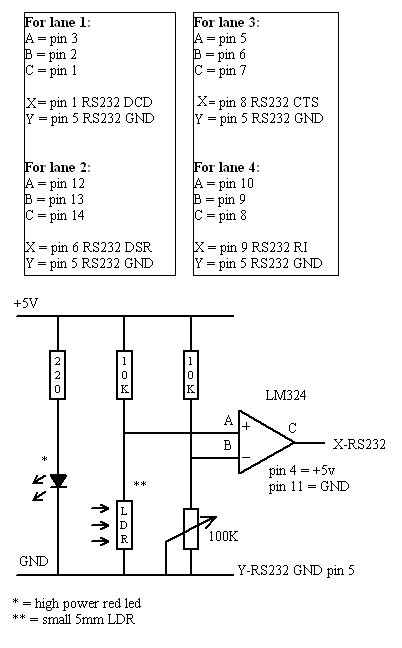 Schematic |
We bought everything from Radio Shack. In the layout the LM324 is separated into quarters. Each quarter serves a car. You will need:
- LM32 4- Qty. 1
- 100K-ohm PC Mount Potentiometer - Qty. 4
- 200-ohm Resistors - Qty. 4
- 10K-ohm Resistors - Qty. 8
- LDR or Photocells - Qty. 4
- Hi-Brite LED's - Qty. 4
- DB9 Female - Qty. 1
- Perf-Board, wire, solder
You will also need to have +5vDC. We used an off the shelf plug-in transformer. We also ran it with batteries. 4.5 to 6vDC (3 to 4 AA cells) worked fine. Using the schematic, lay everything out, wire it up and solder.
Making The Tower
Here, you can be as creative as you'd like to be. We've included a line drawing of a basic tower. But, like we said...go balistic. You could make the tower look like one of those cross-over bridges you see at real road courses.
Here are some more line drawings: Hold On, I'm Trying To Scan Some REAL Pictures In.We hope that you can use the info presented here. This setup is in no way "perfect". But, It does serve it's purpose of being an extremely low cost lap counter. Did some of the cars slip past without being counted? Yes, but by adjusting the sensitivity, and placing the tower right in or after a tight turn, we got 100% counting! Other problems? Well, there was some "interference" from the LED's. One of the eggheads over here said it was called "scatter". Where the light from one LED is recorded by a photocell that shouldn't be recording it. Anyway, using thin pieces of cardboard, we made "blinders" to go around each LED and photocell. Sort of looks like a traffic light now. We are gonna replace the cardboard with thin plastic so it will look better. Anything else? Hmm, I don't now what the maximum length of the serial cable is, but we haven't had any problem with that. The PC is about 4 feet away from the track. I would guess that there is some sort of limit. One of the guys here just made a modification...he lined each hole were the LED's are, with aluminum foil. He said it will help reflect more light to the photocells. Just becareful that no foil touches the LED leads. Hmm, let's see if this causes our tower to catch fire ;-)
Copyright � 2001 Palermo Italian-American Social Club