|
|
INSTITUT TADBIRAN AWAM NEGARA |
|
| Time management and polychronicity: Comparisons, contrasts, and insights for the workplace | ||
| Carol Kaufman-Scarborough, Jay D. Lindquist | ||
IntroductionStudents of time management have attempted to analyze and understand the time use of those persons who want to become more efficient on the job, in their home lives, and in the other activities that they undertake. Through the years, some sets of common precepts have emerged. These include the need for prioritization, the creation and use of lists, and the assigning of activities to particular time slots on an individual's calendar (see, for example, Bond and Feather, 1988; Macan, 1994; Macan et al., 1990). Such approaches are based on the assumptions that activities can be arrayed longitudinally and completed in manageable bits, allowing a person to work through the obligations of the day to achieve their desired goals. The present study attempts to extend prior investigations by examining the relationship between traditional time management behaviors and the concept of polychronicity. Polychronicity has been defined as the extent to which people prefer to engage in two or more tasks or events simultaneously (Bluedorn et al., 1992; Kaufman et al., 1991a; Slocombe and Bluedorn, 1999). Thus, polychronic behavior appears at first glance not to fit the more traditional step-by-step, one-thing-at-a-time suggestions which characterize efficient time management. Rather than prioritizing and ordering activities one by one, polychronic time use is characterized by overlaps of activities, interruptions, and the dovetailing of tasks. In the present paper, it is proposed that persons who are comfortable with polychronic time use, termed "polychrons", are more likely to be able to manage and to be comfortable with interruptions and activity switches than their monochronic peers. Further, they are more likely to indicate that such polychronic behaviors are perceived to contribute positively toward reaching daily goals. Persons who are monochronic, termed "monochrons", prefer to concentrate on one activity at a time; they are expected to lean more toward strict planning, time allocation, and prioritizing in attempting to meet their obligations. These two types of behavioral tendencies are present to varying degrees in the workplace; they are likely to exist side by side in many work environments and may be a source of conflict because of their contrasting approaches to time management. If the relationship between polychronicity and time management can be established and examined, further research on time management strategies may investigate fitting differing timestyles to certain work situations. Given this general set of expectations, the present study was carried out in order to examine and test this relationship. A revised version of the original Polychronic Attitude Index (PAI) (Kaufman et al., 1991a) was regressed against a battery of survey items which are thought to represent people's planning, scheduling, and organizing behaviors. The set of variables are drawn in part from the time "structure (S)" dimension of the FAST Scale (Settle et al., 1972; 1981). The remaining variables were developed based on Bond and Feather's (1988) "Time structure questionnaire", and other discussions found in the time management literature. BackgroundA number of typologies have emerged in the literature to describe the various aspects of time which characterize human life (see Bluedorn and Denhardt, 1988; Hirschman, 1987; Juster and Stafford, 1985; Kaufman et al., 1991b for reviews). When considering monochronic and polychronic behavior patterns, it is helpful to explore objective and subjective aspects of time for possible connections (Hirschman, 1987; Hornik, 1984; Jacoby et al., 1976; Settle et al., 1972). Objective and subjective aspects of timeObjective approaches to time generally consider time as a uniform commodity where people view it much as they do money. "Traditional" studies have tended to incorporate time in terms of amounts available, assessing "deficits" or pressures which result from having too little time (Arndt et al., 1981; Becker, 1965; Gronau, 1977; Hill, 1985). More recently, researchers have examined individuals' perceptions of time (Feldman and Hornik, 1981; Leclerc et al., 1995; McDonald, 1994). The basic contrast between "objective" and "subjective" time is that the former is characterized by concrete or measurable quantities of time which people actually have to work with, and the latter is based on people's perceptions of the amounts of time available, relative to the things they have to do (Graham, 1981; Hornik, 1984). One of the subjective perceptions which vary between polychrons and monochrons is thought to be related to an aspect of time which is called "structure" (Bond and Feather, 1988; Settle et al., 1972). Structure represents a view of time related to planning and scheduling; time can be perceived by some as continuous and smooth, and by others as structured and purposive. The time structure questionnaire (TSQ) (Bond and Feather, 1988) comprises a set of 26 questions assessing an individual's abilities to structure their time use in relation to their activities; factor-analysis revealed five underlying factors, given as purpose, structured routine, present orientation, effective organization, and persistence. Several indicators of structure are also found in a 64-item psychographic inventory called the "FAST" scale, which was proposed to represent four time dimensions corresponding to the acronym FAST; these are:
According to the TSQ responses and the FAST items ("S-") which indicate a dislike for structured time, some individuals think of time as continuously flowing like a river, never ending from past to future. Time is less structured and the individual often changes from among a group of activities, which seems to match the way that polychrons tend to view time. According to the time structure questionnaire (TSQ) responses and the FAST items ("S+") which indicate a preference for structured time, others see time as divided into discrete units, such as days, hours, and decades, which can be organized into a daily routine. For them, various activities fit nicely into the resulting time blocks. This leads to the desire to plan in detail, develop schedules, and keep track of activities. Monochrons are more closely aligned with this view. Time use in the workplaceIt is expected that an individual's awareness of the monochronic/polychronic side of personal timestyle affects their overall approach to time use, their perceptions of time pressure, and the amounts and order of time spent on tasks (Gross, 1987). This likely affects personal efficiency assessments, whether one sees oneself as a good planner or a time waster. "Good" time management in the traditional sense appears to have been linked with "orderly behavior," with conscious ordering, sequencing, and combining of activities during the time that is available. Such an approach assumes that time is generally used for one purpose within a given clock block, that activities are sequenced, and time is measured objectively in minutes and hours. This economic approach dominated many of the seminal time use databases (Juster and Stafford, 1985; Walker and Woods, 1976). However, a closer look at the authors' methods reveals that though multiple time use was reported by respondents, various transformations were applied so that only one activity at a time was considered in the analysis. While anthropologists had reported polychronicity in other cultures, its recognition and explicit measurement were not common in studies of the workplace or the household. Prior to research done in the late 1980s, time studies in management and in marketing were predominantly founded on assumptions of monochronicity (Bluedorn and Denhardt, 1988; Kaufman et al., 1991a; Vinton, 1992). Studies on polychronicityThe term "polychronic time use" was originated by Hall (1959). Anthropological studies by Hall and by other researchers found that monochronic time is characterized as linear, tangible, and divisible into blocks, consistent with the economic approach to time (Hall and Hall, 1987). Monochronic time use emphasizes planning and the establishment of schedules, with significant energy being put into the maintenance of established schedules. In contrast, polychronic time use occurs when two or more activities are carried out within the same clock block; switching among activities can be both desirable and productive. More recent studies embrace the notion that individuals can do more than one thing in any given clock block of time (Bluedorn and Denhardt, 1988; Feldman and Hornik, 1981; Lane et al., 1989). A polychronic time use strategy is thought to result in an output "exceeding" that of 24 hours of single, monochronic activities (Kaufman et al., 1991a). In earlier studies, polychronic time use was not generally considered an alternative type of "desirable" time use, but instead it tended to be linked to time pressure, where people were "forced" to tolerate interruptions and combine tasks which would otherwise be done separately. There have been some anecdotal profiles of monochronic and polychronic behaviors presented in the literature resulting in speculations concerning what monochronic or polychronic individuals would be "likely" to do. Unfortunately, empirical verification lagged and data transformations were often used to make reports of polychronic time use "fit" monochronic assumptions (Robinson, 1977; Szalai, 1972; Walker and Woods, 1976). There have been some recent studies with "polychronicity" or "polychronic time use" as their major focus. Kaufman et al. (1991a) investigated polychronic time use as a strategy to help consumers improve the ability to "use their time well" and in the process developed and tested the PAI. The scale was modified for management settings, and was proposed as a measure of departmental or organizational polychronicity (Bluedorn et al., 1992). Research has also been done to attempt to determine why certain people are polychronic, while some are not. For instance, gender has been linked to polychronic tendency with women found generally to be more polychronic than men when faced with combining work and social/leisure activities (Manrai and Manrai, 1995). Time management observationsThe work of Drucker (1966) formalized the concept and approach of time management in terms of the workplace. From that foundation, time management actions have typically focused on the prioritization of activities, deliberate concentration on the prioritized actions until they are completed, and development of a plan for work which uses the prioritization schema as an organizing structure (Slaven and Totterdell, 1993). While early attempts at time management focused on organization and goal-setting, contemporary approaches require the individual to assess the relative importance of their activities through the development of a prioritization plan (Alderman, 1995). Determining time priorities. Some studies have explored how people evaluate their tasks, set goals, and prioritize their activities. Priority determination may be related to the person's emotional reaction to the activity, rather than the goal of efficiency (Puffer, 1989). Some researchers recommend that people manage their time by setting goals and visualizing time limits, planning out their activities in terms of geography as well as time (Hayes-Roth and Hayes-Roth, 1979; Lay and Schouenburg, 1993). Others recommend distinguishing between importance and ease of completion; individuals tend to spend time on unimportant tasks which are urgent and easy to complete, neglecting those which are important and not urgent, but may take more concentrated time to complete (Sorohan, 1995). The management of interruptions. The blocking out of some time on the calendar for unexpected activities and interruptions has recently been recommended (Pollock, 1994). Since some workplace situations may involve many interruptions, planning for such time use appears to be a realistic strategy. The "dangers" of interruptions are warned against in the traditional time management literature as having the potential to "destroy plans, alter deadlines, and devastate projects" (Romeo, 1993). Similar warnings are made regarding activities which simply waste time. However, there are parts of some jobs that involve interruptions, especially when managing others, so "necessary" interruptions may have to be managed, rather than eliminated. Reactions to time pressure. When people are asked to keep time diaries and consider their feelings about personal time use, frequently the response is that they feel rushed to do the things that have to be done (Godbey and Graefe, 1993; Robinson, 1990). To cope with feelings of time pressure, many attempt to pack more productivity into the time they have through what is called "time deepening" (Robinson and Godbey, 1996). Time deepening consists of trying to speed up an activity, substituting an activity that takes less time instead of one which takes more time (monochronic or polychronic behavior), doing more activities at the same time (polychronic behavior), and undertaking an activity with more conscious regard for the time it takes (monochronic behavior). Ability to organize one's time. The nature of one's workplace and/or profession can have a significant impact on time use and ability to schedule. In many cases employees are told what time to start work, what time they will finish, and often exactly when certain activities have to be performed. Other professions, such as sales, are often less-structured, requiring that the sales associate identify his/her own customers and then structure personal schedules to successfully deal with them (Scott, 1989). In contrast, organizations may develop time "rituals" and practices which formalize the ways that the employees are expected to organize, use, and account for their time (Coffey, 1994). For instance, some manufacturing and retail firms require that a time clock be punched, while other firms instead manage employee time by the tasks which have to be done and, in some cases, time logs or activities sheets are kept. Hence one's organizational "time culture" may "dictate" the dominant or acceptable time use approach, whether monochronic or polychronic (Kaufman et al., 1991b). This may result in conflict or confusion for the worker. Managing the time of others. Managers face the complex task of managing their own time, as well as the time of others. A substantial share of the day can be allocated to organizing, regulating, and controlling activities within the firm, requiring much time spent in talking to others, or listening to them (Horne and Lupton, 1965). Thus, managers' time may be fragmented and their activities often interrupted as they attempt to deal with different persons and the latters' problems throughout the workday (Kurke and Aldrich, 1983). The workstyle reported by Kurke and Aldrich (1983) seems to run counter to traditional, arguably monochronic, time management methods and recommendations. That is, it appears to be impossible to tightly plan and organize a day full of scheduled activities, when a large part of the day is made up of unforeseeable interruptions. The typical managers' workstyle appears to more properly be characterized by polychronic time use. Emerging issuesEarly time management methods and techniques have been criticized for not considering the different systems of time which may characterize specific workplaces. Indeed, the literature reveals that initial approaches to time management emphasized the monochronic time style, even when the fit with task needs was not optimal. In some cases, an artificial emphasis on relative prioritization has resulted in an overuse of time planners, which may over-organize to such an extent that needed spontaneity and the ability to react to relationships are sometimes eliminated (Farris, 1995). More recently, there has been increased recognition that effective workplace behaviors can also reflect the polychronic timestyle. More generally, tasks within the workplace are likely to benefit from workers whose timestyles bring appropriate skills in using their time. Some workplaces are likely to benefit from the ability to develop and maintain highly-organized time structures which deliberately attempt to minimize interruptions. Conversely, unplanned activities, task switching, and interruptions may be part of the nature of other specific workplaces, and should be managed productively. In those instances, "juggling the many tasks at hand at any one time is essentially the art of successful time management" (Kleiner, 1992). Monochronic and polychronic styles are likely to be different in their effectiveness in various workplace situations. It is potentially beneficial to understand the differences in workplace attitudes and behaviors so that the "right" mix of individuals may be hired to fit an organization's situation. Such understanding may allow mutual appreciation of both styles and create higher potential for harmony within an organization. The present study proposes to investigate some of the planning, scheduling, and goal attainment perceptions of a sample of respondents, classified as monochrons and polychrons; a series of hypotheses that were used to organize the study are presented next. Objectives and hypothesesThe present study is organized by three major objectives, which are to:
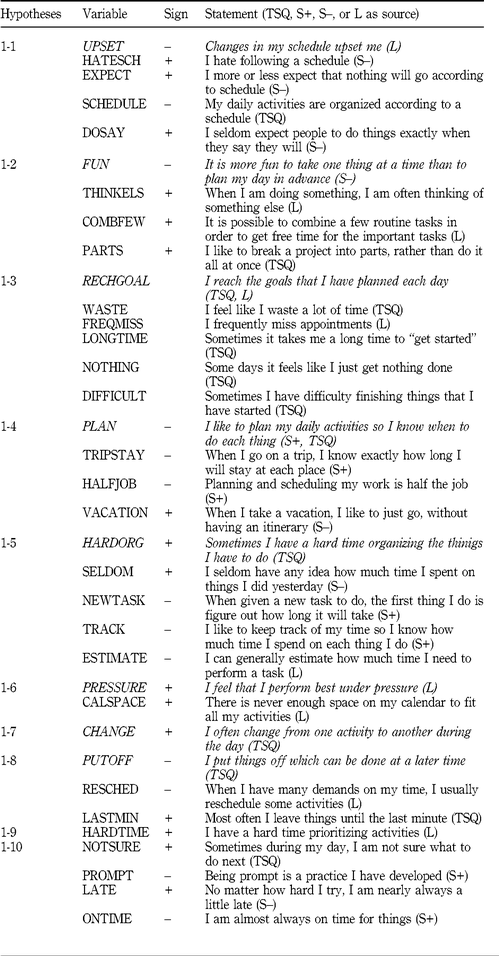
Our first objective was to identify the key monochronic/polychronic predictor variables from a battery of 35 time management statements taken from the TSQ, the FAST scale, and from the literature (L). Basically, polychrons were expected to agree with the items which indicate a disliking for planned schedules and prioritization, preferring activity switching and schedule changes. Conversely, monochrons were expected to agree with the items representing deliberate attempts at managing one's time. Ten general hypotheses are given below; the specific variables, their expected relationships, and their sources are given in Table I. While the items could have been combined into subscales, there was considerable overlap among the issues that the items represented. A factor analysis of the 35 variables suggested an 11-factor structure, but the varimax rotation failed to converge and the factors were not clearly interpretable into meaningful dimensions of time management. Given that result, the variables were input to the regression individually in order to attempt to uncover the "details" of monochronic and polychronic time use.
The second objective attempts to determine if monochrons or polychrons report patterns of calendar use which appear to match the behaviors expected of them, as described in the literature. Four indicators were used:
Finally, the third objective examines whether people feel that their work matches the ways that they want to use their time. If job situations for most people are either mostly monochronic or mostly polychronic in time style, then one would expect a feeling of a poor match with the way some employees would want to use their time. If one assumes that more work environments would be monochronic than polychronic, it is expected that polychrons would be more likely to feel that their timestyles are out of fit with the workplace.
MethodologyResearch instrumentThe research instrument consisted of the following:
The time-related scales used were five-position, Likert-type, agreement scales (1 = strongly disagree to 5 = strongly agree). Respondents also had the option of choosing either "don't know" or "not applicable." Data collectionData were collected in urban residential neighborhoods adjacent to the city of Philadelphia, Pennsylvania. A starting point was selected in each neighborhood near the residence of the trained interviewer, who was a student. The starting residence plus every fifth residence was targeted to be in the sample. Each person was to complete ten interviews. Two "call backs" were required before an additional residence could be included in the sample. The head of household agreeing to do the survey was interviewed. The sampleThe total number of usable surveys before the regression analysis was executed numbered 181. The number of respondents who provided answers to all the variable scales included in the final regression equation was 112. The sample consisted of adult heads of household; 70 percent were females. Ages ranged from 18 to 65, with 68 percent having completed at least some college. The remainder had various types of schooling and technical training and all had completed high school. Median income was in the $50,000 to $60,000 range. All but seven respondents were working; 47 percent indicated they worked more than 40 hours per week. Of the sample, 53 percent were married, 29 percent were single, never married, and 15 percent were separated or divorced. Analysis procedureOne of the keys to the analysis procedure was to be able to classify respondents as to where they fit on the monochronic-polychronic spectrum. The PAI was to be the basis for this classification. The four original agreement items of this index were:
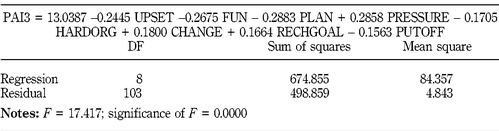
The authors were concerned with (3) because of its situation-specific constraining language. Hence, it was decided to see what the impact on coefficient alpha would be if this item was removed from the index. The findings of the proposed revision of the original PAI scale were in line with expectations. The PAI alpha value with (3) included was 0.79. If (3) was removed, the coefficient increased to 0.82, based on the 158 respondents who scored all four items on the survey. If any of the other three items were removed (one at a time) the resulting alpha was, at the most, 0.73. The decision was made to revise the PAI by eliminating the weakening item. The reliability coefficient was then calculated based on the 172 respondents who had scored the remaining three scales; the value was 0.81. A factor analysis was executed and confirmed that the three items produced one factor with an eigenvalue of 2.19, explaining 73 percent of the variance. Respondent classification was then based on the revised PAI, called PAI3, scores. The range of scores went from three (highly monochronic) to 15 (highly polychronic). The median score was ten with approximately 49 percent of respondents at 11 or above. A stepwise multiple regression was next carried out. The dependent variable was PAI3 and the independent (predictor variables) were those discussed earlier in the "Research Instrument" section of the report, and also are listed in Table I. The decision criteria were an F ratio of 0.05 for variable inclusion and an F ratio of 0.10 for deletion. Also, variables were to be included in the final solution as long as the correlation between the independent variable and the dependent variable was greater than its correlation with the best predictor variable (Hair et al., 1992). Selected cross-tabulations of categorical calendar use-related items versus a two-category monochronic/polychronic tendency split ("high/moderate monochronic" and "moderate/high polychronic") were carried out as a preliminary exploration of written scheduling actions by respondents. A Pearson's Chi-square analysis was used with acceptable significance of 0.05 or less to determine differences. Results and conclusionsEight key monochronic/polychronic predictor variables from the scales tested were found. The variables entered the stepwise-determined regression equation as follows:
All seven of the variables that entered from step 2 through step 8 met the criteria that their correlations with PAI3 were greater than their correlations with UPSET, the "best predictor," allowing them to remain in the solution. The value of the multiple correlation coefficient was 0.75827 and the adjusted coefficient of determination was 0.54196, meaning that about 54.2 percent of the variance in the PAI was explained by the regression equation. Some of the standardized regression coefficients (betas) were not signed as expected and this will be discussed with appropriate hypotheses. The predictor equation to four decimal places and the analysis of variance are given in Table II. Examining the relationship between polychronicity and time managementAs noted in Table I, each hypothesis was tentatively associated with a set of variables pertaining to its general topic area. These items were not summed to form scales, since they appeared to represent different aspects of each topic. The regression equation which resulted is a composite of specific aspects of time management which showed the strongest association with the monochronicity/polychronicity continuum. Thus, the hypotheses will be discussed in terms of support or lack of support for variation within each general time management area.
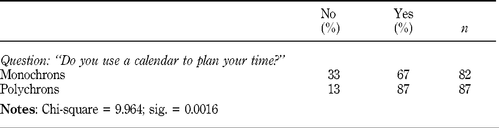
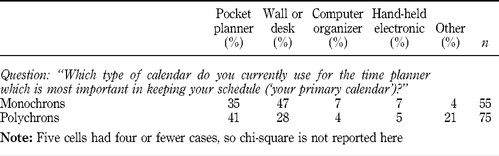
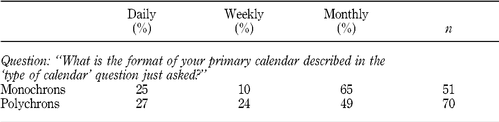
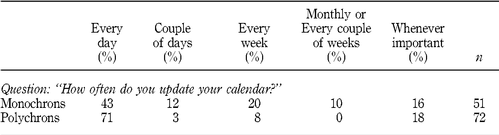
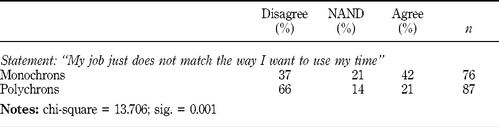
Calendar use patterns among monochrons and polychronsRecall that this objective was focused on investigating whether any patterns can be found for monochrons and polychrons regarding calendar/planner use, format and updating. It was expected that calendars/planners would be more useful to monochrons than polychrons because of the former's stronger ties to scheduling and planning. Recall that people on the monochronic-polychronic continuum were dichotomized into approximately equal sized groups for this analysis since this part of the study was to be more exploratory in nature. Calendar planning use. At least two-thirds of both groups in the sample answered "yes" to this question, indicating that calendar use was common to both monochrons and polychrons in this study (see Table III). About one in three of the monochrons in the sample and less than one in eight of the polychrons said "no". Statistically, a greater proportion of the sample polychrons used a calendar to plan their time. Type of time planner/calendar. The data suggest that almost one half of the monochrons in the sample were using calendars fixed at their workplaces, whereas slightly more than one in four of the polychrons did the same (see Table IV). Conversely, polychrons may be using pocket planners more than monochrons. Note that 28 percent of the sample did not answer this question. The "other" category consisted primarily of portable "day planner" calendars; one in five of the polychrons indicated that choice. It may be possible that polychrons are more likely to prefer a calendar which can be updated on the spot, regardless of location; however, the data in the present study did not address the reasons for calendar type. Primary calendar format. Chi-square analysis did not yield a statistically significant difference between the two groups. However, the monthly calendar format was most popular for both the monochrons and the polychrons in the sample (see Table V). Two-thirds of the monochrons and about one-half of the polychrons used this method. Note that approximately equal shares, nearly one quarter, of both groups also use daily formats. It is possible that the respondent's past, present or future orientation is related to their choice of calendar format; in addition, format is likely to be related to the individual's tendencies to plan for the short or long term horizons (Das, 1987). While such measures were not incorporated into the present study, instruments including scales such as the "focus" dimension of the FAST scale would be a logical starting point to examine the impacts of orientation and horizon (Settle et al., 1972). Planning calendar updating. Polychrons in the sample (89 percent) focused on daily or "whenever important" updating of their calendars (see Table VI). Monochrons mostly updated daily, but "every week" and "whenever important" were also frequently mentioned. Polychrons in the study seemed to want to be more current in their updating. Though the chi-square value was significant, two of the cells had less than five respondents in them so the value has unknown accuracy. Matching between the workplace and desired time useContrary to expectations, the polychrons in the study had more positive feelings about a match between their preferred way to use time on the job and what they actually did in this situation than did the monochrons (see Table VII). The monochrons are split on this though they lean more toward agreement with the statement. Notice that two thirds of the polychrons in the sample disagreed with the statement. The chi-square value is statistically different. Thus, H3-1 is rejected. DiscussionThe results of this exploratory research effort suggest that the impact of a person's polychronic or monochronic timestyle tendency is a potentially important consideration in understanding his/her personal approach to time management in the workplace. Certainly time management is complex and multidimensional (see Macan, 1996 for a review); both monochrons and polychrons attempt to manage their time in ways which are compatible to them. The revised three-item PAI (PAI3) is an acceptable measure of polychronic/monochronic tendency. Its 0.81 alpha value is good, but most likely could be improved by adding other relevant items. A number of variables that comprised the regression equation developed in this study might be part of the expansion of PAI3. The key would be to select from among them those variables that would be less situation-specific and with acceptable intercorrelation values to avoid redundancy. The "predictor variables" that surfaced in the stepwise regression solution may be categorized as follows:
Each is considered in turn. Planning and organizingThe three significant predictor variables related to planning and organizing do appear to reflect the subjective aspect of time, supporting Graham (1981) and Hornik (1984); clearly, the respondents had various feelings of liking and perceptions of difficulty with planning and organizing their time. Their responses to "I like to plan my daily activities, so I know when to do each thing," "It's more fun to take one thing at a time than plan my day in advance," and "Sometimes I have a hard time organizing the things that I have to do" are a study in contrasts. Each of the three variables carried negative beta signs, and thus are associated with tendencies toward monochronicity. Monochrons in the study say they like to plan activities, yet find it more fun to do one thing at a time, rather than plan. This could be based on a preference for taking one thing at a time, while not enjoying deliberate attempts to organize activities to occur one at a time, which may be difficult to control. What monochrons may actually be saying is that they like the outcome of planning, which lets them know when to do each thing. However, the actual meaning of these items is unclear and needs further study. Both monochrons and polychrons may benefit from time management programs which enable them to express their subjective feelings about parts of the time management within their organization. While time management training has been found to have some beneficial results (Macan, 1994), programs in time management could potentially increase the benefit related to job performance by tailoring their recommendations to the timestyles and feelings of the participants, as well as the timestyles of the specific workplace under consideration. Attaining daily goalsThe finding that polychrons perceive that they reach their daily planned goals more than monochrons was not expected. The authors felt that both groups, following their own preferred way of using time, simply differed in how their work was done, rather than how successful they were in completing that work (see Slocombe and Bluedorn, 1999). The issue is not resolved in the present study because there were no actual measures of goals set or work actually completed. Further study might include measures of actual behavior or completion of activities, following the methods of Simons and Galotti (1992). In actuality, both groups may or may not be meeting goals; polychrons simply may be more likely to feel that they have attained them. Additional research is needed to understand this preliminary finding and its implications. Reaction to changeSome recent workplace analyses have suggested that activity change can be appropriate and needed in certain types of workplaces (Farris, 1995; Kleiner, 1992). The findings, which clearly link acceptance of change to polychronicity, suggest the possibility of fitting polychrons into workplaces which are characterized by interruptions and task switching, rather than trying to minimize their occurrences. The two variables that entered the equation were "Changes in my schedule upset me" and "I often change from one activity to another during the day". The negative standardized beta coefficient linking monochrons to upset feelings with schedule change is expected. Likewise, the positive standardized beta coefficient for CHANGE is expected, since polychrons generally change from one activity to another with ease. Note that a difference may be due to the source of the changes; monochrons are upset by changes, possibly imposed by someone else, while polychrons appear to initiate the changes during their day. The responses may be related to the control of time which is perceived (see Jalan and Kleiner, 1995). Schedule changes should be as limited as practical for monochrons; they avoid change because it upsets them. Polychrons, however, are comfortable with change and they are also change-proactive because of their time behavior style. Performance under pressurePressure is often associated with feelings of time scarcity in relation to the tasks at hand (Robinson, 1990). The need to accomplish a specific task may arise, according to a workplace deadline or a change in schedule. The polychrons in the sample were more likely to agree with the statement: "I feel that I perform best under pressure", resulting in a positive beta coefficient in the regression solution. This is a logical finding since polychrons are more likely to be able to juggle activities in order to complete a specific task "on time". Monochrons wish to stay on schedule; feelings of pressure to complete a specific task may call an established schedule into question, causing monochrons to feel that they have performed poorly. More detailed study is needed, however, to determine the specifics of a pressure-polychronicity relationship. However, the study results suggest that polychrons are better adapted to high-pressure jobs and situations. Procrastination"I put off things which can be done at a later time", had a negative beta coefficient implying that monochrons are more likely to procrastinate than polychrons. This finding has face validity in that polychrons enjoy and are able to handle more things simultaneously, perhaps necessitating less "putting off" behaviors. Monochrons, however, wish to do one thing at a time, so may need to put off activities in order to bring that about. This tendency may be related to the monochrons' deliberate efforts to determine what activities can be done later and independently of other activities. However, procrastination is also related to difficulty and boredom of the task (Puffer, 1989), which needs to be explicitly considered in order to isolate the relationship with polychronicity. Use of calendarsA series of four questions were asked relating to calendar-planners. Both monochrons and polychrons used calendars to plan their time. Two thirds of the monochrons did so, as did almost 90 percent of the polychrons. The monochrons would have been expected to be more prone to use such an aid because of their apparent need for planning and structure. However, monochrons' discomfort with activity change and reported difficulty of organizing may moderate the types of planners which they choose. If, as Bond and Feather (1988) assert, structure and purpose in the use of time is associated with positive self-esteem, there may be a further need to "fit" the type of purpose and the calendar format, with both the individual's purpose and with his or her level of polychronicity. The polychrons in the study used pocket planners more than wall/desk organizers; the reverse was found for monochrons. Monthly planners are the most popular format among all respondents, and even more so for monochrons. Clear patterns did not emerge in the sample; about a quarter of both the monochrons and polychrons in the study preferred to use daily planners. Thus, the present study cannot conclusively attest that one calendar pattern over another is a better fit, given the level of polychronicity. What does emerge is a tendency for polychrons to appear to use portable, frequently-updated calendars, which possibly allow polychrons to make changes and additions to their schedules on the spot. Monochrons updated their calendars less frequently, which suggests that time management for polychrons should incorporate some mechanism for dynamic updates, changes, and additions, rather than impose a reliance on schedules made long in advance. Match of time style with workplaceFinally, it was unexpected to find that polychrons had more positive feelings about the match between their preferred way to use time on the job with what actually occurred. A limitation is that type of workplace was not recorded for each subject. It was assumed that a typical work environment would be more structured, with tasks linked with specific activities and deadlines, imposing a monochronic timestyle. However, depending on the workplace, monochrons may also be asked to change tasks each day more than they would like. This can also upset them and cause a sense of mismatch. Some workplaces have moved toward flexible time schedules, while other jobs, such as sales, are flexible by definition. This bodes well for polychrons but is not as comfortable for monochrons. Probably a majority of jobs and career opportunities are monochronic today and will continue to be, so there will be ongoing need for monochronic timestyles and the skills and time management perspectives they bring. Further, the findings of Slocombe and Bluedorn (1999) show that organizational commitment, perceived performance evaluation by supervisor and co-workers, and perceived fairness of evaluation impact on perceived match. These dimensions were not explored in the current study and have potential to have an effect on the results found; this is a further limitation of the present study, which provides additional direction for further investigation. Limitations and future research directionsWhile the present study indicates some differences in time management between monochrons and polychrons, several limitations must be noted which can be further examined in future research. First, the data all represent behavioral self-reports provided by the respondents, without a subsequent phase which tracked confirmatory measures of actual behavior. In addition, the research was not focused primarily on the workplace, and the sample was not drawn in a way to allow for generalization. Specifics regarding each subject's job and the timestyle characterizing that job are additional measures which may add extra variability. Additionally, no indicators were used to assess the level of self-control of the work timestyle and whether the individual was a manager of the time of others. The study was essentially exploratory in nature, and the strength of the findings are tentative at best. Scale refinement and alternative wordings are necessary for further development and testing. Polychronic/monochronic assessmentIf the results of this research are reinforced over time, the value of identifying monochronic and polychronic timestyles may be determined. Measurement techniques could be designed to create timestyle maps to serve as guides, providing insights into why individuals or organizations behaved and/or thought as they did when managing time in the workplace. Also, work assignments, level and type of supervision, number of activity shifts, daily goal setting and assessment could be keyed to an understanding of the monochronic-polychronic tendency positions of employees. Job descriptions could be analyzed pointing toward the timestyle behavior/attitude most suited to carry them out. Job applicants could be evaluated and the results may serve as a guide for hiring and training of new employees so that a better timestyle fit could be found with the firm as a whole or with the work team into which the new hire would be placed. Further, knowing the timestyles of those with whom a person works or supervises or by whom one is being supervised has the potential for better understanding of behaviors, should help reduce conflict and lead to more realistic expectations of behaviors. Monochrons appear to want a planned, deliberate control over their time. They like to identify time periods when certain activities will be done. It would appear that they are well-suited for workplaces which require the establishment of a well-planned schedule, such as determining repetitive programs and activities whose success is based on structured time. Their strengths may be utilized in developing schedules whose exactness and precision allow workers to function in a cooperative manner. Monochrons would be likely to excel at activities which require linking activities to specific times of day, such as the determination of work schedules, transportation schedules, sequential production runs, and so forth. Their abilities to see the big picture, and all the interrelationships among the parts, are possible key contributions to workplace harmony. Polychrons, however, would be expected to thrive in jobs which have uncertainty and pressure. Careers which require great juggling of tasks, such as tour directors, administrative assistants, creative developers of products and of advertising, receptionists, and emergency room personnel are just a few possible illustrations. Such jobs require that the individual constantly adjust to incoming new jobs and responsibilities, integrating them with other activities which have already been scheduled. They enjoy change as part of their job, in which they are challenged to make a better fitting schedule which meets everyone's needs. Time management trainingThe development of time management training for polychrons and monochrons, either separately or in combined sessions, should be studied further. The traditional ideas associated with goal setting, planning, prioritization and organization of tasks are still sound, yet they may not be appropriate for everyone, especially for polychrons. The use of portable calendar planning devices is certainly to be encouraged. However, the check-off approach, where one thing is to be done at a time against a fixed clock block time-planning schema, will typically not be effective for the polychron. They feel they meet their daily goals and are not easily "rattled" when circumstances change. Polychrons must be taught to identify, support, properly manage and/or be managed by those with monochronic workplace habits, depending on their specific workplace situations and time cultures. Traditional time management training approaches have potential to work for monochrons. However, if the nature of their workplace incorporates interruptions, they should be taught to consider planning for a certain number of interruptions throughout the day. They may learn to anticipate or plan in a certain amount of time into their day, which matches the approximate amount of interruptions which are likely to take place. Such workers may need more personal attention, time and reinforcement from supervisors. Further, they will need help in organizing their day's work. If managed by a polychron, the latter will have to be grounded in the behavior patterns to be expected and be trained to use them properly. Having said this, one must be aware of the findings of Macan (1996), where contrary to expectations, respondents did "not report more frequent use of time-management behaviors, more job satisfaction, or less job-induced tension after training, compared to those not receiving training". Polychronic or monochronic tendencies are not "good" or "bad" - they just "exist". The authors believe that polychrons and monochrons can contribute side-by-side in the vast majority of work situations. The strengths of each can often compensate for the weaknesses of the other. These two timestyles can be recognized, understood and put to good use in the workplace.
Table I. Regression hypotheses, with polychronicity as the dependent variable (expected signs given for each variable/variables in final equation in italic)
Table II. Regression solution
Table III. Calendar use
Table IV. Type of calendar used
Table V. Primary calendar format
Table VI. Frequency of calendar update
Table VII. Matching between workplace and desired time use |
||
|
Taken form Emerald Fulltext Website |
||