|
|
INSTITUT TADBIRAN AWAM NEGARA |
|
||||||||||||||||||||||||||||||||||||||||||
| The Basics of Team Building | ||||||||||||||||||||||||||||||||||||||||||||
| Team Technology & MTR-i Ltd | ||||||||||||||||||||||||||||||||||||||||||||
|
Introduction In the late 80s and 90s, 'Team Building' has been recognised by many companies as an important factor in providing a quality service and remaining competitive. Yet the term 'team building' can sometimes seem rather nebulous - people often know that they need it, but aren't quite sure what it is. What is a team?Here are some terms that are often used to describe 'a team'. Which ones do you think define what a team is?
Some of these terms are features of good teams. For example, 'whole > sum' is a feature of a team that is working well together - but there are some teams whose collective performance falls short of what you might expect given the quality of individuals. The Apollo Syndrome is a good example of this - where a team composed of highly intelligent people often performs worse than teams made of up 'less-able' members. The term 'reporting to one boss' can be a misleading one. In a well-designed organisational structure, people reporting to one boss do often form 'teams'. But reporting lines are frequently designed within the constraints of grading structures. Of necessity, there is often a compromise between pay structures or traditional reporting lines, and grouping people together who are a team. In reality, team structures are often complicated, and people can be members of several teams, because a team is a group of people working together towards a common goal. . Common goalsConsider the example of a financial services organisation, selling pensions. Who is a member of the 'sales' team? From the definition of a team, you first have to define the common goal of the sales team before you can define who is in it. Let us suppose that the goal is 'to increase the sales of the company'. Who contributes to that goal? There are many people:
An example - the 'Personnel Team'Looking at this hierarchy of goals, one might initially conclude that the goal that defines the personnel team might be 'to build a skilled workforce'. But who contributes to this goal? Surely line management have as major a role to play in this as Personnel, because they so often do the recruitment and most of the training 'on the job'? If this is true, what exactly is the goal of the Personnel team? Could it be 'to promote good practice in the company which leads to the recruitment of high quality staff and an excellent standard of training'? Clearly, defining a team as 'a group of people working towards a common goal' may cause us to challenge some long held assumptions about what a team is. It may cause a team to examine their purpose and their 'membership'. What is team building?A team is a group of people working towards a common goal. 'Team Building' is the process of enabling that group of people to reach their goal. It is therefore a management issue, and the most effective form of team building is that undertaken as a form of management consultancy, rather than as pure training (though there is a role for training within a programme of team building). In its simplest terms, the stages involved in team building are:
The primary skills in this process
are recognising the right issues, and tackling them in an
appropriate way and an appropriate order. Team building can also
take a different form depending on the size and nature of the team.
In teams where membership is static - typically in management teams - how the individuals within the team relate can have a big bearing on team performance. If a member leaves, or another joins, the dynamics of the team can be changed greatly. Here, the scale is small - say, 2 to about 12 - and the team building consultant endeavours to improve relationships between team members, using tools such as the MBTI and/or the MTR-i team roles. A larger scale operates between teams. Where the teams do not relate well, they are called 'team islands', and it is the relationship between the teams that becomes the focus for the consultant. The largest scale is that of organisational team building. With the exception of the senior management team, the ability of individuals to make an impact on the corporate culture is very limited. One of the key aims of the team building consultant is to change the behaviours and attitudes prevalent in the organisation, which are almost independent of who actually works there - new recruits who are 'different' often start behaving in accord with the existing culture. Summary
|
||||||||||||||||||||||||||||||||||||||||||||
|
Taken from Team Technology & MTR-i Ltd Website |
||||||||||||||||||||||||||||||||||||||||||||


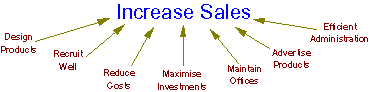 In this example, it is easy to see the need for a corporate culture
that recognises and values the contribution that everyone makes to
the sales process, and other important goals. The whole organisation
is truly a team, and working together towards a set of common goals.
The example also shows the hierarchy of goals that exists within the
company.
In this example, it is easy to see the need for a corporate culture
that recognises and values the contribution that everyone makes to
the sales process, and other important goals. The whole organisation
is truly a team, and working together towards a set of common goals.
The example also shows the hierarchy of goals that exists within the
company. 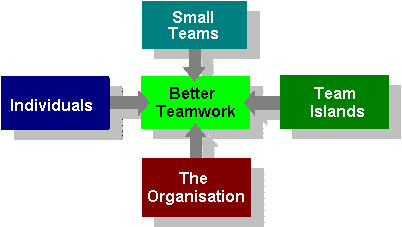 In a project environment, where team composition is continually
changing, the emphasis must be on developing the skills in
individuals to be effective team members. The 'scale' involved is 1
person, and the team building consultant is endeavouring to change
the skills and abilities of the individual at operating within a
team (or within multiple teams).
In a project environment, where team composition is continually
changing, the emphasis must be on developing the skills in
individuals to be effective team members. The 'scale' involved is 1
person, and the team building consultant is endeavouring to change
the skills and abilities of the individual at operating within a
team (or within multiple teams).