|
Peter Siddell's works are deservedly popular. This is not surprising as paintings able to magically capture the apparent reality of the world we see have always had a large and devoted public following. As we are awed or entranced by the immediacy of the realism, in this case of suburban Auckland, it is easy to overlook the artistic principles upon which good realist art like this is based.
What most of us fail to recognize of course is that the skills and processes for painting objects and places exactly as they are seen is purely a technical skill which can be assiduously learned. It is not therefore simply the skill of capturing on the canvas the cornices, gables, weather boards or tombstones of our familiar world which makes Peter Siddell's paintings 'art works'÷although many viewers may tend to stop at that.
No what moves a straight "realist" painting into an acknowledged 'art' work is much more complex. It involves the rigorous selection' the intellectual 'realisation' of which details to portray. It involves the subtle yet deliberate control of colour and depicted textures of the spaces within the objects and their arrangement or composition within the selected scene. As is neatly stated in Suruiser's much quoted remark from earlier this century "A picture, before being a horse, a nude or some kind of anecdote is essentially a flat surface covered with colours in a certain order." Along with a strict process of observation and analysis, the assembling and order ing of the material is the critical element in realist paintings. Its real value as 'art' lies in its disclosures about our familiar world. Its 'realization' of our apparent reality.
What Peter Siddell is doing in these paintings is to draw us inextricably into a world of his imagination which we immediately accept as real. Siddell has entitled this exhibition 'Urban Memory" and uses his realist paintings to record his own remembered experiences. The painting is the vehicle for 'still images that linger in the memory'.
While the initial subject of many of these paintings appears at first glance to be the older buildings of suburban Auckland,
Siddell is in fact selecting and assembling units with which to build a "memory" image. The stimulus, he says, often comes from music, reading, something smelt or tasted, from the visual play of light and shade on a surface or from a glimpse through a window.
His use of architecture to do this stems partly from his earlier experiences visiting relatives in unfamiliar houses or as a newspaper delivery boy "As I walked the empty pre-dawn streets" says Siddell "each house took on an identity for me. I rarely saw the occupants but I knew the houses very well. The buildings somehow became symbols of the people who lived there".
Other features of the Auckland isthmus, the harbours cloudscapes, and particularly the terraced volcanic cones or the strange monuments Siddell says "refer to earlier habitation. None of my paintings are of real places but are built up in my studio from sketchbooks recollection and imagination".
Our confrontation with this reality is therefore highly selective and partial, Peter Siddell is deliberately presenting a still image. "Anything that works against that is excluded. That is why I don't include peeling paint, street signs, power lines, washing hanging out, cars or people engaged in activities" he says, "These would give a narrative interest that I feel would work against the still atmosphere of remembered times and places".
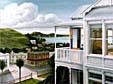
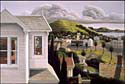
At first glance the scenes look incredibly familiar. We sense that we have seen exactly that house or that bannister, moulding or window. In fact there are no places exactly like the scenes in these paintings, but each piece in the scene has its own reality. This sense of hyper realism is heightened by the super-sharp focus given to every detail. We are normally aware, as we look around a space, that our eyes only focus on the details as we give them our attention. Because we never see every object simultaneously we are usually unaware of this selective focus. In Siddell's paintings therefore, as we are presented with every item in sharp focus, the outer reality is made subjective. We tend to relate objects which actually exist to those in the painting.
Obviously there are enormous time discrepancies between the time it takes to paint a scene, the time it takes to observe it and the 'time-frame' implied in the depiction. You may notice for instance the oranges in the bowl or the towering clouds in Urban Memory or the clock on the mantlepiece in Trellis. Amid the overall stillness of the scene small elements like these nudge against our subconscious aware ness of time and through the deliberate manipulation of the painter enhance the sense of stillness. Memory has a fundamental timelessness and this is one of the ways Siddell paints this timeless ness into his scenes.
Another deliberate element in these works which adds to the sense of heightened reality is the directness of the encounter. Paths stretch away imme diately in front of the viewer and doors and stairwells begin at our feet. This rigid frontality implies a steady frontal rather than a glancing oblique gaze. In this way it also builds up a sensation of slowed time.
Also in the majority of these works there is a double orientation. This is in part created by the way Siddell has made the light stream into the view from the side. In Churchyard or Doorway , for example, a strong beam of light enters from the right creating an oblique counterpoint to the frontal, and usually right angled lines of the paths, hallways or walls. As well as the compositional balance achieved in this way we are also subconsciously fed the suggestion that the world continues beyond the limits confined within the painted scene.
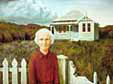
Usually the observer is implied. In Terraced Cones , Churchyard or White Verandah there is not another soul in sight. The observer sees all the details of the floorboards and pebble chips but no one else. Thus is created a sense of loneliness and isolation. Figures, when they do appear as in Old Woman (No 6) or Old Man and Church, are notoriously solitary. They stand looking directly, also confrontationally at the observer. Siddell also uses the implications of empty space for emotional effect. In Urban Memory and Autumn After noon we are led right inside the airy and deserted spaces in the quiet homes. With Five Palms we are made acutely aware of the open space around the monument and in Stairwell (No 21 ) we are drawn through the window right out across the inlet, while in Churchyard (No 10) we are ushered by the monumental angles right into the darkened quietness of the church.
"Because of the way I work I don't paint chronologically in series but rather on a sort of thematic spiral where the related paintings are often years apart themes are never discarded but can be returned to again and again".
It is with this adjustment of space and detail that many realist painters like Peter
Siddell create an atmosphere of under lying tension. Accustomed to the photo graph's impersonal evidence of reality, we tend to similarly trust the reality of the realist painting. It is no wonder we become unconsciously caught up in its manipulated mood.
Siddell occasionally uses a camera to record special details but finds, like most painters, that photographs are never sufficient alone. Once an idea for a painting is formed Siddell explains the next step is to ".. . develop it through quick compositional sketches in news print jotter pads. Very occasionally a satisfactory form will develop from these first sketches and I will progress directly to the painting. Usually however the form of a satisfactory painting remains elusive and the idea will be left for the time being.
"Over a period of weeks months or even years I will return intermittently to the idea and eventually it will resolve itself to a painting. For some paintings the number of compositional notes, where I am trying to give concrete substances to my ideas, can reach the hundreds.
Discussing his working methods, Siddell says, "At the moment I am using mainly acrylic paint with hardboard which has been prepared with layers of sanded Liquitex gesso. I find that the fast drying qualities of acrylics allows me to rapidly glaze and overpaint in a way that would be very laborious with oils. My present method is to begin painting directly on to the board with only the briefest of chalk outlines taken from my final composi tional sketch and to establish detail as the work progresses. This means that I am able to make considerable changes as a painting develops without having to preserve an underlying drawing.
"While most of the work in this exhibition has been painted in acrylic much of my painting in the past has been carried out in oil paint. I will probably return to oil paint in the future as it has a richness and luminosity that acrylic paint doesn't match.
"Paintings never turn out as I had hoped them to. There is always an enormous
gap between my initial idea and the finished painting. I suppose it's this dissatisfaction that keeps me working. I have found that paintings are taking an increasingly long time to complete as I struggle to get the work right.
"My own tastes in painting are fairly wide and I find it difficult to pinpoint influences on my work. Painting that is vastly different from mine has often had more influence as painting which appears to be similar to my own. Probably as much influence is exerted by other art forms.
Proust's "Remembrance of things Past" being a novel that comes immediately to mind.
Peter Siddell was born in Auckland in 1935. His father worked on the Auckland wharf and the Siddells lived in Grey Lynn, a working class suburb of Victorian villas. Although he did well at art in school and much of his spare time was spent drawing and painting, the idea of becoming an artist was quite foreign to the family and on leaving school he was apprenticed as an electrician. For the next 10 years Peter Siddell worked as a tradesman and art was forgotten amongst the other activities which seemed more attractive to a young man. In 1960 he married, moving into a new house in Blockhouse Bay where he still lives with his wife, the artist Sylvia Siddell, and two daughters. In the early sixties he became a primary school teacher and in 1966, when over thirty, he began painting as a hobby. Apart from one term at night school Siddell is self taught. He recalls "When I began painting I knew nothing of New Zealand art and I can still remember the thrill of discovering W A. Sutton's 'Nor Wester in a Cemetery in the Auckland City Art Gallery. I was impressed by artists such as Rita Angus, Colin McCahon, Toss Wollaston and Don Binney, who had reacted to their environment and made paintings which , as a New Zealander, I could understand."
The early years of painting were spent exploring styles and methods and discovering the sort of paintings he was able, and wanted to do. He soon realised that the use of an image was of prime importance to him and that he wanted that image to be still and clear.
"My first attempts at painting were very stilted, wooden and tightly painted. I wanted to achieve a more painterly quality in my work but found that such a style did not allow me to create the stillness I wanted in my paintings," he says.
By 1970 Siddell was using simplified hard edge forms with a very shallow picture space as seen in the first paintings in this exhibition. Over the next two years he began adding texture and detail and steadily increasing the illusion of space in his work. The form of realism which was developing seemed to be the right vehicle for the imagery he wished to make and has continued to the present time.
|
|
|