|
On this page there is a small selection of unedited reviews of my work. Two are by T. J. McNamara, the New Zealand Herald's art critic : one for my first solo exhibition and one for my most recent
Review of 1973 exhibition T. J. McNamara New Zealand Herald
PETER SIDDELL AT MOLLER'S GALLERY
In Moller's group show at the end of last year there were two remarkable paintings by Peter Siddell and his first one-man show has been awaited with considerable interest
Now that it has been mounted at the same gallery it fulfils expectations and indicates the fruition of a considerable talent. Peter Siddell's method is to bring together disparate elements all painted with meticulous accuracy in order to evoke an atmosphere in his paintings that recalls the work of the American Andrew Wyeth as well as New Zealand artists like Brent Wong and David Barker.
The elements are mostly a weatherboard house of the kind common in Herne Bay or Ponsonby set down in a steep West Coast landscape where every blade of grass has been recorded. Sometimes the foreground is occupied by a weathered fence , or a tumble of rocks. The only figures that appear are a girl or an old woman. There are some unsuccessful paintings but for the most part each one breathes an atmosphere of loneliness but with a hint of future joy and the possibility of a return to happiness . They are landscapes of the mind and not landscapes of a particular place, for all their sharp drawing.
The houses are well painted. as are the hills of "Cliff" and "Avril and Pohutukawa" but where Peter Siddell sometimes misses is in the texture of the scrub and the figures that stare out of the paintings are wooden and lifeless.
T. J. McNamara.
New Zealand Herald
2 Oct 1973
Review of 2000 exhibition T. J. McNamara New Zealand Herald
|
|
|
 |
|
 |
|
|
|
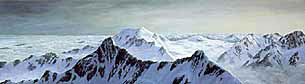
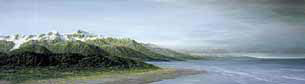
Gillespie's Beach from Main Divide January 1958 |
|
|
|
The Main Divide from Gillespie's Beach 2000 |
|
|
|
|
|
|
|
|
|
Construct, not as a verb but as a noun, has become a very fashionable term. Books, paintings, philosophies and even sciences are described as such.
The meaning intended is that the artist as taken aspects of reality and reassembled them to express an independent reality of its own.
The word suggests a dry assemblage to a prearranged plan. Yet good art has an inexplicable element of inspiration and response that creates mystery, a magic that goes beyond something assembled from a theory.
At Artis gallery in Parnell, Peter Siddell - in his exhibition Three Points South - is showing paintings that refer to his fascination with the Southern Alps in
his mountaineering youth. In many ways the treatment of rocks and scree resembles the images in his first exhibition of headlands and hills more than 30 years ago.
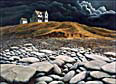
Most of Siddell's work since then, though apparently sharply realistic, has been a bringing together of elements taken from different places to evoke such things as the feeling of the houses and hills and the glimpses of sea that are the character Auckland. These paintings are more specific places yet they still have sense of being constructed.
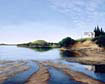
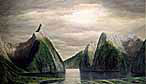
The big, spectacular work Fiord, which depicts Mitre Peak, pulls the valley to the left of the peak up closer so it becomes the spectacular amphitheatre. The depth of the sound is dramatised by light on the water and by the swoop of a saddle between hills on the right. It is the process making an image that is not the mountains but a dream of the mountains.
The lovely work Gillespie's Beach from Main Divide January 1958 was painted this year from memory. What the artist is doing is recapturing the memory of glimpsing, from high in the alps and across the clouds, a distant hint of coastal beach and waves. A vision of a farther shore.
The mountains and, particularly, the ridges that catch the light on their sharp edges are very accurately conveyed, but it is the sense of the mystery of the distant beach that gives the work its element of magic.
There's also a canvas of exactly the same dimensions which shows the reverse situation. Titled The Main Divide from Gillespie's Beach 2000, it looks from the beach to the mystery of the mountains. It is an equally fine work. These comparatively small paintings consistently achieve that extra element that gives intensity to the image.
The larger works are more heavy and solid with a sense of strangeness all their own. They represent a remarkable achievement.
T J McNamara
New Zealand Herald
Dec 4 2000 |
|
 |
|
|
|
Click here for more information on this exhibition |
|
Fiord |
|
|
|
|
|
|
|
|
|
Review of 1996 exhibition John Daly-Peoples National Business Review
VIEW FROM THE ANTIPODES, BY PETER SIDDELL,
Artis Gallery, Auckland, until December 20.
Reviewed by John Daly-Peoples
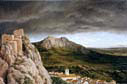
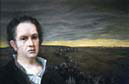
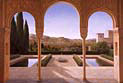
In the 19th century European artists travelled to the other side of the world to record the exotic landscapes of the Antipodes. They had a vision of unspoilt Edens, of the truly sublime landscape. They tried to find their heritage in the purist land scapes of another place. Peter Siddell, in his latest exhibition, A View From the Annpodes, is reversing the vision in presenting a series of views of Spain. This is partly a nostalgic view of the European heritage, the view that impels thousands of New Zealanders on the European Grand Tour. It is also an attempt to define our European cultural and historical roots. These works also show Siddell as a magician in not just creating the appearance but also manipulating the landscape views he presents. Many of his Auckland landscapes are hard to place for this reason. The familiar volcanoes, roads and land forms are moved, transformed or excluded. At one level we have a mythic view of our landscapes, of Nature investing them with a life of their own. Yet all landscapes are primarily shaped by human intervention. The land has been bumed, farmed, cut, shaped and levelled. The exhibition of 17 pastels and four oils is in three parts. One part is of views of some of the major cities - Gaucin, Segovia, Guadeloupe, Tru jillo and Toledo. Another includes portraits of Spanish artists in landscapes. In two pictures of Toledo, Siddell changes the small town. He removes all vestiges of contemporary development and he also moves the bridge and the river to transform the landscape. The two Alhambra works use the Moorish arches of the "Court of Lions" to frame a distant landscape. One of the works is titled "Frontera" or "frontier", which acknowledges that both the severe landscape and Moorish history have con tributed to Spain's "frontier mentality" and to the Spanish colonisation of South America. Three works show us El Greco, Velasquez and Goya in landscapes, El Greco notably standing before his town of Toledo. Goya appears with a ragged column of refugees which could have come from his own series, Disasters of War. Nevertheless the work has a contemporary feel - it could be Bosnia or Rwanda. Velasquez is copied from "Las Meninas", with the artist fixed on the observer with a stare that connects the past and present. This is Siddell's homage to an artist who, more than any other, has been able to convey physical and psychological truth through paint. In all these works Siddell imposes order on the landscape. The buiidings are regulated, groves of olive trees are carefully arranged, the crumbling rocks and sprawling foliage form pattems as if conforming to the artist's idea of harmony. Siddell does not normally use pastel in his major exhibitions but here he demonstrates a superb use of the medium. Rather than the hard edge and crisp colours of his oils, we see in these works a softness and density. The colour seems to hold in the earth tones, smells and the light of Spain. The satiny textures of lowering clouds and the chalky rough ness of stone and rock are conveyed masterfully
National Business Review
John Daly-Peoples
Dec 6 1996
Click here for more information on this exhibition
Review of 1998 exhibition T. J. McNamara New Zealand Herald
ART TRANSPARENCY AND A SENSE OF TIME
A sell-out exhibition poses special problems for a critic. He doesn' t need to write an interpretation of the work because obviously people understand them enough to buy them. He doesn't need to evaluate the work because already people have demonstrated how much they value the paintings. He doesn't need to celebrate the achievements they represent because that too has been covered.
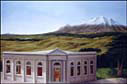
So what remains to be said about the work of Peter Siddell at Artis Gallery in Parnell? Perhaps something that defines the nature of their appeal because Siddell's paintings are apart from the mainstream of contemporary art. They are often described as realistic because the buildings and the landscape in them are readily recognisable. Yet although they give a very strong sense of place they are not of a particular place. Each painting is a synthesis and its realistic elements are combined in a special way that suggests time. Time that is past or time that may be. Yet, and it adds to the strangeness of the work, there is also an absolute stillness in the paintings. No people and no movement at all, even when water in the foreground spreads over a rocky shore. Furthermore, the realism is more apparent than real. Siddell is fascinated by transparency and by reflection so that there are many instances where you can see through things, where buildings are more narrow than they would be. Transparency is linked with the sense of time. In a simple painting of the hallway of a villa, the interior and the polished floor give the sense of one time and the view beyond the door, of pathways and clipped hedges, seems to lead to another. In a remarkable painting that shows a public building, now empty, you can see right through it from its elaborate facade and its empty rooms, and beyond it, undulating land scape, and beyond that again the tree line, and beyond again the heights of Ruapehu. The architectural work and the mountain are both in the grip of time. The immediate appeal of these paintings lies in the detail. The extraordinarily careful depiction of cliffs and hills and sky is matched by the exact rendition of buildings and gravestones. Without the peculiar tensions that come from the paradoxes and disturbances of reality these paintings would be craft rather than the high and potent art that is the real nature of their achievement.
It is too late to buy but there is time to go and be moved by their carefully meditated, evocative presence.
T J McNamara
New Zealand Herald
Dec 5 1998
|
|
|
COLD SPECIMENS
|
|
|
|
 |
|
|
|
|
|
|
If there were some kind of award for rapid achievement in painting, Peter Siddell, who has his second one-man show at Moller's Gallery would almost certainly carry it off. From his first solo showing two years ago, this apparently self-taught painter has emerged as one of the country's major realists.
Certainly over the past few years the realist revival,which began as a small tributary stream, has become a flood carrying along with it a large number of small talents. It is easier,perhaps to go with the crowd than to strike off in a new direction. Siddell is not blazing any new trails, but he is adding something reasonably solid to a style which is all too often flimsy and facile.
Control of craft and technique is always to be admired, but when realist painters rely on that alone, which so many seem to, it remains craft and nothing more. What Siddell does might not be to everyone's taste. as it is not to mine. but it nonetheless goes admirably beyond technical skill. Possibly the label realist is not altogether accurate in this painter's case. He paints real things of course, with a patient attention to minute detail not in the real world. but in the imagination of the painter.
Siddell is having a heavy affair with the domestic architecture of Edwardian and pre-war Auckland. I hesitate to describe his obvious passion as a love affair since the absence of any obvious emotional commitment to the things he paints seems a weakness in his work.
The landscape he paints is idealised. It is a world untouched by urban problems, unspoilt by the motor car, an Auckland (if indeed it is Auckland) before motorways and parking buildings, when houses clustered around grassy cones or marched in neat rows back into a lush green environment. Siddell's houses are rendered in chilling, detail. It is possible, in some of them. to see w hat goes on inside. Even some of the of the most distant architectural details, like decorative bargeboards, fretwork, coloured glass and leaded fan lights are as precise as those in some architectural drawing The painter works with the primitive's equal balance of attention, Things near and far are given equal weight, and distance softens nothing of the view. But there is nothing naive about these images. For all their sophistication and detail, the paintings are coldly non-committal. It is as if Siddell had caught these architectural specimens like insects in a killing bottle, then pinned them out in neat and tidy displays.
Some of his paintings seem more than a little like the drawers of exotic butterflies or moths that one used to be able to slide out of display cases in old-fashioned museums .
If some contemporary realists go too far in the direction of decoration, Siddell does not seem to go quite far enough. His compositions are coldly frontal houses, hills and trees march back in orderly progression into the picture space, and even towering cumulus clouds or threatening rain storms are frozen into airy monuments. In the handful of works in which human beings appear, they too are treated as specimens even in the snapshot like portrait of Avril and Emily. A solitary man, an elderly couple and a worker at some riveted iron boiler stare out at the viewer with a stolid indifference. There is a want of love and humanity in these paintings, perhaps a lack of compassion, but that may well be the painter's intention. He is, after all, confronting us with a built environment which has vanished from our city and which, in a real way, was the victim of the public vandalism we once accepted as progress.
Perhaps Siddell's houses are intended to stand witness to our various urban crimes; to accuse us mutely of having mucked up an ideal city. Whatever its purpose, this exhibition establishes Peter Siddell as one of the best among the current crop of realist, surrealist and super realist painters.
Hamish Keith
Auckland Star
12 Oct 1974
|
|