|
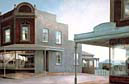
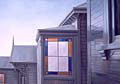
When I was boy I delivered Auckland's morning newspaper,The New Zealand Herald. Each morning I rose early and walked the empty streets in the pre dawn light. Our working class suburb consisted of wooden Victorian houses and these childhood experiences have influenced my adult art. The following is an article which appeared in the Herald at the time of the show.
AN ARTIST'S SALUTE TO THE PAPER BOY YEARS
WET shoes, wet hair. The smell of bacon cooking for somebody else's breakfast and the watered glow of rainy sunrises reflecting on someone's weatherboards
The memories of a morning paper boy, 34 years on. . Peter Siddell, the Auckland super-realist known for detailed, hard-edged paintings of buildings and the play of light on their surfaces, could never understand descriptions of his work as "cold." But he did not dispute their eerie emptiness. Even when the canvases were crammed with the precise detail of ornate Victorian houses, their paint work shiny with freshly painted light, they seem abandoned The images were lonely and chilled. "Yet I'm not a cold sort of person," he pondered The enigma cleared one morning recently. He and his wife were visited in bed by their daughters,, aged 9 and 11. Snuggling up, the girls asked what their 45 year-old dad did when he was a little boy.
It was my chance to play the heavy father remembers Siddell.
"I said: 'when I was your age I got up at 5 am and delivered Heralds. . . It was an experience I hadn't thought about for a long time.
I started remembering walking through the Ponsonby streets in the gloom of early morning. In those days they turned the street lights off at one am. Pre dawn it was very dark But gradually the houses took shape. Old gabled Victorian villas. . . they had quite an ominous feel to me as a small child. I gave the houses an identity according to the people who lived there. If I didn't know the people, I fantasised about who might live inside." Siddell was a dreamy 11 year-old to be out on the streets in the dark, shouldering a bag of news papers so heavy with Saturdays' extra advertising sections that he could only carry half of his copies at once But he was saving for a bicycle and was so enthusiastic about his 11 shillings weekly wage that he delivered over 100 Heralds a day for three years. (Today a similar run would yield about $14.50 a week They were silent, lonely hours, punctuated only by the early bird songs and the first workers tram through Ponsonby. Peter began to think of dawn, with its pale light and soft colours, as his time of the day He did not paint pictures until he was aged in his 30s. He was an electrician and a teacher before he made art his living, . But when Peter Siddell emerged as first a landscapist then a painter of houses he found himself specialising in a certain kind of house "They were from my old neighbourhood around Ponsonby. I didn't question it. It seemed right His self-taught brush strokes also seemed obsessed with the changing subtleties of light. If there were signs of human occupation in his houses, there was rarely a soul about. His paintings now sell for up to and over the $1000 mark It was only recently, when he started thinking about the years as a news paper boy, that he began I to understand the isolation and coldness commentators saw in his work.
His overriding memory from years of early mornings was of being cold, having wet shoes, seeing nobody and drifting through the school day in a tired haze But even as a child stoically trudging through gloomy Ponsonby streets, he noticed things that came mysteriously to dominate his art 34 years later "I was fascinated by lead light windows and the early sun coming through them. I watched the reflections of light on surfaces. A lot of the elements in 'my work I now realise came from the paper-round experience." Peter Siddell has painted a collection of pictures called "Memoirs of a Herald boy." The exhibition is showing at the Denis Cohn gallery in Auckland ' The paintings - many from memory, since much of his childhood neighbour hood has since been rebuilt -feature the rainy streets and the sleeping villas of his paper run There are closed shops with the empty streets reflected in their window panes; stolen glances into darkened living rooms with clocks on the mantels that read 6 am. Unlike much of Siddell's work, there is even the occasional person about. Mainly, though, it is a little boy in black socks with a worried face and a big bag of newspapers
Susan Maxwell
New Zealand Herald
19 November 1980
|
|
|