|
A CATALOGUE ESSAY FOR A 1994 EXHIBITION FROM THE ISTHMUS AT ARTIS GALLERY
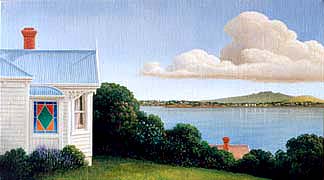
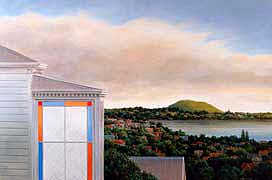
Stillness pervades Peter Siddell's unpeopled cityscapes: not a single leaf flutters in the wind; the voluminous clouds are static. These are the timeless moments of a twilight zone. Laden with nostalgia, a Proustian longing for time past, Siddell's images are also representations of an in-between time of tranquil potency. This is a world, mostly an identifiably New Zealand urban world, poised, not at the twilight of a day's end, but the twilight of a day's beginning. Much has been made, not the least by the artist himself, of the influence his early years as a Herald delivery boy had on the subjects of the adult artist. Walking through the empty streets of suburban working-class Grey Lynn, Siddell saw a world bereft of people, cars and movement. The sun rising, the light and shadows increasing as he journeyed through his paper-round; this is the scene imprinted on the artist's mind. A daily witness to his environment before it sprung to life, he saw his city as it slumbered unselfconsciously, its essence unsullied by activity. A young boy walking alone wondering what possibilities lay behind that closed door, that covered window, occasional glimpses of interiors whose objects hinted at other lives lived. This voyeuristic pleasure fed his imagination, as it now feeds ours. The "tranquil potency" of Siddell's cityscapes also has an unnerving edge to it. It is as if some alien force has lifted all sentient beings (and their cars, telephone and electrical wires) from their homes overnight leaving only one lonely omniscient being to record what remains. His streets and houses, the topography seems well-known but the details initially so reassuringly familiar are finally confusing as each new piece of information contradicts the last. The parts refuse to add up and fulfill our expectations. The painting removes itself from immediate recognition the more we look at it until what was familiar becomes confusing and unfamiliar, demanding re-evaluation. The hyper-realism of the images misleads the viewer into expecting veracity. The works appear to represent real places; but they are to use Roger Blackley's term, "scrambled simulacra''1
REGIONALISM: LIVING IN AOTEAROA In America there was a strong regionalist movement during the 1930s and 40s artists such as Andrew Wyeth, Grant Wood, Thomas Benton, and in some regards Edward Hopper, exemplified this focus on the local. Like the New Zealand artists they concentrated on the landscape, but unlike them, they introduced elements of urban life and people into the narrative of their images. The paintings of Peter Siddell have links to the New Zealand and American regionalist traditions. He shares with them both a concentration on the world in which they live, a desire to represent that which is familiar and particular to their space and place. "Regionalists" usually depict the everyday scene, the commonplace, rather than the heroic moment. Siddell deliberately avoids narrative content by absenting people from his scenes and he differs too from the Americans in that there is no overt political comment in his work; his social comment, if there is indeed any, is ambiguous. He depicts an idealised city; for to exclude cars and people and lamp posts and power poles, is to comment on their presence in reality by their absence in his imagined vision. But is he critical of contemporary urban life? It is more as if he wants to appeal to the viewer on another level. He wants his works to be timeless, undated and unfettered by the fashion inherent in depictions of people or their cars. His refusal to locate his images in a strictly identifiable time or place (being familiar but not accurate representations of actual locales) he pushes the works close to the edge of surrealism, heightening both their "nostalgic" appeal and their fascinating disorientation. Taking time out of his image, he gives his viewer "time out" a time, and a place unencumbered by temporal concerns. No longer denigrated in this, the age of post-colonialism, regionalism is rather re-interpreted as a desire to resist the domination of the Anglo-American culture÷an attempt to define one's own identity in one's own terms. Siddell, is self-taught and came to professional painting relatively late in life (he held his first exhibition at the age of 37); he is regionalist in this sense: he is an artist living in New Zealand, drawing on New Zealand artistic traditions to depict predominantly New Zealand images. However, he is not just that÷as this exhibition shows his eye has now turned toward more international sites.
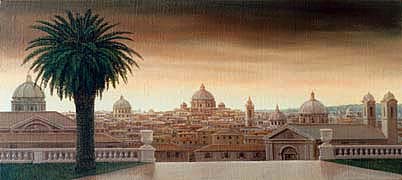
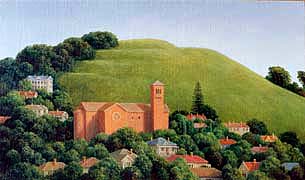
TURNING THE LIGHT ON EUROPE Using a small, almost postcard-like format in these images of Italian and French cities, Siddell again imbues his images with skies that are paradoxically expressive and static creating an otherworldly light that transforms and elevates the commonplace. In Borghese the campanile and domes of Rome are silhouetted by the glow of the morning (or is it evening) twilight; above this band of light cowers a sky heavy with grey and the image is heavy with portent, of what? Ambiguity surreptitiously underpins these works of apparent simplicity. It is in comparing these "foreign" images with local images that we gain further insight into the ways in which these paintings work. In Borghese a palm tree stands sentinel over the silent city, its natural jagged form simultaneously echoes and contrasts with the smooth, perfect man-made domes. In Arno tall cypresses echo the form of the campanile, similarly in St Michael's Mount a conifer to the right of St Michael's bell tower stands parallel, its dark green contrasting with the softer green of Mt Hobson and in Waitemata it is a cloud that duplicates the form of the volcano. Whether a conscious device or an unconscious drive towards ordering, this mirroring of forms, of architecture and nature, subtly but convincingly infuses Siddell's images with a conviction of harmony. These are glimpses, unreal glimpses, of a world in balance. For all their apparent truthfulness this is an idealised world that works its seduction on the viewer. In early works such as Suburban Street, 1970 his propensity to place houses in the almost "embrace", of the hills and volcanoes of Auckland is apparent, as is his practise of undercutting the "safety" of the image by instilling, literally, an air of unreality÷that disturbing stasis. His panoramas powerfully evoke Auckland the isthmus÷a city crowded onto a narrow neck of land, surrounded by water, prey to the microclimate of its unique geography. In panoramas such as Rangitoto his skill and perception in touching his works with mood and meaning through the sky, clouds, light and shadow reaches levels of virtuosity. The contrast of the high-rise city with suburbia is harmoniously anchored by omnipresent Rangitoto. Perhaps it is the influence of his childhood in Grey Lynn, or an inherent longing for the past, for whatever reason Siddell excels in his depiction of old villas. Always immaculately maintained-no peeling paint on their timber boards, no rust on their iron roofs-the meticulous presentation of these villas adds to the unreality of the image. Unlike Siddell's ordered, well-presented Auckland, the reality is a hodge-podge of styles and standards of presentation. Siddell's urban images represent the reality we long for, a reassuring order lacking in the chaotic rush of our every day lives. In Blue Glass the glass door opens out to a world most of us long to exist in. Sunlight streams across the polished boards and Persian rug, the balcony beyond the door invites our presence, beyond lies a road bordered with trees and well kept villas, no cars, no lamp-posts, electricity and phone wires, no bike riders, no boats in the harbour no traces of the disruptive presence of men and women disturb our luxurious sense of space and light. We can breathe this clear air, we can hear the silence, we can relax . . . or can we?
THE THRILL OF THE TWILIGHT ZONE Is it that traces of the vision of the boy, now expressed through the man, pervade these images? Is it that the power of self-presence that we the viewer feel in these images is both exhilarating and frightening? Is it that the harmonious order and beauty of these works is undercut by their emptiness and absence of human presence? There is something both reassuring and disturbing about Siddell's work it is like a good thriller it's that psychological disruption concealed by apparent normality that maintains your interest. |
||||||||||||||||||||||||||||||||||||||||||||||||||||||
|
|