|
FROM A DISTANCE
FOUR PICTURES FROM AN EXHIBITION In November and December 1998 I held an exhibition of paintings called From a Distance at Artis Gallery in Auckland New Zealand and I have included photos of four of the paintings from the exhibition and some accompanying notes. The painting Gulf had previously been included in a touring exhibition Re-Visioning the Real and at the bottom of the page I have included an excerpt from the catalogue for that exhibition. |
|||||||||||||||||
|
|
||||||||||||||||
|
|||||||||||||||||
|
|||||||||||||||||
|
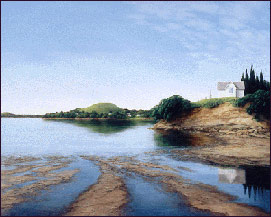
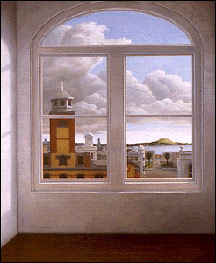
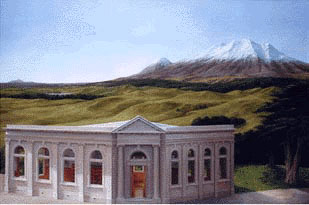
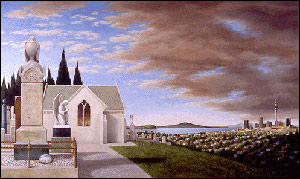
FROM A DISTANCE The distance of separation; the distance of time A number of reasons made it feel appropriate for me to give this exhibition of paintings the title From a Distance.; While there is obvious attempt to create an illusion of spatial distance I am also concerned with the separation and distance of time. In his last TV interview Denis Potter spoke about nostalgia not being just sentimental wallowing but drawing on deep reserves to sustain a creative present. Like many artists I delve into memories of childhood experience. I thought that a few notes may assist as a guide to how I currently approach my work. However, they are not meant to be a definitive interpretation of my paintings as that must be made by each individual viewer. The painting Separation came about following a journey through the North Island of New Zealand. Travelling past the mountains of the central plateau with a glimpse of Mt Taranaki far to the west I recalled the story of how Taranaki and Tongariro had both loved Pihanga and how, after Tongariros triumph, Taranaki in anger had fled to the west with the course of the Whanganui river marking his path. In his separation Taranaki still weeps. In the shadow of Ruapehu is Raetihi, once a thriving regional centre. Like many other small rural towns, there is now a real sense of separation from the rest of New Zealand. The ambitiously grand and solid buildings which once housed the post office, banks, theatre and municipal offices are now tea rooms and craft shops. The mountains of Tongariro National Park which I have represented in this painting are where I started tramping and climbing as a teenager. When I was a young man mountaineering was for many years the driving passion in my life. The mountains I have painted here are the remembered hills of my youth forever separated from me by the distance of time. The window in the painting Looking Out acts as both a pathway and a barrier to the recollected and reassembled architecture of my childhood - a place where I cannot go again - as is the landscape of Point of Departure; a remembrance of papa cliffs and mud flats and childhood hours playing on the fore shore of the Manakau Harbour. As a small boy I can remember Sunday afternoon visits to cemeteries when my mother, who owned a car would drive elderly friends after church to visit the graves of their loved ones. While the adults would do their grown up things my sister and I would play among the head stones. In the 1970s I painted a series of works from these memories. Twenty five years later I am using the same information from my original drawings and sketchbooks. But the paintings are as different as the times. Then my young children played in my studio. Now I have the company of my grandson and my elder daughter lives in a distant country. Today the remembrance of being Peter Siddell 1998 |
|||||||||||||||||
|
PETER SIDDELL: FROM A DISTANCE Everywhere in light and calm the murmuring Peter Siddell has selected four sites for this exhibition- physical sites arising from John Daly-Peoples |
|||||||||||||||||
|
AN EXCERPT FROM A CATALOGUE Begin with Peter Siddell's Gulf (1998). In the foreground, there is a cemetery, what one might term a place of monuments for the dead. In the background, Auckland's cityscape, what one might term a monument to the living. What can Siddell's Gulf possibly be? Is it the space between life and death? Or the one between the lure of life, suggested, perhaps, by the Sky Tower, against its inescapable finitude found in Virgil's chiselled pronouncement, Forsan et haec olim meminesse juvibat - Perhaps even these things will someday give pleasure to recall. Or is Gulf merely reflecting the immediacy of place, the reality of the Hauraki Gulf, made specific, in part, by Rangitoto's identifiable form rising near the painting's centre? It is all of these and none. The true meaning of the work, Siddell's intention, is forever hidden from us. It is here that one might first position what I am terming "the real", which is what one is left with when everything one might imagine about the work, and everything that the work might symbolise, is left behind for this double reading. In coming to terms with the fact that "between our reading of the work and the work itself the real intention of the work is excluded", the viewer can also come to the fact that their real experience of the work comes precisely from this undecidability. And this is written on the surface of the painting precisely insofar as there are always already two intertwined possibilities at play - life and death, movement and stillness, clear sky and cloud. It is as if Siddell is telling us that there is a real, but it is a subjective, personal one, based on our pathways through the choices he portrays. Brett Levine. |
|||||||||||||||||
|
|