|
|
|||||||
|
|
|
|
History |
|
|||
|
Early History Of Malacca Portuguese
Settlement
Fr.
François made an appeal to the British Resident Commissioner in
Malacca, Mr. Reginald Crichton. He was so moved by the plight of the
community that he decided to put them in a place where they could be
preserved for future generations. Rev. Fr Alvaro Coroado, a Portuguese
priest played a good part in persuading the people to move into the newly
created Settlement. Initially, a few responded and built their own
houses there, along the present
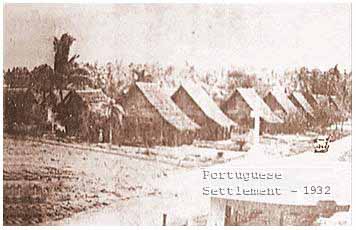
These houses were
spread out in neat rows, each with its own compound. Narrow streets
divide each row of houses. As the people are of Portuguese decent it
was found appropriate to name most of the streets with honoured Portuguese
names. Approaching the Settlement from Ujong Pasir, we are greeted by
the road sign, D'Albuquerque, who laid the foundations of the Portuguese
eastern empire. He subdued Malacca, and remained here for a year. Sequeira Road enshrines
the memory of Diogo Lopez de Sequeira, the Portuguese Admiral in charge of
the first European fleet which keels cleaved Malayan waters. He sent
one of his officers ashore to deliver present and a letter to the Sultan of
Malacca. Another road bears
the name of Texeira. This Texeria was the Officer sent ashore by Diogo
Lopez de Sequeira to deliver the presents and the letter to the then Sultan. Aranjo Road honours
Ruy di Aranjo, who was made a prisoner in Malacca. He wrote to D'Albuquerque
mentioning that the Sultan had no intention of giving the prisoners up, and
also to attack Malacca before the town was fortified. The original
Government-built houses were wooden, with attap roods and earthen
floors. Each house consisted of a verandah, sitting room, one bedroom,
a kitchen and a bathroom. there was neither electricity nor water
supply then. Water was provided by public stand pipes. Improvements
materialized during the tenure of the Regedor (headman), Mr. Paul de Silva,
1953-1973, and the then Secretary - Mr. George Bosco Lazaroo. Through
their efforts, the attap roofing were replaced with zinc. The earthen
floors were cemented on a self-help basis, with the Government providing the
cement and sand, while the tenants did the labour. The main streets
were provided with electric lighting. the thought of the nearness of
electricity to their homes spurred the people to avail themselves of the
facility. The people slowly began to install electric lighting to their
homes, until finally all the homes have been electrified. Similarly,
water supply crept into the houses. In this respect the The flourishing of
the Portuguese Settlement attracted many pensioners and other Eurasians to
build their houses in the Settlement. They obtained land from the
Government on Temporary Occupation Licence and built their own houses.
Many of these new houses are modern in outlook and were fitted with modern
sanitation. Today the number of owner-built houses in the Settlement is
40. Governemtn-built houses to the tenants, while the lands were given on
Temporary Occupation Licence, with a nominal rent of $1.00 per annum.
By so doing, the Government relinquished its responsibility for maintenance
as well as paying rates to the
It must however, be clarified here, that the rents collected from these
houses did not go into the Government coffer, but were utilized for the
payments of rates, with the balance accruing to a Welfare Fund for the
Portuguese Settlement. The sum accrued to the Fund amounting to
approximately $4,000.00 was handed over to the Portuguese Settlement
Committee after the Government surrendered ownership of the houses to the
owners. Settlement opened in 1930. |
|||||||