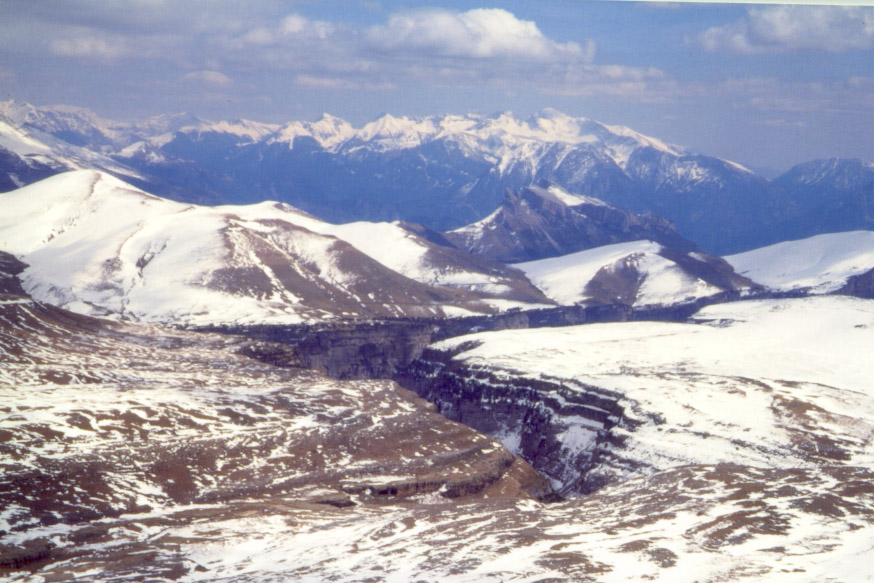
We find in the heart of the Pyrinees the highest limestone massif in Western Europe , its peaks are : "Tres sorores,""Monte Perdido", "Cilindro de Marboré", and "Soum de Ramond" and the valleys of "Ordesa", "Escuain" "Añisclo " and "Pineta" star here.
Both the complicated morfological and geological history and the hard climate have contributed to form high summits and gradient mountain slopes. The landscape is rich : the arid high summits contrast with the green valleys full of vegetation and water falls that cross canyons and gullies. It is this great variety what gives the park its unique and exceptional beauty.
The Pyrinees were not the mountains we can see today, but a sea basin filled with the silt from eroded neighbouring lands which the Hercinian orogenesis lifted 260 million years ago forming an ancient range of mountains, what we call the "Pirinee Axis" . By the end of the secondary and the beginning of the tertiary era new limestone sediments were laid in layers , again the Alpin orogenia lifted the "Pirinee axis" and pushed the limestone sediments upwards 35 million years ago. Nowadays we can see this limestone range of mountains, it is the so called "Sierras interiores" and this is where "Monte perdido" is . The glaciers of "Monte perdido", "Ramond" and "Marboré" are vestiges of past ice ages. The action of these agents carved U-shaped valleys -whereas river valleys are in "V"- and small basins where lagoons like "Turracoya", "Monte perdido" and "Ramond" were formed.
These unique limestone produced maginificent carvings, such as
passes, narrow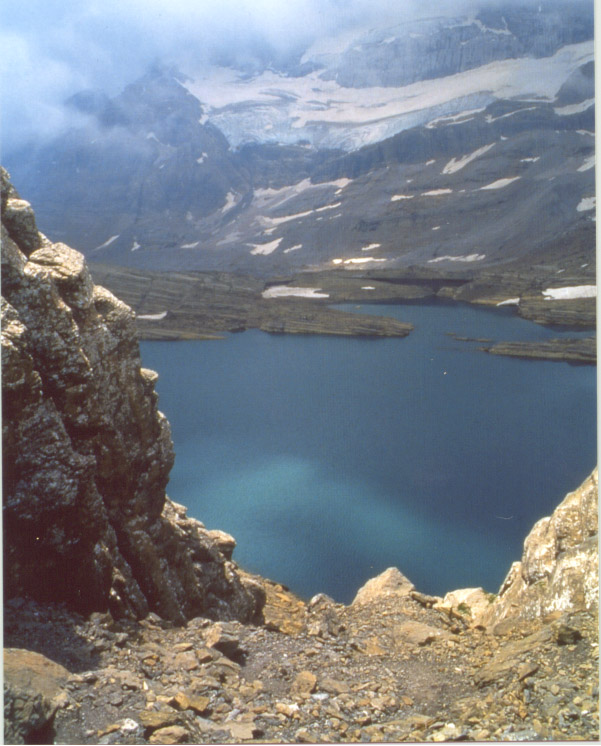 gorges, cave, potholes, and a
complicated network of underground rivers whose limy waters
narrow their channels forming "lapiaces" like those of
"Salarons" and "Calcil".Lots are another
characteristic in the park ,they are terraces modelled by erosion
that stick out from the rocky cliffs.
gorges, cave, potholes, and a
complicated network of underground rivers whose limy waters
narrow their channels forming "lapiaces" like those of
"Salarons" and "Calcil".Lots are another
characteristic in the park ,they are terraces modelled by erosion
that stick out from the rocky cliffs.
The climate in the park is the typical from
the Pyrinnes, though the wide altitude gradient, ( from 750 to
3355 ) , exposures and winds produce many variations. As a
general rule we can say there are big contrasts between day and
night , and summer and winter. Summers are hot and stormy whereas
winters are cold with a lot of snow. With calm winds there is a
temperature inversion, then the cold air remains down in the
valleys and the sun warms the summits . this phenomenon affects
to the distibution of life-forms and communities .Though it's
rainy ( between 900 and 2000 mm per year ) it isn't as much as in
the French slope, as the North slopes create a shield against the
Oceanic storms.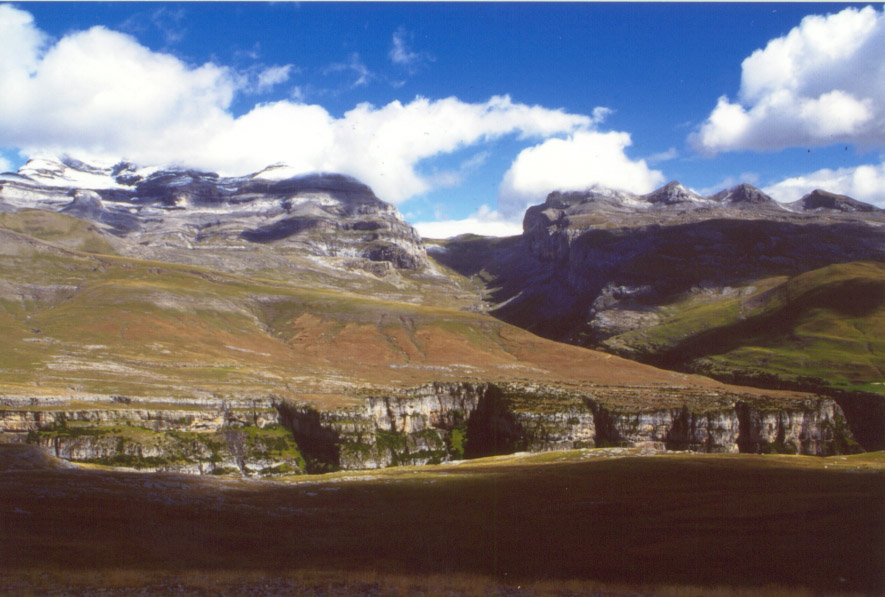
The zooligical escale keeps a strong relantioship and dependency with plants. The species that live in the mountains have to adapt themselves to the gradient slopes and the hard climate. They have developped legs wich can adhere to rocks , strong lungs and muscles, shed coats, abundant feathers , red globules and in many cases the ability to become drowsy in winter.
If we consider the fauna we find the different biotypes in the park :
1.-Ravines and torrents:
The waters are oxygened so there are lots of Salmo trutta fario . It's the place where the Cinclus cinclus and the Motecilla alba and cinerea can get food . It's the habitat for the Galemys pirenaicus, the only species in the world that catches insects and larvas under the water and emerges to the surface to taste them. The Euproctus asper live in the small ponds,but in winter lives underground . The Rana temporaria and Rana pyrenaica live in the same habitat. The Rana pyrenaica is endemic of the Pyrinees and was discovered in 1990 in the surroundings of the Park. In pools we find the Alytes obstetrician who carries its eggs in its legs and the Bufo bufo .
2.- Holm oak woods :
Lots of birds build their nests in the hole of the trees , like the Certhia brachydactila, Picus viridis, Parus spp that eats insects , mainly mosquitoes.We can see Accipiter nisus, Regulus ignicapillus, and Garrulus glandarius in the higher branches of the trees . The Strix aluco keeps watching and hunts its preys at night. among the mammals, the Crocidura russula and the Genetta genetta.
3.-Woods:
The Dendrocopos leucotos is a rare specimen that lives in the cold woods of Europe , the Drycopus martins builds its nests in the dead trunks and with its long beak looks for insects and larvas. The Tetrao urugallus lives in the quietest areas , this is a strange animal with its secondary characters very differenciated , it ieats barks and pine leaves and males start their flight at dawn in spring.
In the most humid areas of the woods the sitta europea builds its nests in the holes of the trees . The Erithacus rubecula and the Turdus merula hide in places with much vegetation . The Caprimulgas ruficolis live in these areas too , and it's worth mentioning its nocturnal habits.
Interesting species
We must point out three very siginificant species in the Park :
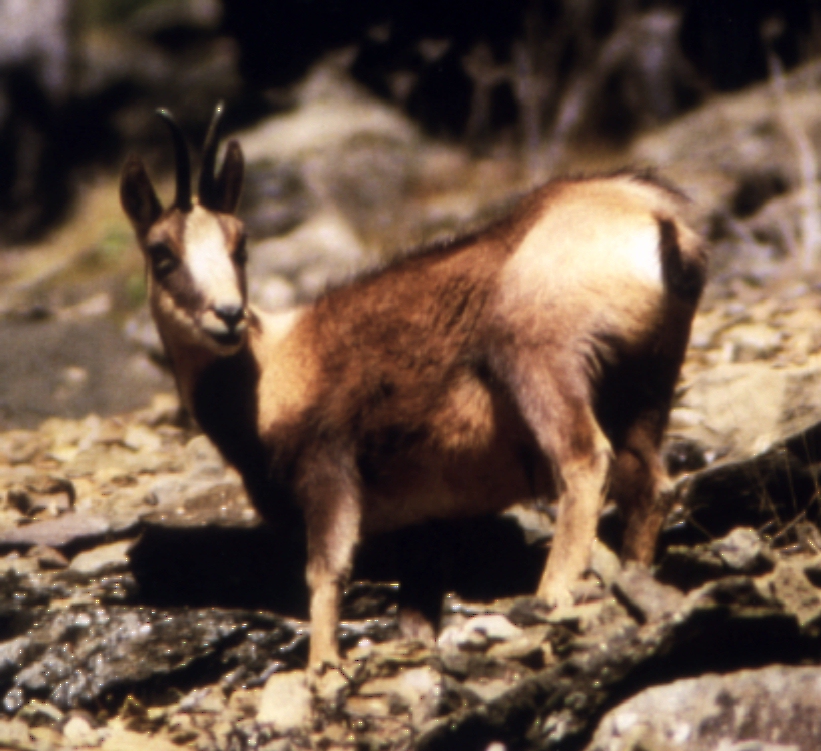
1.-Rupicapra, rupicapra pyrenaica :
It is called "Sarrio" in Aragón . It is always alert , and since it is very young keeps watching and runs away when is in danger. Its alert voice is a penetrating whistle wich ca be heard from far away and alerts all its congeners. Thanks to a protective policy the number of sarrios is increasing considerably .
2.-The Capra pyrenaica pyrenaica :
 This type of goat is different from the
other wild goats , it a subspecies and has got a very important
zoological interest. for a very long time a small colony of Capra
pyrenaica lived in the park , but because high consanguinity
the number of animals has been reduced. In 1995 there were three
females , one of them died a year after , a hybridation was tried
with another specimen but failed. Samples of epithelial tissues
and blood from the last specimen were taken , cultivated and
frozen in a laboratory in Zaragoza, with a view to clonation .
This last goat died in January 2000 and with it the last pirenaic goat.
This type of goat is different from the
other wild goats , it a subspecies and has got a very important
zoological interest. for a very long time a small colony of Capra
pyrenaica lived in the park , but because high consanguinity
the number of animals has been reduced. In 1995 there were three
females , one of them died a year after , a hybridation was tried
with another specimen but failed. Samples of epithelial tissues
and blood from the last specimen were taken , cultivated and
frozen in a laboratory in Zaragoza, with a view to clonation .
This last goat died in January 2000 and with it the last pirenaic goat.
3.-"Quebrantahuesos" ( Gypaetus barbatus )
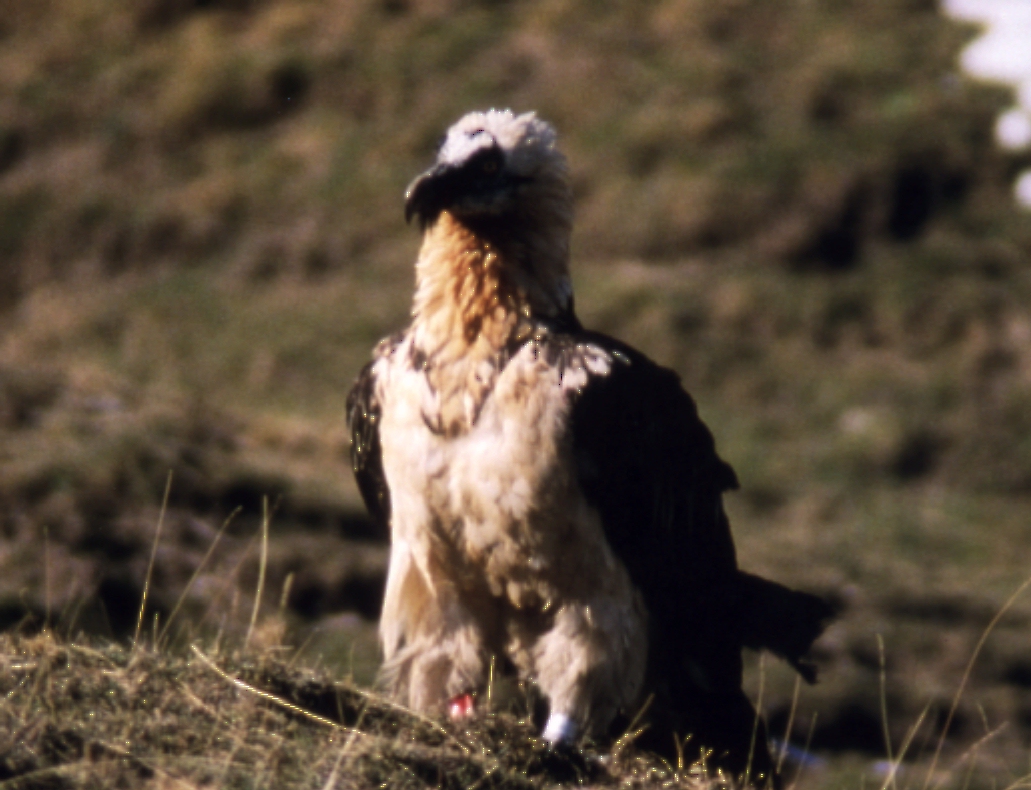 It is a bird of prey that belongs to the
same group as the vultures . It gets its name because the way it
gets its food , it eats the bones of his prays but before it
drops them from high to break them into pieces and eat them easily. It lives in cliffs where it finds caves and cornices to
breed. By the middle of the XX century there were some Gypaetus
barbatus that lived in Spanish mountains , but because
illegal hunting , poisson, and the destruction of its habitat to
build it's almost extinguished . Nowadays there are some in Crete, Corcege, and the
Pyrinees.
It is a bird of prey that belongs to the
same group as the vultures . It gets its name because the way it
gets its food , it eats the bones of his prays but before it
drops them from high to break them into pieces and eat them easily. It lives in cliffs where it finds caves and cornices to
breed. By the middle of the XX century there were some Gypaetus
barbatus that lived in Spanish mountains , but because
illegal hunting , poisson, and the destruction of its habitat to
build it's almost extinguished . Nowadays there are some in Crete, Corcege, and the
Pyrinees.
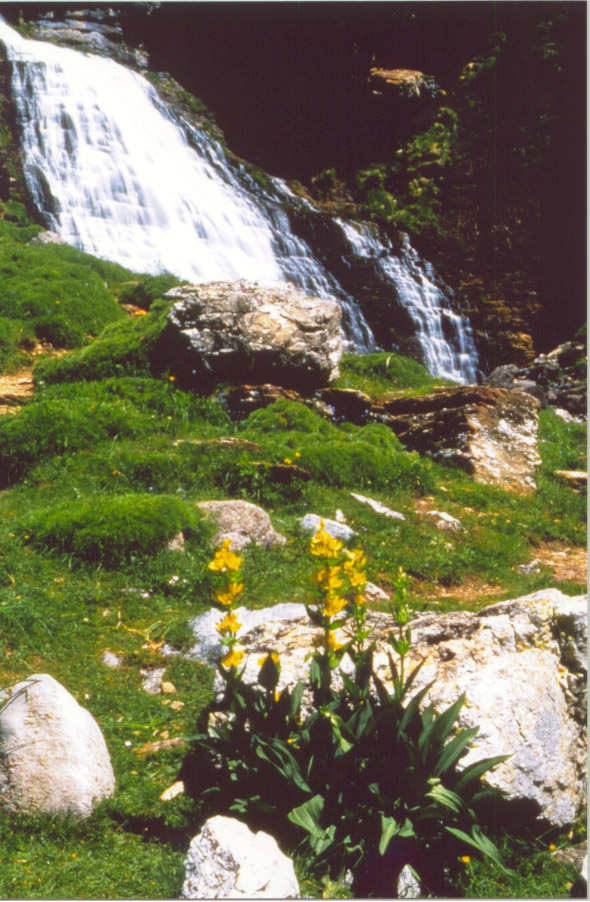 Both flora and fauna are highly conditioned
by climate and geomorphology. Over 1,500 plant species dwell in
this area . Ordesa and Monte Perdido might well be described as a
huge and unique alpine botanic garden , where endemic and non
endemic species coexist.
Both flora and fauna are highly conditioned
by climate and geomorphology. Over 1,500 plant species dwell in
this area . Ordesa and Monte Perdido might well be described as a
huge and unique alpine botanic garden , where endemic and non
endemic species coexist.
According to height we can distinguish three big groups of vegetation :
1.-Submediterranean
2.-Montane
3.-Alpine
The park in autumm changes with a great profussion of colours that range from the green of pines, the yellow and red of birches and maples to the coppery beeches.
DISTRIBUTION OF THE MAIN COMMUNITIES IN THREE VEGETATIONS LAYERS BY ELEVATION
Submediterranean ( from 600 to 1,000 or 1,600m ) At this level we find mainly mid mountain holm-oak woods. These areas are mild and dry, though due to the narrow gorges where mists remain and produce humidity, there is temperature inversion, and we find in lower levels species and group of communities which usually grow in higher and colder areas. this is the case of the Quescus ilex and the Quercus rotundifolia. the Quercus faginea and Quercus puebescens grow in sheltered areas together with holm oaks and box. |
Intermediate montane ( 1000 or 1,300 to 1,700) From 1000 to 1,500 : Beech-fir forest is the characteristic vegetation at this level , we may also find Mesophilous Scotch pine forest and dry pine forest with hedghog broom in drier areas. From 1,500 to 1700 : Mountain pine forest with grassland forest or thorn forest with hedgehog broom on windy crestlines. |
Alpine From 1,700 to 2,200m : Subalpine mountain pine (Pinus uncinata) forest. In drier areas Upper-montane, Mediterranean mountain-pine forest From 2,200 to 2,800 : Typical alpine pasture and in dry areas upper-montane,Mediterranean pasture. From 2,800 to 3,355 : Snow line level with variations . Solid substratum. |