 P.E.M.’s Objectives
  P.E.M.’s Objectives
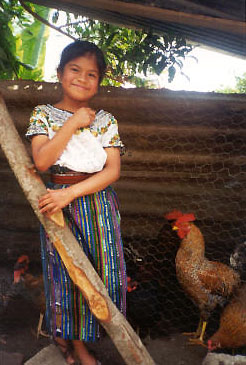
 The
foundation of P.E.M. in December 1993 was primarily motivated
by the catastrophic situation of school education in Guatemala.The
public schools are not free and the school fees too high for the
extremely tight budget of Indigenous families. Consequently, many
children only attend classes irregularly and less than half of
all students graduate from primary school. Too poor to learn how
to read and write these children are needed by their families
as additional workers.
The
foundation of P.E.M. in December 1993 was primarily motivated
by the catastrophic situation of school education in Guatemala.The
public schools are not free and the school fees too high for the
extremely tight budget of Indigenous families. Consequently, many
children only attend classes irregularly and less than half of
all students graduate from primary school. Too poor to learn how
to read and write these children are needed by their families
as additional workers.
P.E.M. is committed to help improve
these inadmissible circumstances by using donations from people
like you to pay for the entire school education of Indigenous
children from San Antonio Aguas Calientes. It is P.E.M.’s
goal to help young women and men graduate from high school with
a diploma permitting them to immediately start working in their
specialty.
Since its foundation P.E.M. has
had three successful graduations: Hilda Lopez (graduated
in 1996) is working as a bilingual secretary in a Spanish and
Mayan Language School in Antigua. Gregoria Xicay Pichola
(graduated in 1998) is working for the Guatemalan government in
the field of rural development. She teaches women how to
open small businesses in the food industry to improve their miserable
living conditions. Silvia Salazar (graduated in 1999) is
shop manager for an international ceramic business in Guatemala
City. All three young women are now pursuing univer sity
degrees. Thanks to their steady 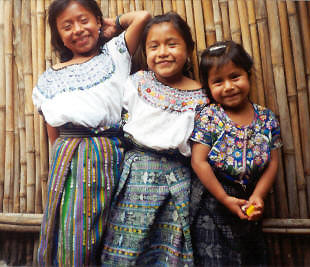 income
they can afford to pay for their higher education. P.E.M.
aims to increase the numbers of these successful graduates whose
lives have been markedly improved by their access to a continuous
education.
income
they can afford to pay for their higher education. P.E.M.
aims to increase the numbers of these successful graduates whose
lives have been markedly improved by their access to a continuous
education.
Since its foundation, it has always
been P.E.M.’s aim that the project be run autonomously by
the parents of San Antonio Aguas Calientes. This goal has
successfully been achieved and put into practice for the past
three years thanks to the dedicated efforts of parents and former
graduates who are regularly advised by foreign representatives
in Europe and the United States.
Thanks to the voluntary cooperation
of local project families and foreign representatives 98% of donations
are directly used for the schooling of Indigenous youths.
Approximately 2% are used locally for administrative costs such
as office supplies.
 |
Back to Home Page |