| THE SOVIET UNION IN THE SPACE RACE | |
|
Well, for this section I had tried to devise a way other than list a bunch of reference dates for you, but that is the way it is going to be. In 1957 the USSR launched the statelite Sputnik into space, where it would orbit Earth. Sputnik was the very first man-made object to ever have gone into space. 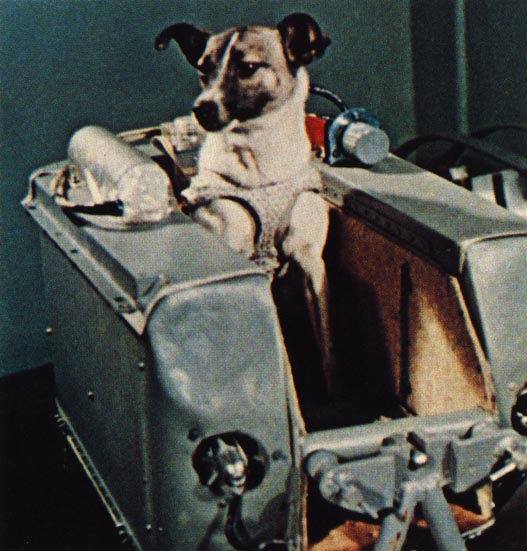
Merely one month later, in November, the Soviets launched Sputnik 2 into orbit. This statelite, however, had transported the first Earth-born living being in to space. She happened to be a small dog named Laika (pictured above). Oh, I have noticed that one of you people out there was referred to my site by typing into your search engine, "What happened to Laika the cosmonaut dog?" It was then I realized that I had never quite told you what happened to her. She lived for a handful of days in her little orbit, but the Soviets had absolutely no way of getting her craft back to Earth, so she eventually died up there. Don't cry, now. In 1959, the Soviet probe Luna became the first spacecraft to orbit the sun, Luna 2 landed on the moon and became the first craft to reach another celestial body, and Luna 3 was the first craft to return images of the far side of the moon. | |
|
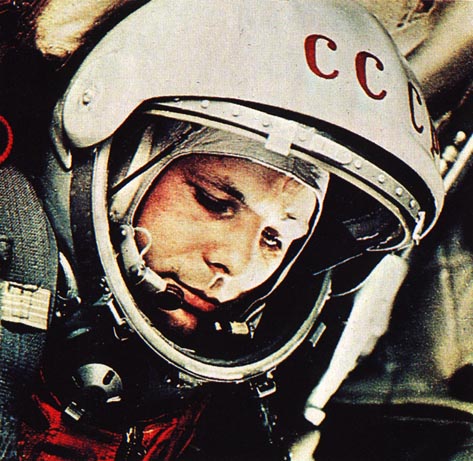
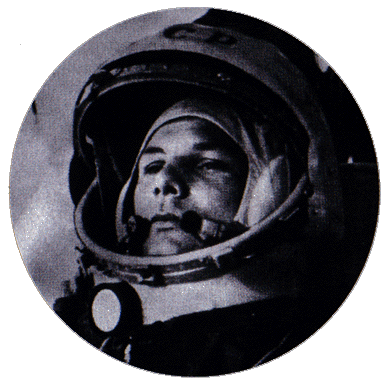
Finally, in 1961, the Soviets had sent the very first man in to space: Yuri Gagarin on board the Vostok (There he is pictured above). But hey, one has to wonder what is the big deal? Yuri only stayed in space for 108 minutes whereas Laika the dog spent seven days up there! But I suppose it is only because people are mainly conserned with records dealing with people... In the year of 1963, the very first woman entered space. She was cosmonaut Valentina Tereshkova who went up in the Vostok 6 (I suppose the Soviet engineers were running short on creativity when it came to spacecraft names...). She orbited Earth a total of 48 times. The very first space walk was performed by cosmonaut Alexei Leonov in 1965 from the Voskhod 2. His walk lasted ten minues. In 1966 the Soviet Luna 9 was the very first craft to relay images of the moon's surface directly back to Earth. Then, a month later in March, Soviet Luna 10 was the first craft to actually orbit the moon. In 1968, the Soviet craft Zond 5 was the first craft that was able to orbit the moon and return to Earth, bringing with it plant and animal life that was used to test the dangers of radiation in space. In 1970, the Soviet craft Venera 7 was the first to land on Venus. In 1971, the Soviets had launched the very first space station which they called Salyut. In 1975, Soviet crafts Venera 9 and Venera 10 were the first crafts to transmit pictures of Venus' surface to Earth. Well, let us see, after the Soviet-collapse, what we pretty much have is Modern Russia. Click here to return to the index |
Copyright � 2001 Yahoo! Inc. All rights reserved. |
