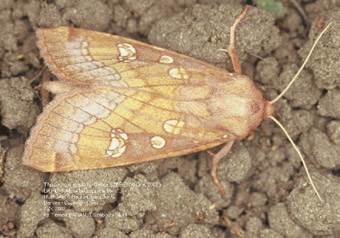
Photo: Gábor Szerényi
Photo: Gábor Szerényi
I checked the only six Peucedanum officialis populations I know from the region for the striking traces of the caterpillar of this strictly protected moth species. Occupied plants show the typical whitish excrements from the caterpillars around the base of the plant. The species was present on all checked populations of its food plant with a minimal number of totally 300 individuals. At least 200 individuals live in the site between Marokpapi and Hetefejercse. This could be one of the most important population of whole Hungary. However, this site showed also the lowest percentage of occupied plants, with often only 3% of the checked plants occupied (1 out of 30), while around Fülesd and Mand, sometimes up to 20% (1 out of 5) of the plants have been occupied. This could be a consequence of the flood in spring 2001, which affected the complete area of Hetefejercse to Marokpapi. During the flood, many of the overwintering eggs could have been affected, they are laid in early October into the remaining leaves around steams of dried grasses. The flood shows the danger of concentrating conservation efforts on only few key sites, which can easily be affected by accidental events impossible to manage or predict. Therefore the detailed survey of all other Peucedanum officinalis populations is very important too. Further, I suggest, that money for compensation of damage to nature caused by the Tisza flood should be used to buy and restore/manage so far unprotected sites with occurrence of Gortyna borelii, mainly in the surroundings of Fülesd!
All known sites for the species should be fully protected. Just recently destroyed habitats (e.g. south of Fülesd) should immediately be restored. The sites must not be mown between July and May to secure the laying of the eggs in dry grasses and the secure overwintering of them. During the time, when caterpillars are feeding in the roots of the food plant, mowing is possible, best in early June. However, it is very advantageous, if several stripes remain unmown to secure successful egg laying (most grasses seem not to produce suitable steams any more after mowing!). As long as Peucedanum officinalis is not decreasing, the sites can also be set aside completely, the moth flies also in open forests (see Garbolc, but only low density). Low intensity grazing seems also appropriate.
Many occupied plants are situated along small, overgrown channels (around Fülesd). These channels should not be changed! If it is of urgent importance for large scale water management, only very careful, sympathetic work should be allowed over at least two years. On freshly reprofiled bankside slopes, Peucedanum seems to germinate quite well (e.g. north of Fülesd)!
Any kind of burning within the occupied sites should be strictly forbidden
and hardly punished! It is deadly for the overwintering eggs! I observed
burning at several places around Hetefejercse.