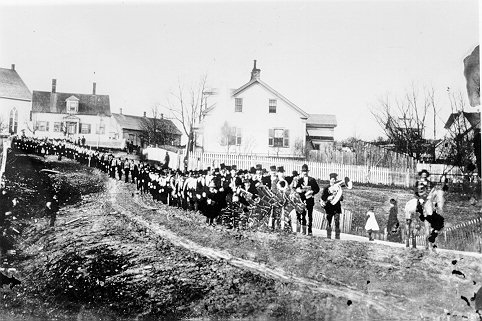
 |
| CANADIAN ORANGEISM ORANGE ASSOCIATION IN CANADA The Loyal Orange Association has played and continues to play a great part in the history of Canada. It is not known when or where the first Orange meetings were held and there are no available records that confirm when the first Orangemen arrived in Canada. There is, however, evidence of Orange activity in the very early 1800s. The majority Protestant population at that time was in Upper Canada (approximately 36,000)many of whom were Orangemen, with or without certificates or warrrants. The Orange Association was officially formed in Canada in the year 1830 in Brockville, Ontario, mainly through the efforts of Ogle R. Gowan who came to Canada from Wexford, Ireland, in 1829. Upon his arrival in Brockville, he immediately took note of the large number of Irish immigrants who lived there and he quickly became aware of the great advance that Orangeism had made in the community and he set out to extend it. On Gowan's initiative, a general meeting of all Orangemen was called at Brockville on New Year's Day 1830. The result was the forming of the Grand Orange Lodge of British America and Gowan was chosen to be the first Grand Master. With the organisation of the Grand Lodge, the Canadian Orangemen created a central governing body which placed the Order under a uniform system of controlling membership, dues, rituals, signs, passwords and the election of officers. The first Orange warrant was issued to Brockville LOL No. 1 which is still in existence today. MILITARY LODGES But Orangemen were in Canada long before the first Orange Lodge was formed. The first Orangemen in Canada were military soldiers. Orangeism was introduced in Saint John, New Brunswick, by the medium of military lodges. Most of the British warships and regiments carried with them Orange warrants during the period of 1818-1824. Gowan himself, was a Lieutenant-Colonel and he commanded the Queen's Royal Borderers. He was wounded at the Battle of the Windmill, near Prescott, Ontario, in 1838 while Canadians were defending themselves from an attack from the United States. BATTLES AND REBELLIONS There is evidence to indicate that Orangemen were with General James Wolfe at the Battle of the Plains of Abraham in 1759. Orangemen fought with General Isaac Brock at the Battle of Queenston Heights in the American War of 1812-1814. Orangemen fought with the Queen's Own Rifles and helped to hold back the Fenians at Ridgeway, Ontario, in 1866. An obelisk there marks the spot where Orangemen died in defending their country against the Fenian invaders. The Grand Orange Lodge of Canada had to postpone its meeting that year because over one thousand Orangemen were at the front. Orangemen played a big part in suppressing the Upper Canada rebellion of William Lyon Mackenzie in 1837. Though the rebellion was but a skirmish and short-lived, neverthless, 317 Orangemen were sworn in by the Mayor of Toronto and they resisted Mackenzie's march down Yonge Street in 1837. Orangemen were in western Canada during the rebellions of Louis Riel in 1870 and 1885. Riel had an Orangeman, Thomas Scott, killed and he himself was executed by the Macdonald government. Go to page 2 |
|