





|
|




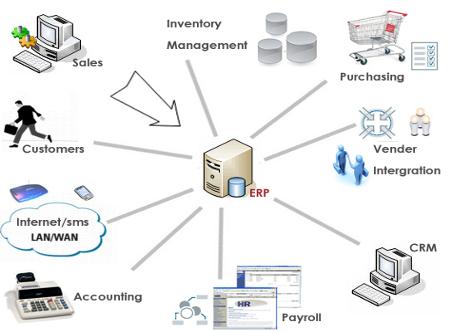
what is CRM and ERP software?ERP, which stands for Enterprise Resource Planning, is central to your company’s business management responsibilities. ERP Software typically features integrated modules like Marketing, Field Service, Production Management, Inventory Control, Procurement, Distribution, Supply Chain Management, Human Resources Management, Finance, Invoicing and Accounting. CRM, which stands for Customer Relationship Management Software, helps your business administrate and manage customer relationships. Typical CRM Software typically features integrated modules like Sales Force Automation, Customer Service, Call Management. Below is the brief pictorial description of how ERP works.
|
|
ProSys ERP, Division of ProSys Infotech partners with various companies to plan, build, and manage application software to enable their business strategies. ProSys ERP develops ERP solutions that transform the way people work & communicate. Our ERP solutions help to automate your business processes and leverage technology to unify your pan-enterprise functions. Seer is an IT Company specializing in the field of ERP, Product Development, Quality Management and Testing. The team has worked building ERP and other products for manufacturing and retail firms, evaluating software applications and its performance on various environments and architectures. ProSys ERP team consists of experienced Product Managers, Developers, Quality ProSys ERP has established a reputation of maintaining outstanding level of satisfaction to its clients in terms of deliverables, code of ethics, good customer care and Project Management. |
|
The need for cutting edge ERP solutions is becoming crucial in this information age. This is accentuated by the fact that even the most fundamental market philosophies are changing rapidly and radically. Market for almost all products / services has become truly global. Another important factor that is driving the demand for ERP solutions is the changing characteristics of customers. Customers, who have become more knowledgeable of the various choices in offer, have come to expect better quality, faster delivery, highly customized products, and enhanced support services. Delivering all these to customers is getting more difficult with the consistent entry of new players in the market space, competition getting stiffer and enterprises losing its regional domination because of globalization. An economical and efficient ERP solutions offering is the need of the hour. With the help of such ERP solutions, enterprises are increasingly looking at sharing relevant business process-related information with its business partners quickly and accurately. This not only allows all the partners involved to take decisions quickly and plan out actions according to the changing market compulsions, but also decreases the overall risk factor. Quest for the ideal IT support Hence, enterprises with a global outlook are making a beeline for implementing cutting edge ERP solutions, which goes much beyond the focus of traditional ERP solutions. This is rendering the vast majority of the current ERP solutions obsolete from both architectural and business importance viewpoints. So we see an increasing demand for both ERP II (from large enterprise) and advanced ERP (from SMEs) solutions. |
|
So what can ERP do? ERP automates the tasks necessary to perform a business process—such as order fulfillment, which involves taking an order from a customer, shipping it and billing for it. With ERP, when a customer service representative takes an order, he or she has all the necessary information—the customer's credit rating and order history, the company's inventory levels and the shipping dock's trucking schedule. Everyone else in the company can view the same information and has access to the single database that holds the order. When one department finishes with the order, it is automatically routed via the ERP system to the next department. To find out where the order is at any point, one need only log in to the system. With luck, the order process moves like a bolt of lightning through the organization. ERP handles all aspects of organization viz. Finance, Inventory, Production, Quality Control, MRP II&Sales, purchase, distribution, I Machine/Operator monitoring & utilization, Excise, Personal & Payroll. Sometimes it may not be possible to implement such a extensive software in one stroke, but one can start with the basic essential modules and at the later date, when required can upgrade the system by building the upper layers or implement independent modules of their choice. This ensures the continuous growth of the system in place along with your business. ERP is highly parameterized hence most of the requirements of your organization are satisfied however it can be customized to any extent considering all the peculiarities of your business, it means system adapts to your practices and not you. |

|
If you have any queries, Mail us at [email protected]. We will get back to you immediately. |