
<< Back to About Me
My Reflections
Ocassionally, I have had reasons to pause and reflect on my work (and a sundry other things in life). Especially during those silent, droopy dull moments when I couldn't justify whatever I was doing right then. Or while discussing "art" at various internet fora. Since you have dug deep enough to reach this page, I would welcome you to take a read through these issues. Thanks, eternally!
Reflections now and then
Birth of a painting and...
the act of creation.
 When
painting reclaimed me (I am 34 now, this is 2004, I am four years into painting, having spent nearly half a life in pursuit of other interests), restless visions exploded inside of me, one after another, and I could hardly wait to record those on
canvas. But I have never had proper schooling
in the craft of painting, was technically inequipped, and didn't want my works to be intellectually
manufactured, that is, spawned out of
a conscious process of image building. I simply painted whatever I saw inside
my head.
When
painting reclaimed me (I am 34 now, this is 2004, I am four years into painting, having spent nearly half a life in pursuit of other interests), restless visions exploded inside of me, one after another, and I could hardly wait to record those on
canvas. But I have never had proper schooling
in the craft of painting, was technically inequipped, and didn't want my works to be intellectually
manufactured, that is, spawned out of
a conscious process of image building. I simply painted whatever I saw inside
my head.
What I saw were not lines, dribbles, patches or splotches - but real physical objects. Like people or landscape reflecting real light, and mostly obeying the observed laws of physics. In short, the outside world I saw (or perceived) was internalized and adapted to contextually fantastic settings. This was a process of subconscious and automatic image creation. But like a bumbling ameteur, who hardly knows when to hold back, I plodded on and on and 'recorded' a good many of those visions.
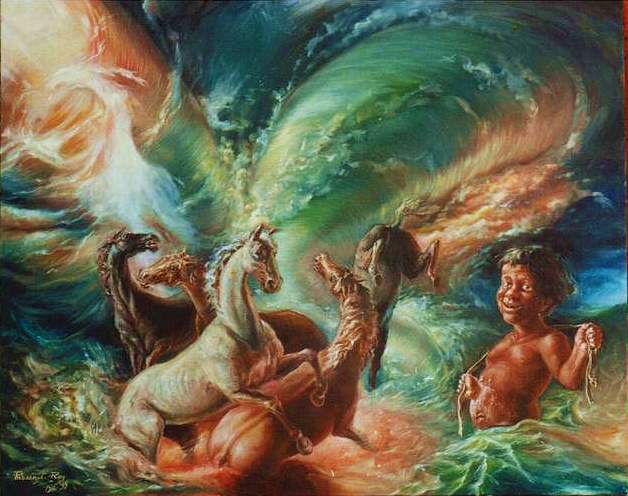 Now,
when I look back at some of these older works, I am mostly aghast at my ineptitude
as far as skill is concerned. But they are historically relevant (my personal history, of course!), and that gives me some respite. What
I am doing now is different...I look at ordinary, easily
"over-lookable" things, and instead of overlooking, take a second look.
Like say a used coffee cup, or a pencil, or rumpled piece of paper and
try to paint it, or at least have a working sketch going. An intimacy
soon develops with the observed thing, a difficult-to-explain psychological
bonding, that gives me impetus to paint on. And perhaps on and on...
Now,
when I look back at some of these older works, I am mostly aghast at my ineptitude
as far as skill is concerned. But they are historically relevant (my personal history, of course!), and that gives me some respite. What
I am doing now is different...I look at ordinary, easily
"over-lookable" things, and instead of overlooking, take a second look.
Like say a used coffee cup, or a pencil, or rumpled piece of paper and
try to paint it, or at least have a working sketch going. An intimacy
soon develops with the observed thing, a difficult-to-explain psychological
bonding, that gives me impetus to paint on. And perhaps on and on...
Skill, for me is like a geiger counter unearthing subatomic ticks of submerged souls.
The act of creation
The 'act' of painting is relevant (apart from the sensory delights involved) only so much as pen, ink or paper is relevant to writing. Having marked the face of a rock with a piece of natural chalk, the first thing man did was probably wonder "what else can I do with this?" Soon he began to delight in the fact that he could render seen images like mammoths and sabre tooths and stuff, things that consumed most of his thoughts - food and security. In fact, the need to make the mark and express/communicate/record thoughts were far more important than the act of marking. That need came first. The tactile, visual, olfactory(?) sensations one enjoys while painting came secondarily. Certain 'M'odernists used to argue that sculptural illusions on a flat surface(canvas, e.g.) lowers the value of painting since it diverts attention to what is being sculpted rather than the material, say, the stone itself. Pieta would have sighed, David would have sulked! This is untenable and reads suspiciously like the invention of a frustrated painter (or sculptor). As a painter I know that I did not take to painting primarily because I like to mix and match colors on the palette or canvas, the smell of turpentine gives me a 'high' or because of the texture of the canvas, and how it feels to drag a loaded brush across it - all of which is immensely pleasurable, at times almost sensual, but that wasn't what primarily made me put down my scalpel and white coat and return to painting. The act of painting, and all the techniques and disciplines involved are just tools of the trade. A mechanic loves to tinker with his tool, but what he loves most is to admire the object he has created. The feeling that his design has succeeded, his plans expressed. The most important thing is what IS being painted. Greater the psychological distance between the process and the outcome, the more successful is the work. I paint because I need to communicate with the innermost trains of my own thoughts - like thinking aloud, so as to understand my needs, so as to bring out the subconscious as an explanation for events occurring in the conscious plane.
I refuse(just) to be a dedicated quarryman admiring veins in a block of marble instead of wondering what 'pieta' could be hewn out of it. Or, to be a paint chemist besottedly messing around with relative proportions of pigment, oil and filler, instead of using those to create art. I do not need to harp on the fact that canvases are flat, I know it already. I am much, much more interested in the forms and the combination of colors poised to appear on its textured surface.
Next > Inspired Clones?
Back < Tomorrow's Art
