The Sirius Mystery
This legend might be of little interest to anybody but the two French anthropologists, Marcel Griaule and Germain Dieterlen, who recorded it from four Dogon priests in the 1930's. Of little interest except for the fact that it is exactly true.
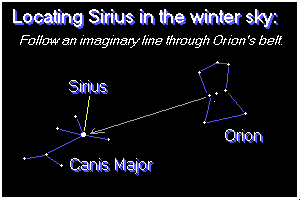
The star Sirius is certainly no stranger to mysteries. As the brightest star in the sky it was known and worshiped by ancient civilizations. Its appearance in the dawn sky over Egypt warned of the impending Nile floods and the summer's heat and marked the beginning of the Egyptian calendar. Strangely though, ancient records explicitly list Sirius as one of six "red stars." The other five are still seen as red, but from the time of Arab astronomers to the present day Sirius has been blue-white.
Astronomers classify Sirius as a "class A" star, hotter and younger than our sun, Its brightness is due largely to its proximity to us; it is barely eight light-years away from the earth. This is only a stone's throw by galactic standards, and Sirius is only twice as far away from our solar system as are the nearest stars to the sun, the Alpha Centauri system.
But how did a people that lacked any kind of astronomical tools know so much about an invisible star?
Sirius figures prominently in the Dogon myths. The tribe has a periodic Sirius festival called the "Segui" ceremony; each celebration lasts several years (the last was in 1968-72.) The interval between ceremonies may be forty, fifty or sixty years. Through the carbon dating of old ritual masks researchers have established the antiquity of the Segui ceremonies. Such criteria suggest that these periodic festivals have been going on for at least 600 years and possibly much longer.
Their myths speak of Jupiter's dominant four moons and Saturn's rings, which were not seen by human beings until the invention of the telescope. They speak of the star Sirius and of a pair of invisible companions. One of them circles Sirius every fifty years, and is made of a metal that is the heaviest thing in the universe. Astronomers have discovered that such an object (called "Sirius-B") does actually exist, but only the most sophisticated and sensitive instruments -- unavailable, of course, to the Dogons -- can detect it.
The tribesmen believe (and astronomy confirms) that the planets of the Sirius system circle their sun in elliptical orbits. The Dogon also relate the legend of how Po Tolo (their name for the invisible Sirius B) is joined in its orbit by a third companion star Emme Ya, which is orbited by the homeworld planet of a race known as Nommo, who came to earth long ago and enlightened the Dogon people. But whether this is true or not, who told the Dogons about Sirius and about the other space science secrets? Author Robert K. G· Temple (The Sirius Mystery, St, Martin's Press, 1975) claims to be able to trace the Sirius-B myth back through Egyptian mythology to Sumerian mythology, thus establishing the certainty that the informants were “extra-terrestrials”, or rather “Ancient Astronauts” who were the source of ancient knowledge and civilisation.
But here's the rub: there is no archaeological evidence that the specific references to the twin hidden companions of Sirius are anywhere near that old. Furthermore, most Dogon symbology already has multiple levels of meaning; the sketches used to illustrate the Sirius secrets are also used in puberty ceremonies. The Dogons hold that Jupiter has four moons when in fact it has at least 12, plus a ring, as any true extraterrestrial would have known. Saturn is not, as the Dogons insist, the farthest planet in the solar system. At least three are farther and at least one of them has rings too.
So what is the alternative to the extraterrestrial hypothesis for the Dogon myths? The Dogons could have learned of European Sirius lore in the 1920's from traders, explorers or missionaries, many of whom are avid amateur astronomers. The Dogons were not isolated. Many served in the French army in World War I and some of them could have returned years later with colourful embellishments for their native legends.
In response Temple claims that bas-reliefs of the Sumerian demigod Oannes, which depict a "fish man," prove the physical presence Nommo, whom he identifies as an amphibious extra-terrestrial. Unfortunately he neglects to mention other bas-reliefs which show "fish-deer" and "fish-lions" and which consequently suggest that the fish motif was symbolic, not descriptive.
So where does this leave the mysteries of Sirius? The antiquity of the Dogon astronomy is not so obvious as “Ancient Astronaut” enthusiasts claim, but neither has it been disproved. The ancient records are filled with unanswered astronomical questions -- including the "red Sirius" and the possible Sumerian Ea-Oannes references to the spectacular Vela-X supernova. The Dogon myths may or may not be related to these other putties, it seems unlikely that we will ever know for sure. Whatever their place in the search for extra-terrestrials, the Dogon myths are certainly odd. The Stone Age storytellers speak by their campfires of other people on other planets and of other mysteries. Our mysteries may be different but our questions are the same and we are no wiser.
Addendum: When Temple first issued his book in the 1970's there was no solid evidence of a Sirius C. In 1995, however, two French researchers, Daniel Benest and J.L. Duvent, authored an article in the prestigious journal Astronomy and Astrophysics with the title "Is Sirius a Triple Star?" and suggested (based on observations of motions in the Sirius system) there is a small third star there. They thought the star was probably of a type known as a "red dwarf" and only had about .05 the mass of Sirius B. As we know from in-depth study of a 12th planet theory, it is possible for a planet in close orbit to a red dwarf to gain enough heat and light to support life ...