Plato's Atlantis

Plato used a series of dialogues to express his ideas. In this type of writing, the author's thoughts are explored in a series of arguments and debates between various characters in the story. A character named 'Kritias' tells an account of Atlantis that has been in his family for generations. According to the character the story was originally told to his ancestor Solon, by a priest during Solon's visit to Egypt. So why is there a fierce debate surrounding the re-telling of a story ? Well at numerous points in the dialogues Plato's characters refer to the story as "genuine history" and it being within the "realm of fact".
Plato also seems to put into the story a lot of detail about Atlantis that would be unneccessary if he had intended to use I only as a literary device.
The capital city of Atlantis was a marvel of architecture and engineering. Plato describes Atlantis as alternating rings of sea and land, and at the centre a hill with a temple to Poseidon on top. It was said that Poseidon (the God of the Sea) himself founded the island society, which he divided into ten sections, each to be ruled by one of his 10 sons. The name itself came from his first son "Atlas".
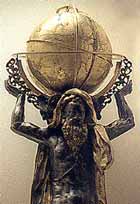
In "Timaeus", Plato described Atlantis thus "Now in this island of Atlanris there was a great and wonderful empire which had rule over the whole island and several others, and over parts of the continent, and, furthermore, the men of Atlantis had subjected the parts of Libya within the Columns of Heracles as far as Egypt, and of Europe as far as Tyrrhenia." He goes on to tell how the Atlanteans made a grave mistake by seeking to conquer Greece, and after their defeat a natural disaster sealed their fate. "afterwards there occurred violent earthquakes and floods; and in a single day and night of misfortune all your warlike men in a body sank into the earth, and the island of Atlantis in like manner disappeared in the depths of the sea."
Interestingly Plato tells a more metaphysical version of the Atlantis story in "Critias". There he describes it as a noble, sophisticated society that reigned in peace for centuries, until its people became complacent and greedy. Angered by their fall from grace, Zeus chose to punished them by destroying Atlantis.
So what really happened ?
Plato identified the location of the land he named Atlantis to the west, in the Atlantic Ocean. In reality, Egyptian legend placed Keftiu west of Egypt, not necessarily west of the Mediterranean. Historian Galanopoulos suggests Plato's error here was nothing more than a mistake in translation of some figures from Egyptian to ancient Greek, which added an extra zero. This would mean 9000 years ago became 900 years ago, and the distance from Egypt to Atlantis went from 2,500 miles to 250 miles. Due to this miscalcuation Plato had no alternative but to accept that the lost continent must be in the Atlantic ocean. Yet this and the detail that remained are enough to allow a clear connection to none other than the land of the Minoan culture (based around Crete and Thera).
Archaeological records show that the Minoan culture spread its dominion throughout the nearby islands of the Agean from approximately 3000 BC to about 1400 BC. They were an advanced civilisation who had language, commerical shipping, complex architecture, and ritual games. Their capital was situated in Crete (now part of Greece), but it is very likely that related islands (Santorini and Thera) would have been part of the same culture. Investigation of the area shows a striking lack of military activity within the ruins (and also within their surviving artwork), suggesting that not only were the Minoans peaceful, but as a people they had little tendancy towards war or force in general. Further similarites are evident in the Egyptian account of ritualistic bull fighting in Keftiu. They were said to wrestle with and jump over bulls, a practise richly illustrated in surviving Minoan artwork.
The destruction of Atlantis
Santorini was a part of the ancient Minoan civilisation, and ruins can be found throughout the island. At its centre stood a mountain, approximately 1500 meters in height .. that was until 1470 BC when this 'mountain' erupted. From tectonic location, compostition, and physical structure it is possible to identify similarities between volcanoes. The volcano at Santorini was geologically similar to the 19th century Pacific volcano Krakatoa which exploded violently in 1883, sending unparalleled tsunamis of up to 120ft high crashing into neighbouring islands, and killing 36,000 people. The ash that was thrown into the air blackened the skies for 3 days, the sound of the explosion was heard 3,000 miles away.
Santorini was about 4 times larger than Krakatoa, and probably at least twice as violent. The fury of Santorini's final explosion is inferred from geological core samples, and goes like this ..
In summer 1470 BC Santorini exploded, sending volcanic ash high into the
sky, blotting out the sun and triggering hail and lightning. A heavy layer
of volcanic ash rained down over the Agean, covering islands and crops.
Earthquakes shook the land, and stone structures fell from the motion.
Finally the enormous magma chamber at Santorini collapsed (along with
a majority of the island) under the sea leaving the enormous submerged
crater evident in the map below, and sending enormous tsunami in all directions.
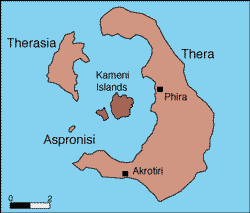
The island of Santorini is now only the rim of the once huge volcano, and a pile of ash and pumice the mute remains of the ancient Atlantis.
Click here to go back to the Ancient Knowledge menu
