The Facts about Easter Island
What Roggeveen discovered on the island was 3 distinct groups of people, dark skinned, red skinned, and very pale skinned people with red hair. It is suggested that the inhabitants are of Polynesian descent, but for decades anthropolgists have argued the true origins of these people, some claiming that ancient South-American mariners settled the island first. The people themselves were scattered across the island and had almost no culture they could remember, and without any links to the outside world.
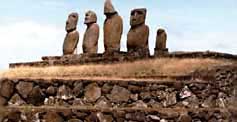
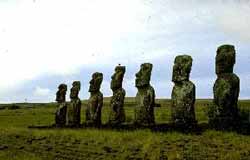
When we think of Easter Island we immediately think of those huge stone figures, the Moai monoliths. They are carved from island rock and are found all over the island in various stages of completion. Many of them are still lying in the quarry where they were mined, abandoned and forgotten. No one knows what purpose they served, but research accumulated with local knowledge has ascertained that the Moai were carved by the ancestors of the present inhabitants.
It is believed there were two 'classes' of people on the island. One
group dominated the other, and to keep them subservient forced them to
carve huge images of their ancestors which were then used to plot celestial
phenomenon (the inhabitants were ancestor worshipers and had only one
deity - Make Make). After many generations the lower class rebelled and
slew their rulers. This explains two important historical points. Firstly,
why the statue building ended so abruptly, and secondly why all of the
Moai were toppled. The ones seen standing have all been rebuilt since
their first excavation by Thor Heyerdahl in the 1950's.
Click here to go back to the Ancient Knowledge menu
