| |
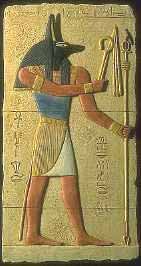
"Anubis, the Judge of the Dead"
|
|
| |
|
|
| |
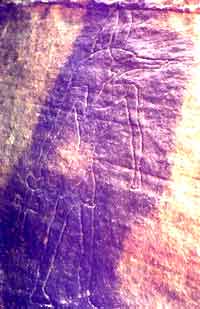
So why was this amazing discovery mostly ignored during
examination in the 1950's? Quite simply - the hieroglyphs are extremely
ancient, in the archaic style of the early dynasties. The archaic style
is very little known and untranslatable by most Egyptologists (who are trained
to read Middle Egyptian onwards). The classic Egyptian dictionaries only
handle Middle Egyptian, and there are few people in the world that can read
and translate the early formative style. These early characters contain
forms of glyphs that correlate with archaic Phoenician and Sumerian sources.
With this in mind it is easy to see how early university researchers who
examined them dismissed them as bizarre and ill-conceived forgeries. |
|
| |
|
|
| |
Egyptologist Ray Johnson, who has translated extremely
ancient texts for the Museum of Antiquities in Cairo, eventually identified
the texts as Third Dynasty, and set about translating the two walls of glyphs.
The story they tell is one of great tragedy. Ancient explorers were sent
to explore Australia just after the reign of King Khufu (somewhere between
1779 and 2748 B.C.). They became shipwrecked in a strange and hostile land
with no food or water. Setting out across the land they searched for a way
to survive. It was during this time that their royal leader "Lord Djes-eb"
was bitten twice by a snake. They prayed to Amon, the hidden one, for he
was struck twice in ancient myth, but to no avail. So here they buried their
exhaulted leader, before setting off again into the vast wilderness, and
disappearing into the void of history … or did they? |
|
| |
|
|
| |
In 1931 Professor A. P. Elkin, Professor of Anthropology
at Sydney University, came upon a tribe of Aborigines in the North West
Kimberley's. They had never met a white man before, and the professor was
astounded when tribal elders greeted him with Ancient secret Masonic hand
signs. He was struck by the startling Semitic features present in the natives,
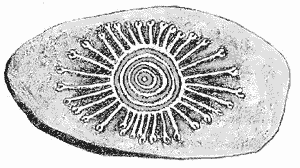
and astounded when he found out that they worshipped the sun - not in itself
unusual until you see how they represent it .. |
|
| |
|
|
| |
The symbol inscribed in this stone is identical to that
of the Aten, the solar deity worshipped in Egypt. The sun was depicted as
having little hands that reached out to touch mankind. |
|
| |
|
|
| |
They told him stories of how the Wanjina had come from
across the Indian Ocean in great vessels and taught them many great and
mysterious things. More amazing still was the discovery Professor Elkin
made much later - many of the unrecognisable words spoken by the tribe were
in fact Egyptian in origin. |
|
| |
|
|
| |
So if we are to accept that ancient Phoenician style Egyptian
script and language is present on the continent of Australia, we must then
accept that the mariners of antiquity were quite capable of extensive ocean
voyages, and a whole new age of history is opened before us. |
|
| |
|
|
| |
|
|