The Rosetta Stone
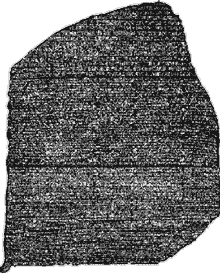
The immediate importance of the Rosetta stone lies in the fact that the Egyptian hieroglyphic text is accompanied by a Greek translation which could be read. A third inscription on the stone was written in Demotic, a cursive script developed late in Egyptian history, based on the Greek alphabet, and used almost exclusively for secular documents. Thus the stone displays the same text in 3 scripts, but only 2 languages - Egyptian and Greek, and it didn't take long to realise that all 3 contained the same message. The Greek could be translated immediately, so providing clues to the others.
The stone has been dated to March 196 BC in the 9th year of Ptolemy V, and it is the confirmation of the control of the Ptolemaic kings over Egypt. The Ptolemies were Greeks who had been ruling Egypt since the fragmentation of the Empire of Alexander the Great, and while they built temples in the Egyptian style, their lifestyle and language remained exclusively Greek. Egypt had by now become a multi-cultural society, a mixture of Greek and Egyptian, although in many parts of the country the two rarely met.
In the years preceding the setting up of the Rosetta stone, control of certain parts of Egypt had been lost from the family of the Ptolemies, and it had taken the Ptolemaic armies some time to put down opposition in the Delta; parts of southern Upper Egypt (in particular Thebes) were not yet back in the control of the government. It appears that it was decided that the best way to emphasize the legitimacy of the 13 year old Ptolemy V in the eyes of the Egyptian elite was to re-emphasize his traditional royal credentials with a coronation ceremony in the city of Memphis, and to affirm his royal cult throughout Egypt. This second aim was done through a version of the decree issued at the city of Memphis.
The inscription begins with praise of Ptolemy, and then includes an
account of the siege of the city of Lycopolis (a town in the Delta which
has yet to be identified), and the good deeds done by the king for the
temples. The final part of the text describes the decree's overriding
purpose, the establishment of the cult of the king, how the king's shrine
is to be set up, and days when certain festivals (such as the king's birthday)
shall be celebrated. It ends by saying that it is to be made known that
all the men of Egypt should magnify and honour Ptolemy V, and that the
text should be set up in hard stone in the three inscriptions which it
still bears today.
Click here to go back to the Ancient Knowledge menu
