| |
| 138 |
JOURNAL OF THE ATMOSPHERIC SCIENCES |
VOLUME
20 |
|
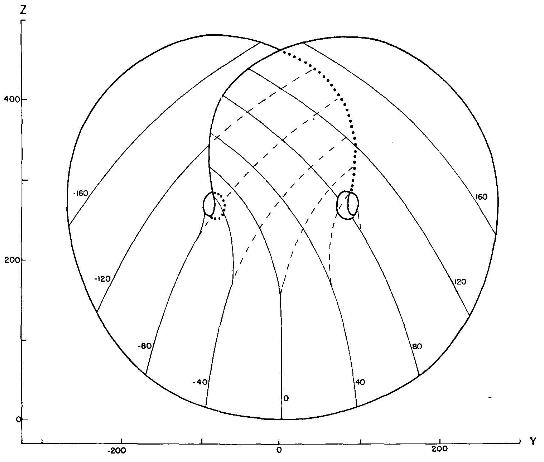
FIG. 3. Isopleths of X as a function of Y and
Z (thin solid curves), and isopleths of the lower of
two values of X, where two values occur (dashed curves),
for approximate surfaces formed by all points on limiting trajectories.
Heavy solid curve, and extensions as dotted curves, indicate
natural boundaries of surfaces. |
|
as one of two smooth single-valued functions
over the remainder of the range. In Fig. 3 the thin solid
lines are isopleths of X, and where two values of
X exist, the dashed lines are isopleths of the lower
value. Thus, within the limits of accuracy of the printed
values, the trajectory is confined to a pair of surfaces
which appear to merge in the lower portion of Fig. 3. The
spiral about C lies in the upper surface, while the
spiral about C' lies in the lower surface. Thus it
is possible for the trajectory to pass back and forth from
one spiral to the other without intersecting itself.
Additional numerical solutions indicate that other
trajectories, originating at points well removed from these
surfaces, soon meet these surfaces. The surfaces therefore
appear to be composed of all points lying on limiting trajectories.
Because the origin represents a steady state, no trajectory
can pass through it. However, two trajectories emanate from
it, i.e., approach it asymptotically as r→-
∞. The heavy solid curve in Fig. 3, and its extensions
as dotted curves, are formed by these two trajectories.
Trajectories passing close to the origin will tend to follow
the heavy curve, but will not cross it, so that the heavy
curve forms a natural boundary to the region which a trajectory
can ultimately occupy. The
|
holes near C and C' also
represent regions which cannot be occupied after they have
once been abandoned.
Returning to Fig. 2, we find that
the trajectory apparently leaves one spiral only after exceeding
some critical distance from the center. Moreover, the extent
to which this distance is exceeded appears to determine
the point at which the next spiral is entered; this in turn
seems to determine the number of circuits to be executed
before changing spirals again.
It therefore seems that some single
feature of a given circuit should predict the same feature
of the following circuit. A suitable feature of this sort
is the maximum value of Z, which occurs when a circuit
is nearly completed. Table 2 has again been prepared by
the computer, and shows the values of X, Y, and
Z at only those iterations N for which Z
has a relative maximum. The succession of circuits about
C and C' is indicated by the succession of
positive and negative values of X and Y. Evidently
X and Y change signs following a maximum which
exceeds some critical value printed as about 385.
Fig. 4 has been prepared from
Table 2. The abscissa is Mn , the
value of the nth maximum of Z, while the ordinate
is Mn+1, the value of the following
maximum. Each point represents a pair of successive values
of Z taken from Table 2. Within the limits of the
round-off
|
|
|
|