Approximately one second per iteration,
aside from output time, is required.
For initial conditions we have
chosen a slight departure from the state of no convection,
namely (0,1,0). Table 1 has been prepared by the
computer. It gives the values of N (the number of
iterations), X, Y, and Z at every fifth
iteration for the first 160 iterations. In the printed output
(but not in the computations) the values of X, Y,
and Z are multiplied by ten, and then only those
figures to the left of the decimal point are printed. Thus
the states of steady convection would appear as 0084,
0084, 0270 and -0084, -0084, 0270, while the
state of no convection would appear as 0000, 0000, 0000.
The initial instability of the
state of rest is evident. All three variables grow rapidly,
as the sinking cold fluid is replaced by even colder fluid
from above, and the rising warm fluid by warmer fluid from
below, so that by step 35 the strength of the
convection far exceeds that of steady convection.
Then Y diminishes as the warm fluid is carried over
the top of the convective cells, so that by step 50,
when X and Y have opposite signs, warm
fluid is descending and cold fluid is ascending. The motion
thereupon ceases and reverses its direction, as indicated
by the negative values of X following step
60. By step 85 the system has reached a state not far from
that of steady convection. Between steps 85 and 150 it executes
a complete oscillation in its intensity, the slight amplification
being almost indetectable.
The subsequent behavior of
the system is illustrated in Fig. 1, which shows the
behavior of Y for the first 3000 iterations. After
reaching its early peak near step 35 and then approaching
equilibrium near step 85, it undergoes systematic amplified
oscillations until near step 1650. At this point a critical
state is reached, and thereafter Y changes sign
at seemingly irregular intervals, reaching sometimes one,
sometimes two, and sometimes three or more extremes of one
sign before changing sign again.
Fig. 2 shows the projections on
the X-Y- and Y-Z planes in phase space of
the portion of the trajectory corresponding to iterations
1400-1900. The states of steady convection are denoted
by C and C'. The first portion of the trajectory
spirals outward from the vicinity of C', as the oscillations
about the state of steady convection, which have
been occurring since step 85, continue to grow. Eventually,
near step 1650, it crosses the X-Z-plane,
and is then deflected toward the neighborhood of C.
It temporarily spirals about C, but crosses the X-Z-plane
after one circuit, and returns to the neighborhood of C',
where it soon joins the spiral over which it has previously
traveled. Thereafter it crosses from one spiral to the other
at irregular intervals.
Fig. 3, in which the coordinates
are Y and Z, is based upon the printed values
of X, Y, and Z at every fifth iteration for
the first 6000 iterations. These values determine X as
a smooth single-valued function of Y and Z over
much of the range of Y and Z; they determine
X
|
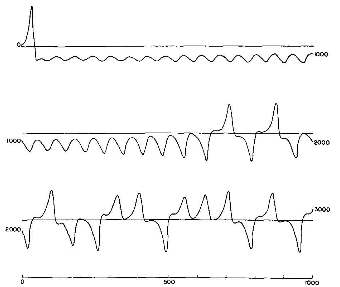
FIG. 1. Numerical solution of the convection equations.
Graph of Y as a function of time for the first 1000
iterations (upper curve), second 1000 iterations (middle
curve), and third 1000 iterations (lower curve).
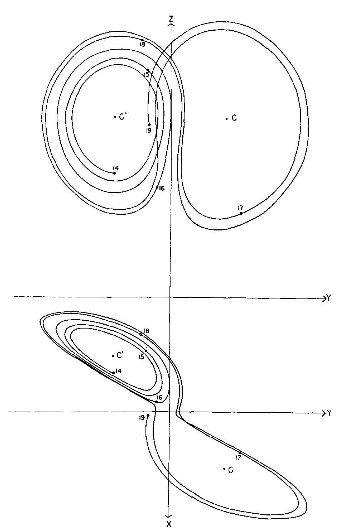 FIG. 2. Numerical solution of the convection equations.
Projections on the X-Y-plane and the Y-Z-plane
in phase space of the segment of the trajectory extending
from iteration 1400 to iteration 1900. Numerals "14,"
"15," etc., denote positions at iterations 1400,
1500, etc. States of steady convection are denoted by C
and C'
FIG. 2. Numerical solution of the convection equations.
Projections on the X-Y-plane and the Y-Z-plane
in phase space of the segment of the trajectory extending
from iteration 1400 to iteration 1900. Numerals "14,"
"15," etc., denote positions at iterations 1400,
1500, etc. States of steady convection are denoted by C
and C'
|