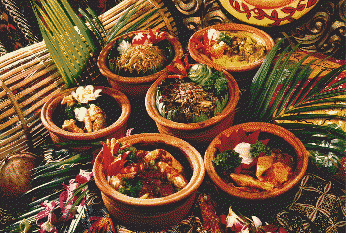
Because most Muslims are Malays, they observe strictly the Halal (permissible) code. Muslims are forbidden to eat pork or meat or which has not been slaughtered in the name of Allah. Islam also strictly forbids the consumption of liquor.
Malay food is famous for its spicy flavour, and there is no end to its variety. The Malay archipelago is the world's premier source of spices (and that's what got us colonialised hundreds of years ago). From curries to rendang, Malay food is anything but bland. That is not to say that the dishes are hot. Some gravies like kuah lemak are not.
unlike Indian food, Malay dishes are distinguished by the liberal use of coconut milk (santan), which unfortunately contributes to high cholesterol levels. But the spices and the santan give Malay food its distinctive taste. That includes the kueh lemak as well as the ever-popular nasi lemak.
Rice forms the main staple of the Malays, and this is often taken with a variety of dishes. Daily meals are based on white rice, and for special occasions like weddings, nasi minyak, yellow rice cooked in ghee, is often served. A typical spread for lunch or dinner would include rice, some form of gravy (curry or kuah), a meat or fish dish and vegetables. A popular vegetable dish is ulam or lalap, which are raw vegetables taken with a dash of hot spicy sauce (sambal).
The most popular of these is sambal belacan, a sauce made of fermented shrimps. Indeed, no Malay meal is complete without the sambal.
The Melting Pot
In Singapore, Malay food has benefited from the influences of Indonesia, Malaysia, and even countries further afield. Nowhere else can you find mee siam, ostensibly Thai noodles, but having no resemblance to the dish up north. Gado gado, a popular Indonesian salad, has its original mix preserved, down to the fried tempe (soya beans cake). And, although the Malay rojak (another spicy salad of fruits and vegetables with a hot sauce) is popular, the Indian rojak has no equivalent on the sub-continent.
|