Shona Laing
Whispering Afraid
and...
Shooting Stars (are only seen at night)
Make no mistake, I genuinely love progressive
rock, but one can't make a meal of it. Even I need a rest-break from
non-stop key changes and time-signature shifts at times. At such times,
sometimes a simple singer-songwriter record is just the break one needs.
The "singer-songwriter" phenomenon is, in general, more well-respected
than prog-rock (which on the respectability scale tends to fall
somewhere between disco and Grand Funk Railroad). It's also an
immensely diverse genre (if it can even be called that)...what more
needs to be said when "singer-songwriter" can mean anything from John
Martyn to Carly Simon to Tim Buckley? Certain singer-songwriters have
long been overlooked, only to be rediscovered years after their
flourishing. How else to explain the current "hipness" of folk-singer
Nick Drake, who recorded his last material circa 1975?
Still, there are some singer-songwriters whose material is largely
forgotten. Take Shona Laing, for example. In the States, she's mainly
known
for some socially-conscious Fairlight-synth-pop tunes such as "Soviet
Snow"
from the late 80's, but she's had a much longer career than many
Americans
or Europeans realize. In fact, in her native New Zealand, her career
stretches back to the early 70's. And it's that time period on which
I'll be concentrating in this review. Specifically, on her first two
albums: Whispering Afraid and Shooting Stars (are only seen
at night).
A bit of history, first of all. The young Shona came on the scene
circa 1972 with a folky single called "1905." It became a big hit in NZ
and Australia, won all sorts of awards and garnered notice even in
Japan
and Southeast Asia. Two albums and a half dozen singles followed, and
while
the fourth and fifth singles ("I'm Crying Too" and "Rainbow") were her
best ever, they were considerably less commercially successful compared
two her first three. Thus after the surprise novelty hit "I love my
feet"
in 1975, Shona moved to the UK in search of greater things.
Sadly, Shona's talents went largely unnoticed and underappreciated in
old Blighty. A few singles and a long-player (1982's Tied To The
Tracks, released only in Great Britain and Canada) were all that
resulted. These garnered her a little airplay but no commercial success
to speak of. She
did earn the respect of fellow musicians, though, notably Manfred Mann,
on
whose Somewhere in Afrika album she sang in 1984. It was
Shona's highest-profile gig to date. More importantly, Mann introduced
Shona to
the world of synthesizers, something which would change her whole sound.
Upon returning to the Antipodes in 1985, Shona immediately released a
Fairlight-laden LP entitled Genre. Released on the small Pagan
label, it was initially greeted with little fanfare. But gradually, the
tune "Not A Kennedy" (with its memorable samples of John F. Kennedy
speeches) crept up the charts in Australia, and by 1986 it was
receiving acclaim
and airplay from as far away as Germany. Virgin Records signed Shona,
and
they built an album of new tracks around a remixed version of "(Glad
I'm)
Not A Kennedy" entitled South. The haunting "Soviet Snow," the
six-minute centerpiece of South, earned Shona an entirely new
audience. A rather butchered version of South (substituting
some tracks, like the controversial "Neutral and Nuclear Free," for
tracks from Genre) appeared on the TVT label in the States,
where the video to "Soviet Snow" received heavy rotation on MTV.
Never terribly prolific, Shona released only three albums in the
nineties: New On Earth, Shona and Roadworks,
each more stripped-down than the last (Roadworks was entirely
acoustic). Of all her albums, only the edited American version of South
remains generally available, New On Earth and Shona
having fallen out of print years ago, CD's of Genre and Roadworks
never having garnered so much
as an American release...and the others never having made it to CD at
all.
For someone as talented as Shona, that's pretty shabby treatment.
Compared to later albums, Whispering Afraid and Shooting
Stars seem to occupy a different world. I've heard some listeners
(who were first exposed to Shona via "Soviet Snow") expressing shock
when they were met with the stripped-down sound on New On Earth.
One can only imagine what their reaction to Whispering Afraid
would be. Her voice is far more youthful and searching, her outlook far
less jaded. And the arrangements are far more organic, a far cry from
the high-tech (for the 80's) Fairlight synthesizer arrangements of Genre
and South.
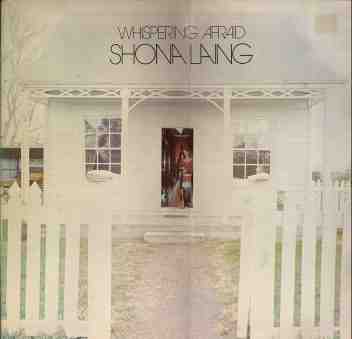
Whispering Afraid opens with a lush string fanfare—a bit of
telegraphing, this is the main theme from the album's title song—then
it's
straight into Shona's debut single, "1905." It's easy to see how this
tune endeared her to an entire nation, harder to see why it didn't find
her a broader audience around the world. Strummed acoustic guitar and
driving drums carry the rhythm, with a light string orchestration
enterring in the chorus, adding a nice colour to proceedings. The
lyrics tell a tale of sadness and regret over lost time, certainly
something we can all relate to.
"Lady Dipton" has quite a different tone. It's about a friend of hers
she met at a holiday resort, and in the larger sense, is about the
sense of well-being talking to a friend gives one. This charming little
tune
(the original B-side to the "1905" single) features perhaps the
simplest
and most intimate arrangement on the album, just Shona and her acoustic
guitar alone.
"You are the one" again offers a shift in tone. Something of a highly
positive and optimistic "protest song," it seems she was influenced by
the "passive resistance" of Gandhi and Martin Luther King Jr. to
compose
this little ditty. "Peaceful revolution, that's what we need," she
sings
with an air of hope and even slight despair. It's easy to say she was
young
and naïve to offer sentiments like "You are the one who can change
the world," but it's also sweet and charming...in today's hectic and
mean-spirited world we could use more of such sentiments. And I doubt
even Shona today would offer something in such a positive light. The
background music, as with "1905," is led by Shona's acoustic guitar,
with a light orchestration of strings and French horn.
The title track follows, and offers another change of mood. In the
liner notes, Shona describes the lyrics as "'slightly' depressing."
It's basically a rumination on getting older and worrying about one's
future. The melody is gorgeous and the lyrics are touching and
emotional; in a more just world, this song would be a standard. Another
wonderfully subtle Dave Wrightson arrangement compliments the tune:
Shona's voice accompanied only by her acoustic guitar and a gentle
string and woodwind arrangement.
The A-side closes with "Quiet Night," possibly the most rock-oriented
arrangement on the album, opening with decisive organ chords and buoyed
along with jangling 12-string guitar. Though the wailing Moog
synthesizers over the closing of the track date it a bit, it's really
quite a good little tune with Shona in particularly good voice. The
bridge ("Let me see through objective eyes...") has chord changes to
die for and some wonderfully bluesy electric guitar injections from
Wrightson.
A la Motown, each side opens with a single, so with the B-side we're
met with "Show Your Love." This one's based more around Dave Fraser's
keyboards (acoustic and electric pianos) than earlier tracks. The
lyrics definitely decry the Anglo-European emotional iciness. "Have you
ever seen how a
touch make's people pull away? And to smile at a stranger's not the
thing
to do today." Certainly more of a wistful and longing tone of voice
here
than on "You are the one." The mandolin-like bass trills at the end of
this track (courtesy of Wrightson) are a nice touch.
"If Only" is another emotional and sad tune with a touching vocal. An
odd arrangement on this one, as she's only accompanied by strings for
the first verse, the guitar entering only on the second. It's a nice
touch, and showed that Wrightson really did know what he was doing.
Shona describes "Like days gone before" as "a sort of answer to
'Whispering Afraid' (unintentionally)." Indeed, the lyrics and entire
tone of the song display a much more chipper mood. It's probably the
most lovely and folky arrangement on the album, with just acoustic
guitar and sparse strings (perhaps just a quartet), even if the tune
itself doesn't stick out as well
as some of the others. Certainly Shona's dreamy vocals can't be faulted.
"Is Anything Ever Everlasting" is perhaps Shona's most philosophical
contribution to the album. "Don't tell me you're going to love me till
the sun falls from the sky, that's a lie," she sings, playing havoc
with love-song clichés as she muses on the brevity of life and
finality of love affairs. She picks up her 12-string here again, backed
by a powerful rock drumbeat and eventually joined again by the
ubiquitous strings. This again is one of the stronger songs on the
album, and deserves to be better-known in the larger sense.
Whispering Afraid closes with Shona's third single,
"Masquerade." Actually, this is possibly my least favourite tune on the
album, trying as it does to be too many things at once. The
delightfully simple (but not simplistic) quality of the album's other
tunes is rather undone by "Masquerade." The verses are saddled with
some none-too-subtle over-orchestration, anchored by Fraser's electric
piano...and the middle section—a sort of country-folkie-jig section
with fiddle and handclaps—seems totally inappropriate, as though it
were Frankensteined in from a completely different song. The trite "get
back to the land" sentiments of the lyrics do not help. Still, I'm
willing to cut her slack, as she was still green (no pun intended) as a
composer. And the quality of the album's other tunes more than makes up
for the shortcomings of "Masquerade."
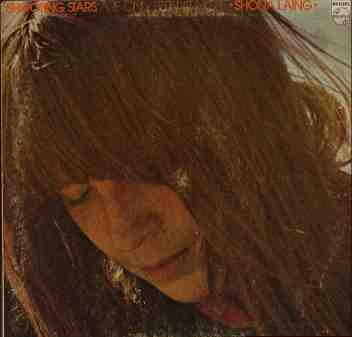
For her follow-up album, 1974's Shooting Stars (Are Only Seen At
Night), Shona worked with a different producer (G. Wayne Thomas)
and a different backing group (the Crystal Voyager Band, featuring
guitarist Mick Liber and keyboardist Ray Vanderby). The results were
often more
rock-oriented and more "contemporary" than the rather late-60's folkie
sound of much of Whispering Afraid.
"I'm Crying Too" opens the disc with a bang, featuring an assertive
brass and string arrangement, and a propulsive rhythmic drive measured
by guitars, piano and Bruno Lawrence's tasteful rock drumming.
Immediately one feels far from the charming, if monochromatic, sound of
Whispering Afraid. Amazingly, the single of "I'm Crying Too" was
a bit of a commercial flop compared to her earlier releases, a pity as
it's a wonderful song
featuring one of Shona's finest, most soulful vocal performances.
"Remains To Be Seen," lyrically, only goes to show that her songwriting
has advanced to become rather more elusive. It's tough to say what it's
"about" exactly, but it seems directed at someone with whom she was
having difficulty communicating. Musically it certainly can't be
faulted, this
is more of the new, assertive Shona, some of the obvious transition to
her
more politicized 80's work. It's another rock-like sound, based around
her
rhythmic acoustic guitar work answered by Mick Liber's choppy electric.
Joan Armatrading's early Glyn Johns-produced albums spring to mind as a
comparison,
though the song is rather darker than most of Armatrading's of the
period.
There's some subtle orchestration as well, mostly some dark cellos and
some
jazzy flute inserts. Certainly a more complex arrangement than anything
on
Whispering Afraid, "Remains To Be Seen" offers a lot to chew on,
and
is another superb composition excellently performed.
With a synthesizer flourish, "Happy Song" arrives true to its title. A
sprightly folk-rock number, Shona's jangly 12-string carries it along
accented by bluesy guitar touches from Liber and Moog effects from
Vanderby. Not quite as substantial as what's come before, "Happy Song"
is a trifle that's nonetheless quite enjoyable.
"This Moment Here" is rather like "Whispering Afraid" in reverse.
Whereas "Whispering Afraid" was an expression of anxiety of what the
future
may hold, "This Moment Here" expresses sadness and regret on what has
passed. As such, it receives a similar arrangement of acoustic guitar
and gentle strings. And again, it's a lovely song, deserving to be sung
by all the greats giving Shona lots of money in residuals rather than
languishing in undeserved obscurity.
"Tony" is even more stripped-down, just Shona, her guitar and some
subtle, flute-like synthesizer. I can't help but wonder if the song was
inspired by a real-life person. And I can't help but wonder, given more
recent revelations regarding her sexuality, if the name "Tony" was
chosen deliberately for its sexual ambiguity. Too ephermeral and
fleeting to be a highlight of the album, it's a pleasing and well-done
little number nonetheless.
Opening with a tremulous guitar solo from Liber, "Shooting Stars"
certainly has cojones compared to the arrangements on Whispering
Afraid. But it's really just an electrified take on her folk-rock.
Lyrically, it uses Hollywood stardom and filmmaking as an extended
metaphor,
a bit of a longwinded way to make a rather hackneyed "Be thankful for
what you've got" point. Still, not bad, though I didn't warm up to it
initially.
I was eventually won over by the rhythmically dynamic chorus.
Opening the B-side is "Someone Like Me," which certainly offers
something different from Shona. The arrangement, based on piano and
horns, brings to mind late 60's Nilsson sides like "Cuddly Toy." The
vocal performance is another corker like "I'm Crying Too," and the
lyrics are snappy with some wonderful turns of phrase ("You can keep
your Mercedes Benz/And your Sobrani cigarettes/Your camera with its
telephoto lens..."). Liber's searing guitar solo in the middle is the
icing on the cake. This is another one that just cries out to be remade
by someone with foresight and talent.
True to its title, "I Want You" is kept simple, with a rather plain
acoustic guitar/bass/celeste/brushed drums arrangement. As with "Happy
Song" and "Tony," it's another trifle, but another enjoyable one.
"Now I Know," on the other hand, deserves better. With a corny MOR
arrangement featuring muted horns, strings and a saccharine sax solo
worthy of the Carpenters, it sounds like they were trying hard for the
"adult contemporary"
radio airplay. A pity, as with a more sympathetic arrangement, I'm sure
Shona's disarmingly simple songwriting could shine through. As it is,
the
sappy, dated, "easy listening" sound of the instrumentation swamps her
charming performance here. A big waste, I'm afraid.
The more timeless piano/guitar sound on "A Room" acclimates to Shona's
voice far more fittingly. Vanderby again adds some subtle Moog melodies
here and there, adding a bit of distinction to the sound. Lyrically,
though, it's one of Shona's weaker offerings, an attempt at describing
all the memories an old room holds, but awkward and not too successful.
Shona regains her footing for "Not so long ago," though. It's another
winning combination of strong songwriting, confident singing and a
punchy folk-rock arrangement. Like "Quiet Night," this one features a
bridge
to die for, a feature of Shona's songwriting she would continue to
further develop on her 80's and 90's albums.
The album closes with another undeserved flop single (commercially),
"Rainbow." This song presages all the more "political" tunes Shona
would go on to write in the 80's, such as "Soviet Snow" and "Migrant
and Refugee." A sort of harrowing future image along the lines of Tim
Rose's "Come Away Melinda," it tells of a mother and son's discussion
during an outing to the beach. Images of oil-covered birds, poisoned
water and brown skies make this a bit heavy-handed, but powerful. In
terms of strong, humanistic songwriting, some of Bruce Cockburn's 80's
output (as on albums like Humans or Stealing Fire)
could be seen as a fair comparison, though this predates Cockburn's
more externally conscious songwriting by some years. Musically, it's a
similar arrangement to "Remains to Be Seen," with strings and woodwinds
a bit more to the fore, and Vanderby's delicate piano providing the
perfect, poignant foil to Shona's vocals...which again are in the
darker mode reminding of "Remains to Be Seen." "Rainbow" is a
near-perfect song acting as a perfect album-closer, and again it
deserves far more recognition. It alone makes the purchase of the album
worthwhile. Fortunately, it's not the only reason Shooting Stars
deserves to be heard.
So, who should track down these two rarities? Proggers need not apply,
unless you have an open mind; this music is pretty far from complex.
Fans of Shona's 80's music expecting more synth-oriented stuff will
probably likewise be disappointed. But fans of her 90's output, people
into singer-songwriters in the vein of Bruce Cockburn or Joan
Armatrading, or just fans of well-written songs emotionally performed
and succinctly arranged will find much to enjoy here, particularly on Shooting
Stars. In spite of its minor weaknesses round about Side Two, Shooting
Stars is an excellent album, deserving of a much larger audience.
Such is unlikely any time soon, only the single tracks ever made it to
CD, and then only on the long out-of-print compilation 1905-1990: A
Retrospective. So come on, Phonogram, make these available on CD!
Buy 'em: Check for availability of the LP's over at gemm.com. And good luck!
Or get CD's of other albums by Shona at Amazon, using the link provided
below:
Click on Shona to return...
©2003 by Progbear