Kiki Dee
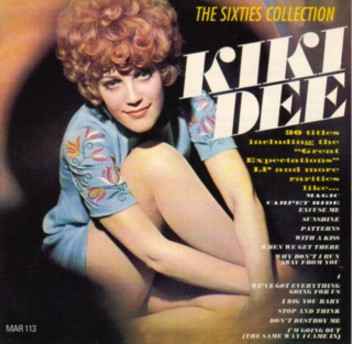
An Artist Profile
Point #1: this is the first of two reviews this month. 'Cause I've been
slacking off on the music reviews, I thought it only fair.
Point #2: this is not a delayed April Fool's gag. Folks probably will
think that Mike's finally cracked when they see the subject of today's
review, but please, humour me. In fact, it was just that sort of reaction
that provoked this review in the first place. You see, I was at my friend
Dave's place, and we were chatting about this and that. Somehow the conversation
got round to CD-R's, and I told him I had an extra copy of Kiki Dee's Loving
And Free album. His response, "Ew!"
Clearly, this was a situation that needed rectifying. (And I could have
gone on about his
musical taste, but I decided to do the gentlemanly thing and let it
slide.)
You see, if people think of Kiki Dee at all, they generally think of
a single song: that horrid duet with you-know-who; a tune which certainly
doesn't show either performer in the best light, especially not Kiki. The
truth of the matter is that had that duet never happened, and had she not
had such a goofy stage-name forced upon her as a naïve teenager, people
would have more respect for her than they do. Indeed, she is a powerful vocalist
with a backlog of superb material that most folks don't know a thing about.
Her career is, however, littered with false starts and missed opportunities
that failed to garner her the audience she deserved.
Pauline Matthews was born in 1947 in the industrial Yorkshire city of
Bradford. Young Pauline was always a singer, and made her first public
appearance at the age of ten at a Spot The Stars contest in Bradford. She
got her big break at the age of sixteen when she was discovered by big-time
British music mogul Mitch Murray. Murray had insisted on a stage name. Based
on either her then-permed hair or her predilection for wearing Honor Blackman-style
"kinky boots" (the story varies), Murray suggested the name Kinky Dee! They
arrived at a compromise (thank the Gods), and Kiki Dee was born.
Kiki released her first single, "Early Night," in 1963. It and her other
early singles, "With A Kiss" and the Carole King/Gerry Goffin composition
"I Was Only Kidding", were grandiose Phil Spector-type productions, but
she quickly became known for a more soul-influenced type of sound. In 1964,
versions of "Runnin' Out Of Fools" (then most associated with a pre-fame
Aretha Franklin) and "How Glad I Am" (previously performed by American jazz
singer Nancy Wilson) were released to much acclaim, if little actual sales.
All this did serve to increase Kiki's public profile; over the next few years
she appeared in the film "Dateline
Diamonds," contributed two songs to the soundtrack of "Doctor In Clover" and, perhaps
most importantly, appeared at the San Remo festival in Italy. At San Remo,
she performed the tune "Aspetta Domani," which came in second.
In the sixties, Kiki found her greatest success overseas, releasing
several singles in Italian and German versions, plus a number of singles
and an EP in French. Meanwhile, she still couldn't get a break at home.
She supplemented her income by working as a session backup vocalist, where
she gained many friends (Lesley
Duncan, the Chanter Sisters, Kay Gardner and Madeline Bell, among others)
who worked alongside her. Most importantly, she befriended Dusty Springfield,
who was operating in a very similar musical mode at the time, and the two
wound up singing on each other's records.
In 1968, Kiki's first full-length album was released. Entitled I'm
Kiki Dee, it mainly consisted of previously released material. Musically,
the album ran the gamut from grandiose Phil Spector-esque productions ("With
A Kiss," "I'm Going Out The Same Way I Came In") to transcendent soul ballads
("I") to torch songs ("Excuse Me," penned by the Addrisi Brothers, who wrote
"Never My Love") and psychedelic pop ("Patterns"). Kiki, however, was disappointed
in the album, and refused to promote it. Nevertheless, it garnered an American
release a year later, retitled Patterns*.
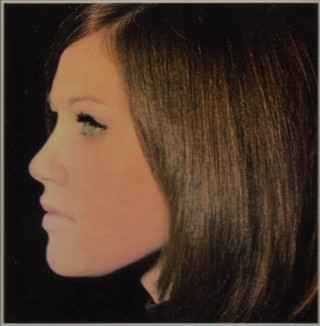
In spite of the album's commercial death, Motown were sufficiently impressed
to give her a try. Like that, an excited Kiki was flown to Detroit in 1969
to lay down some tracks that later came to be known as Great Expectations.
Though the album consisted mainly of new recordings of songs other artists
had done before (Stevie Wonder's "For Once In My Life," Marvin Gaye and
Tammi Terrell's "Ain't Nothing Like The Real Thing," etc.), she puts her
unique stamp on each song. She has a great feel and adoration for the material
and it shows. Perhaps the finest song on here is the heartfelt, emotional
ballad "Jimmy," a performance Kiki throws her all into, making this one really
unforgettable. Perhaps the album's one flaw was the inclusion of a version
of "You Don't Have To Say You Love Me." Which is not to say that Kiki's
performance of it is poor, it's actually quite good, but one can't help but
compare it with Dusty's original. And at a time when Kiki was perceived as
a "poor-man's Dusty Springfield," comparisons were the last thing she needed.
Disappointingly, Great Expectations did not live up to its title
commercially, it and its attendant single, "The Day Will Come Between Sunday
And Monday," went nowhere, and Kiki returned to England empty-handed.
It was not long after, after setting up his own Rocket Records label,
that Elton John came knocking on Kiki's door.
You see, Elton was a big fan of Kiki's from way back, and now decided
that since he needed artists for his new label, she would be perfect. She
jumped at the chance to make relevant music on her own, as opposed to laying
down vocals on tracks that had been recorded by anonymous session musicians
months before. Encouraged by Elton, she began compose her own songs. Elton's
guitarist Davey Johnstone taught her to play the guitar, and their relationship
would soon grow into something more than student/teacher.
In 1973, Kiki's first album on Rocket, Loving And Free, was released
to much acclaim. And, for the first time, commercial success came knocking
at her door when her English-language version†
of Veronique Sanson's "Amoureuse" shot up the charts over in the UK, peaking
at #13. The album as a whole was a very different affair from what had
come before for Kiki. Gone were the overblown horn charts and massive string
orchestras, replaced by a light folk-rock background, gospel-tinged backing
vocals and Mellotron (or occasionally light strings) providing subtle spot
orchestration on occasion. Two John/Taupin songs appear on the album, along
with a selection of well-chosen covers (Jackson Browne's "Song for Adam,"
the Stealer's Wheel tune "You Put Something Better Inside Me" and best of
all, a spirited rendition of Free's "Travellin' In Style"). But it's Kiki's
four original tunes that make the album so special. The pastoral acoustics
of the title track make for a subtle, charming opener, and the gospel/R&B-tinged
folk of "If It Rains" and "Rest My Head" are likewise fine, but it's the
emotional album-closer "Sugar On The Floor" which is the disc's true gem.
It also became something of a standard, covered by Elton John and Etta James,
among others.
Following the success of Loving And Free, Kiki put together a
band and went out on the road. This band formed the basis for her next album,
released in 1974. By then the band consisted of Jo Partridge (guitar, formerly
in Joan Armatrading's band), Roger Pope (drums, ex-Hookfoot), Phil Curtis
(bass, ex-Arthur Brown's Kingdom Come and Spirit Of John Morgan) and most
importantly, Toby "Bias" Boshell (keyboards, former bassist/guitarist of
folk-progressive group Trees). Boshell thought of himself mainly as a songwriter,
and had already had the experience of having his work covered, since French
chanteuse Françoise Hardy had recorded a version of his Trees composition
"The Garden of Jane Delawney." In fact, the band's most exciting song in
their live show was one of his tunes, a number called "I've Got The Music
In Me." The Kiki Dee Band was so hot, they were quickly rushed into the studio
to record two singles, another John/Taupin number called "Hard Luck Story"
and the previously mentioned "I've Got The Music In Me." The former went
nowhere, but the latter shot up the charts on both sides of the Atlantic,
and rightfully so, as it displayed that Kiki really could rock!
The I've Got The Music In Me album soon followed in the wake
of the success of its titular single. All the music this time was original,
three written by Kiki, five by Bias and one lone Jo Partridge composition,
the thoughtful "Out Of My Head." Produced by the late, great Gus Dudgeon,
the album is a slow-grower, but it truly does show Kiki in a fine light,
with a good balance of rockers and slower tunes. Most fascinating of all
is possibly Kiki's own "Water," a very evocative proto-ambient number that
sounds amazingly like the sort of thing Jane Siberry would go on to do. It's no
surprise that Kiki should become a big Sib-booster in more recent years.
The album closes with another excellent, punchy rocker written by Bias,
"You Need Help."
The band followed the album with a U.S. tour, then went back into the
studio in 1975 to record two more singles: "How Glad I Am" and "Once A
Fool." The former was a rocked-up version of the same tune Kiki had done
years before, and became her third British hit single. The latter was a
rather highly produced outside composition, and reached the lower echelons
of the American chart.
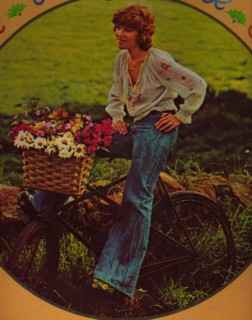
By 1976, the Kiki Dee Band had broken up. She spent the better part
of the year working on an album called Cage The Songbird (allegedly
a concept album about legendary French chanteuse Edith Piaf), which was
never released. The Loving And Free album was reissued that year
to fill the gap, and its title song became her fourth British hit, rising
to number twelve, her best showing yet. It was also during this time that
that duet was recorded and released. You know the one. Sorry, but
I am of the opinion that "Don't Go Breaking My Heart" is terrible. Not that
I have anything against Elton John, but the song is bad, the arrangement
is way overblown and neither performer is challenged by it. Pure, unadulterated
commerciality, it probably did more harm than help to Kiki's career in the
long run. Which is a grave shame because...
...in 1977, after some well-received concerts premiering some new material,
Kiki released her new, self-titled album. With heavy assists from boyfriend
Davey Johnstone and musical director James Newton Howard, Kiki produced
what is probably her musical crowning glory, an album that's excellent from
beginning to end. It kicks off with a rousing, playful version of Robert
Palmer's "How Much Fun," and doesn't let up. The energy level throughout
is never dulled, and Kiki is in consistently fine voice. Kiki contributes
six originals this time round, four solos and two co-writes featuring lyrics
by Gary Osborne. Most people consider the heartfelt ballad "Night Hours"
to be Kiki's best original tune, though I prefer "Walking," a haunting number
that really gets under your skin, and features a chilling, climactic Davey
Johnstone guitar solo. Elsewhere, there's the languid blues of "Sweet Creation,"
the lovely Mellotron folk-rock of "Into Eternity" and the Laura Nyro-like
"Bad Day Child." Davey Johnstone contributes one tune, "Keep Right On," while
Bias Boshell contributes two of the album's best tunes: the upbeat "Standing
Room Only" and another corker, "First Thing In The Morning." The latter
may possibly be Kiki's best single release, brimming over with energy and
excitement, fulfilling all the potential of her vocal range. A tad overproduced,
in the style of Elton's "Philadelphia Freedom," "First Thing In The Morning"
nonetheless manages to overcome its dated production style, becoming something
of a lost classic. The same could be said of the outside composition "Chicago,"
a very powerful blues-rock number with a devastatingly funky bass-line (which
I'm surprised hasn't been sampled at one point or other).
Sadly, though the album contained what was undeniably the best she had
produced up to that point, it went absolutely nowhere. "First Thing In The
Morning" and "Chicago" were minor hits in the UK, but stalled in the nether
regions of the Hot 100 in the States. Various problems, including the rise
of disco, the sudden "persona-non-grata" status of Elton John in the States
following his coming out in a highly-publicized interview, a glut of other
Kiki Dee-related releases on the market ("Don't Go Breaking My Heart" and
the reissue of Loving And Free) and good old-fashioned lack of promotion
made the album die an undeserved death commercially.
By this time, Kiki was living as a tax exile together with Davey Johnstone
in an L.A. apartment. It was only a matter of time before the Southern California
lifestyle caught up with her sound, which is where Stay With Me,
the disappointing 1979 follow-up to her great self-titled 1977 album, comes
in. Thanks to unsympathetic, generic production from Bill Schnee and the
huge cast of pricey L.A. sessionmen that play on the album, Stay With
Me has a real assembly-line feel that leaves the listener cold. The
three Kiki originals on the album were co-written by L.A. singer/actress
Zane Busby, and are not up to the standard of Kiki's previous work, though
"Dark Side Of Your Soul" is a bit charming. Even the Boshell/Johnstone
co-write "Love Is A Crazy Feeling" seems anemic, and the slick disco sound
of "One Step" and "Holding Me Too Tight" was an unwise idea (at least from
an artistic standpoint, not that they created any noise commercially). Most
of the album seems to try to cast her in the Olivia Newton-John mould, a
grave error as she's far too expressive a vocalist to deserve to be saddled
with such lightweight music. On the plus side, the rocker "One Jump Ahead
Of The Storm" is rather good, but it's the old Ten Wheel Drive standard
"Stay With Me, Baby," for which the album is understandably named, which
is the album's undisputed centerpiece. She puts her all into the performance
of Jerry Ragavoy's tale of sadness and regret, and her version is the definitive
one of this much-covered tune, at least to these ears. Too bad the whole
album does not stand up to this standard of quality.
After breaking up with Davey Johnstone, and perhaps disappointed by
her falling fortunes in the States, Kiki returned to the U.K. full-time.
Her next album would have her getting a fresh start, back in Britain with
a new label (Ariola) and a new producer (Moody Blues associate Pip Williams).
It seemed that she was finally emerging from the shadow of Elton John and
forging an strong new individual career path. Well, it seemed that way until
Perfect Timing eventually surfaced in 1981. Basically, the album
suffers from the same faults as Stay With Me, casting Kiki in a
bland MOR pop mould (this time with a synth-heavy 80's production veneer)
when she's so much better at other things. Kiki's two originals ("24 Hours"
and "There's A Need," both co-writes) are emotionally shallow, and Bias'
one contribution is a by-the-numbers bombasto-pop ballad called "You Are
My Hope In This World." The rather paltry highlights this time round are
the midtempo rockers "Midnight Flyer" (a Chanter Sisters composition) and
Pip Williams' "Another Break," the latter enlivened by an energetic Patrick
Moraz synth solo. But the album is probably most epitomized by a lifeless
version of the old Four Tops tune "Loving You Is Sweeter Than Ever," which
just happens to be another Elton John duet. It's all the proof one needs
that Perfect Timing was, for Kiki, two steps backward and not even
half a step forward, artistically speaking.
But, at least on the eastern side of the Atlantic, Perfect Timing
was her first real commercial success in five years. The Doreen Chanter-penned
"Star" was another sizable hit single for Kiki, the album's title tune
also receiving some residual chart action. After contributing the closing
theme to the Richard Pryor/Gene Wilder film "Stir Crazy" (entitled "Nothing
Can Stop Us Now"), she started work on another Ariola album, 1982's Two
Sides To Every Story. Like Cage The Songbird, this album never
saw the light of day on vinyl, and the tapes remain gathering dust in a
vault somewhere. Though if Kiki's 1983 single, "The Loser Gets To Win" is
anything to go by, it's likely to be even more seriously 80's-sounding than
Perfect Timing, with synths and drum-machines for days. And speaking
of synthesizers, she began an association of one of the most influential
synthesizer-duos of their day, the Eurythmics, singing backup with them
live and even turning up in a cameo appearance in their "Who's That Girl"
video.
In 1984, Kiki tried for a slightly different career path, starring in
the West End musical "Pump Boys And Dinettes" alongside American country
singer (and Nick Lowe spouse) Carlene Carter. A couple of years later,
she began collaborating with the Eurythmics' David A. Stewart‡. The results at last came out in 1987 under the
title Angel Eyes. Carrying on in the synth-pop and disco veins of
her past two releases, it manages to surpass them in being a hell of a
lot more energized than either. Nothing here is on a par with her classic
work, but it manages to be very strong and enjoyable throughout, starting
off with the soulful "I Fall In Love Too Easily" and keeping its energy
level resonably high throughout. The Stewart-composed "Another Day Comes"
should have been a dance-floor classic...but unfortunately, it and the album
disappeared without a trace, making Angel Eyes Kiki's most obscure
and hard-to-track-down release outside of her 60's recordings. (It also
didn't receive so much as an American release.)
In 1988, Kiki returned to the London stage, starring as (in a touch
of irony) Mrs. Johnstone in "Blood
Brothers." She received much acclaim, and a nomination for a Lawrence
Olivier Award, for her role. Then in 1991, she was one of the featured vocalists
on Eric Woolfson's Freudiana project. She also spent the year recording
demos with Jeff Lynne and writing songs with Juliana Raye.
Sadly, 1991 was also the year Kiki was diagnosed with uterine cancer,
and had to undergo radiation therapy for the next five years. On the plus
side, Kiki was inspired to begin working hard at writing original material
in earnest again, this time with her new writing partner and accompanist
(on acoustic guitar), Carmelo Luggieri. Her first new material in years
surfaced in 1994, with two cover songs added as bonus tracks to her compilation
disc The Very Best Of Kiki Dee: "Any Way That You Want Me" and a
version of Jane Siberry's "Love Is Everything." Also released during this
period, 1993 to be exact, was "True Love," another Elton/Kiki duet that
became a massive European hit.
Kiki and Carmelo took their songs to the people in 1995, playing acoustic
sets as a support act to violinist Vanessa-Mae on her British tour that
year. The results were recorded and released on the independent Tickety-Boo
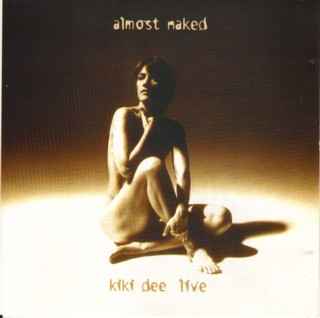
label under the provocative title¤ Almost
Naked. This was easily her strongest album since her classic 1977 set,
featuring heartfelt renditions of Jane Siberry's "Calling All Angels" and
Joni Mitchell's "Carey" alongside splendid originals like "Here For All Time,"
"See Me Through" and "Heal Me Now." The spare acoustic setting gives Kiki's
voice the breathing room it needs, her singing seems only to have grown better
over the years, and she breathes true life into these songs. Versions of "Amoureuse"
and "Don't Go Breaking My Heart" (the former half-sung in its original French)
are included for the recognition factor. While they do not detract from the
album, it really is Kiki's originals that make the album worth owning. Almost
Naked is among the very best of all the albums Kiki has done, one of
her most personal and authroritative musical statements and is highly recommended.
Kiki released her latest studio album, her first in over ten years,
in 1998. Where Rivers Meet is an adventurous set recorded with Indian
musicians. It's also Kiki's first album to consist entirely of original,
self-penned material. New versions of "One And Only Love" and "Heal Me
Now," which premiered on Almost Naked, appear here as well. The
Indian instrumentation is no gimmick, the tablas and sitars add subtle shadings
and feelings to the music. Kiki even sings in Hindi on part of "Under The
Night Sky." The Jane Siberry influence is strong and undeniable on tracks
like "Wake Me From This Sleep." In short, this is another one that's among
the best she's ever done, and like the stellar Almost Naked is likewise
highly recommended.
For the past three years, Kiki and Carmelo have been touring the UK
with tabla player Pandit Dinesh in tow, playing new originals alongside
classic tunes and covers of songs by the likes of Joni Mitchell, Kate Bush
and Peter Gabriel.
So get out there and re-discover the work of Kiki Dee. You might just
be as pleasantly surprised as I was. Her two superb albums with Carmelo
are readily available from their
website. Her earlier albums, sadly, remain unavailable, though exciting
buzz about reissues of all her back-catalogue, including the legendary Cage
The Songbird and Two Sides To Every Story, plus bonus tracks,
have surfaced lately. In the meantime, her Rocket albums are readily available
on vinyl in used record stores, all three (especially the tragically overlooked
third) are highly recommended additions to your collection. Considering how
cheaply they can be acquired, it's worth the investment even if you turn
out to hate them.
So, to sum up: Kiki Dee = good. People who dismiss her because of her
wacky stage name and/or because "Don't Go Breaking My Heart" sucked so
much = bad. Period. End of statement.....
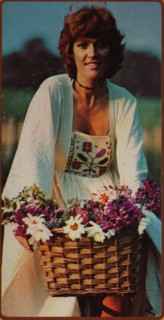
Click on Kiki to return.
*and packaged in scary cartoon artwork to boot,
with a cartoon Kiki in Minnie Mouse drag on the front!
†English lyrics were written by Gary Osborne,
Kiki's sometimes songwriting partner/lyricist who went on to replace Bernie
Taupin as Elton's writing partner during their late 70's/early 80's rift.
‡who was himself a former artist on Elton's
Rocket label, having recorded two albums with the folk-rock band Longdancer.
¤and featuring equally provocative artwork,
what with the 48-year-old Kiki appearing completely nude on the album's
front cover.