| Magical Myths 103 Lesson Nine Dragons! (Part II) |
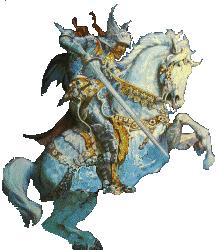
| Continuing with dragons, one of the most famous confrontations between man and beast was St. George, who was reportedly traveling near Silern, Libya, when he heard of a dragon that lived in the local lake. Like many of its kind, the dragon enjoyed feasting on maidens and it refused to allow the townsfolk�s access to their only water supply unless they fed it a maiden each day. Armies prior to this agreement were destroyed tying to fight this creature and St. George arrived on the very day the last maiden in the land was to be sacrificed. She also happened to be the King�s daughter. St. George gallantly offered to fight the dragon and succeeded in killing it with a single strike of his lance. |
| However, as some heroes discover, dragons are often misunderstood. Though they can be frightening, they can also be kind. But don�t expect any friendly dragons in Lord of the Rings. Some scholars say a magical gemstone, call draconite, can be found inside a dragon�s head: �There is cut out of the dragon�s brain a stone, but it is not a stone unless it is taken while the dragon is alive. For if the dragon dies first, the hardness vanishes away with his life...the kings of the East wear these although they are so hard that no man can devise to imprint or engrave anything in it. It has a pure natural whiteness.� |
| In ancient legends, the blood of dragons was magical. This fits with a fact noted in Dumbledore�s Famous Witches and Wizards trading card, that one is his achievement was figuring out the 12 uses of dragon�s blood. Dragons were said to be crafty, gluttonous, and cruel creatures that live in caves or the craters of volcanoes, as well as in lakes and oceans. At times they would feast on livestock or people. Although they have no need for money, dragons are famous for their gold, silver, and other treasures including pearls. Many tales consist of those trying to get to a dragon�s hoard, who by the way, knows of every piece and whoa to any who takes even one coin! (See The Hobbit) We found out a lot about dragons, now you see why dragon-hide gloves are so valuable in many magical applications. We sue their hide, blood, heart, liver and horns as all have magical properties. To Muggles, these creatures do not exist; this is a testament to our well-placed charms and enchantments. We know there are 10 pure-breeds of dragons today, but I am not going to cover that aspect as you can easily get Fantastic Beasts and Where to Find Them. This ends our lesson on dragons. |
 |
 |
| Quiz |
 |
| The success of St. George was so much admired, especially after he was made patron saint of England in the fourteenth century. Dragons then became associated with chivalry and romance, and any literary knight worth his salt had to slay a fire-breathing dragon and rescue a fair maiden to be considered a true hero! |
| 1.) What was the situation that caused St. George to offer to slay the dragon? 2.) Who was the maiden related to that he saved. 3.) What did St. George become afterwards? 4.) What is associated with dragon slaying afterward? 5.) Tell me of the �gem stone� supposedly found in the dragon�s brain. 6.) What is also magical contained within the dragon, and who is famous for finding 12 uses for it? 7.) What are some of the traits of the dragon? 8.) What is so special about them and their �hoard�? 9.) What do �we� use from dragons today? 10.) How many purebred dragons do we know of today? |
 |
| Professor Fairydust will take you back to the Lessons Page! Make sure to turn your to me, though, Hemlock will gladly bring it, if you feed him well. |
 |