 |
 |
 |
| Magical Myths 103 Lesson Eight Dragons! (Part I) |
| Dragons have been featured in myth and folklore for most of recorded history. In the West, they appeared in the early literature of Babylonia, Egypt, Greece, Rome, Germany, Scandinavia, and the British Isles. Physical descriptions of dragons remain fairy consistent from tale to tale. Generally depicted as enormous serpents, dragons tend to have armor with impenetrable scales (thus dragon-hide gloves are the best for many dangerous tasks) and equipped with one of two pairs of legs and a set of bat like wings. The Greek word drakon means �huge serpent�. Legends hold that some dragons have poisonous fangs, sport twin horns, have enormous claws, and a forked or barbed tail. Welsh dragons are often red, German dragons were white, and others came in black or yellow. |
| Almost all dragons had one thing in common, their scorching breath. Most fire-breathers could produce such great flame; entire town and even countries could be destroyed. Even if the dragon was killed, they were still dangerous for the blood was said to be deadly to the touch, but some believed their blood makes good medicine known as �dragons� blood�. Since this medicine�s effects are to miraculous cure wounds it is applied to. Perhaps due to this lore of the dangers of dragon�s blood, we see why one who can discover 12 uses for it would be highly praised. (Albus Dumbledore) Lore also tells us if a dragon�s teeth are planted in the earth, a crop of armed and bloodthirsty warriors will grow. |
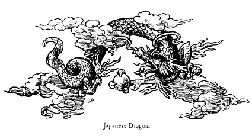
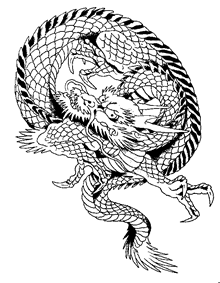
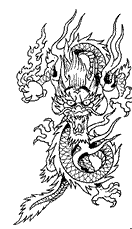
| Dragon lore in China and Japan is quite different. There, instead of being loathed, feared, hunted and attacked, they are welcomed. Dragons have always been viewed as friendly and a sing of good fortune. Though they do neither breath fire nor have wings, they do fly magically. In Chinese legends they guard the skies, bring needed rain and control the rivers and streams. In Japan, they are widely considered to be wise, kind, and helpful. Dragons have served as the official emblem of the imperial family for centuries. The heroes of legend have faced many fiends and monsters, but only a select few have dared challenge the mightiest of them all, the huge fire-breathing dragon. More than just another conquest, in many tales, the dragon represents the ultimate step in the hero�s quest for greatness. So it is fitting that Harry Potter would face a temperamental Hungarian Horntail in his pursuit for the Triwizard Championship. The list of warriors who've done battle with dragons reads like a who's who of heroes. Hercules, of Greek & Roman myth, slew several during his long career. Various Babylonian warriors battled Tiamat, known as the Queen of Darkness. The Norse thunder god, Thor, succumed to the venom of the Midgard Sepent, and Beowulf also met his death while slaying a dragon. In the legend of King Arthur, both Lancelot and Tristran, sometimes cited as the gallant knights of the Round Table, were dragon slayers. Even King Authur, whose last name, Pendragon means "head of the dragon" or "chief draon", had a golden helment which bore a drgaon design. We will continue dragon lore in the next lesson |
| Quiz |
| 1.) How long have dragons been feature in lore and legend? 2.) Physical descriptions of dragons remain fairly consistant, what are they? 3.) Where does the word 'dragon' derive from? 4.) What do all dragons have in common, and what have they been known to do with this...power? 5.) How does the Chinese and Japanese veiw dragons and why is it different then most lore and legend in the European countries? 6.) What must a 'hero' do to truely be counted as a 'hero'? 7.) List some of the warriors, in this lesson, who has faced dragons. 8.) Tell me about King Arthor and how he has ties with dragons? |
 |
| ** Back to the Magical Myth's Lesson Page! |
 |
| Hemlock will bring your lesson to me. |