| Divinaiton Class Tarot History Lesson Four |
 |
 |
|
| These days there is an overabundance of decks to choose from, but in some ways more is less. It sometimes seems that we have lost judgment and discrimination where the Tarot is concerned: there are many decks that are simply gimmicks with scant regard for the history or symbolism of the Tarot. Some are merely nice to look at, which is not a bad thing if the deck is used for its artistic value alone, but offers nothing more. Decks now come in all shapes, sizes and structures: with round cards, square cards, triangular cards and differing numbers of cards. Sometimes the changes are justified, such as the expanded size of the Enochian Tarot (which has 30 cards in the Major Arcana) to accommodate the underlying system of Enochian Magic on which it is based; though whether such a deck is really a Tarot deck is a moot point.
There are now decks based around myriad spiritual traditions, from Paganism, Druidry, Native American Spirituality and Zen Buddhism, to Greek, Norse and Arthurian mythology. But whatever the virtues and vices of these different decks, they confirm the vibrancy of the Tarot and its application to many times and many cultures. The best of these new developments, those that grow from rather than ignore established Tarot tradition and symbology, show that we too can deepen and evolve our use and understanding of the Tarot, just as our forebears did theirs. |
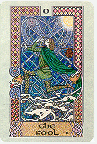 |
| Celtic Deck |
| Tarot cards have been used for divination pretty much throughout their known history, and this is still their main application today. It is by no means their only use, however. Their esoteric links, particularly with the Kabbalah, allow them to be used for spiritual study and meditation. They also have psychological applications and are a valuable tool in the important search for self-knowledge.
The fact remains, though, that most people are interested in the Tarot for the purpose of divination, of seeing what the future has to hold. This raises a number of important questions. Some believe the cards mirror a future set in stone, others that they show likely future trends and problems that can be worked with or avoided, and still others that the cards fall by chance and that reading any meaning into this is empty superstition. The truth is that we don't really know. Subjectively, the cards often do seem to mirror reality surprisingly well, but the human mind does tend to hold on to the hits and lessen the misses in its search for meaning. One thing that is undoubtedly true is that serious use of the Tarot enables a person to consider their life, actions, problems and opportunities with an approach that is both systematic and insightful: a very powerful combination. The cards allow a greater appreciation of the past and how it has molded the present in any given circumstance, as well as showing the possibilities and alternatives of the future. Even if the cards speak in a merely random way of the future, the value and effect of serious Tarot use is still immense because of the perceptive exploratory processes involved in the interpretation of a reading. |
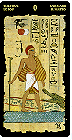 |
| Egyptian Deck |
| Quiz: True or false
1. Today there still remains only two decks of the Tarot. 2. Some decks are merely gimmicks. 3. Decks now come in all shapes, sizes and structures 4. There are now decks based around myriad spiritual traditions. 5. Looking at # 4, give me two examples of such� 6. The best of these new developments show that we too can deepen and evolve our use and understanding of the Tarot. 7. Tarot cards have been used for divination pretty much throughout their known history. 8. They have no psychological applications and are useless tools in the important search for self-knowledge. 9. Some believe the cards mirror a future set in stone. Tarot should not be taken seriously as a predictor of the future. |
 |
 |
| Balian the noble knight will bring your lessons to me, the bag of runes will take you back to the Lessons Page. |