 |
 |
| Divination Class History of Tarot Lesson Two |
|
|
| There are many myths surrounding the origin of the Tarot, and the theories that the cards were invented in ancient Egypt, India or China are often expressed. These ideas owe more to a sense of romance or wishful thinking than to any hard evidence. One popular myth, expounded in Le Monde Primitif (1781) by Court de Gebelin, is that the cards were brought from India by the Gypsies. The true origin of the Tarot cards remains a mystery, but what is known is that cards similar to those we have today first appeared in Italy and France in the late 14th century as stated in Lesson One. |
| The earliest known cards still in existence date from 1392 and, of these, only 17 remain. It is believed that Jacquemin Gringonneur painted them for Charles VI of France, but it is possible that they are actually less ancient and are Tarocchi of Venice cards from the middle of the 15th century. Italian artist Bonifacio Bembo painted the earliest surviving full deck in 1422. This is known as the Visconti deck after the family name of its commissioner, the Duke of Milan. Some pretty highbrow card owners, but you have to remember, it took an aritst to duplicate each deck and that was something a commoner could not afford! |
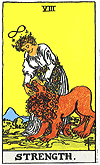
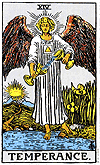
| The standard modern deck consists of 78 cards split into two sections: the 22 cards of the Major Arcana (the archetypal Tarot cards, such as the Lovers, Death and Judgment), and the 56 cards of the Minor Arcana (four suits of fourteen cards, each comprised of cards numbered from one to ten, and four 'court' cards). This structure is a derivation of the Venetian or Piedmontese Tarot, but early decks were of several types with varying numbers of cards. Examples of early European decks related to the Tarot include: |
| Tarocchi of Venice (also known as the Lombardi Deck), which has the same structure as a modern Tarot deck Tarocchi of Mantegna, consisting of five series of ten cards each Tarocchino of Bologna, which differs from the standard structure in having no court cards in the Minor Arcana (so 62 cards in total), and is thought, most likely erroneously, to have been invented by Francois Fibbia, Prince of Pisa Minchiate of Florence, a 98-card deck consisting of the standard 78 cards augmented by twenty additional major cards representing the twelve signs of the zodiac, the four elements (Fire, Water, Air and Earth) and four cardinal virtues (Hope, Prudence, Faith and Charity; though these are often considered to be Wisdom/Prudence, Temperance, Courage/Fortitude and Justice). |
| While there is little actual evidence for the existence of the Tarot before the 14th century, many of the ideas symbolically depicted on the cards are much older. While cards like the Juggler (Magus), the Pope (Hierophant), the Devil and the Last Judgement seem fully at home in the context of medieval Europe, others, such as the High Priestess and the Moon, have a more pre-Christian feel to them. |
 |
 |
| Quiz: 1. We know myth sourrounds the origin of the cards, where are some of the places they are thought to come form? 2. The Court de Gebelin implies the cards were carried from India by who? 3. The earliest know cards date back to when? 4. It is believed that Jacquemin Gringonneur painted them for who? 5. Italian artist Bonifacio Bembo painted the earliset surviving full deck in 1422 for who? 6. How many cards does the standard modern deck consist of? 7. What are the two sections of this deck called? 8. What section would the Lovers, or Death fall into? 9. No evidence exsit that shows us the cards appeared before the 14th century, yet what are some of the symbolic depictions seen on the cards? |
 |
 |
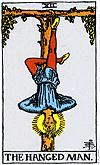
| Clicking the Hangman will take you back to the Divination Lesson Page. |
| The Knight Balian will bring me you lesson if you wish. |