 |
| Divination Class History of the Tarot Lesson One |
|
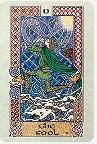
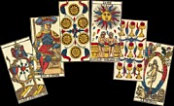
| Though I will not teach you to read the Tarot cards, nor encourage you to do, what I can do is educate you on the Tarot�s history. From that you do what you feel is proper; I just think education is the key to understanding all things. Some time in the first half of the fifteenth century, somewhere in northern Italy, someone created the first set of tarot cards. They were similar to the playing cards of the time; the tarot deck included number cards (1 through 10) in four suits, and court cards page, knight, and king. However, the tarot deck had more: a queen was added to each of the courts, and 22 special cards, not belonging to any suit, were added. These special cards bore symbolic pictures, with such subjects as the Emperor, the Pope, The Wheel of Fortune, Death, the Devil, and the Moon. The tarot cards were used to play a new type of card game, similar to bridge, but with 21 of the special cards serving as permanent trumps, which could be played regardless of what suit was led, and outranked all the ordinary cards. This Game of Triumphs, as it was called, became extraordinarily popular, particularly among the upper classes, and spread through northern Italy and eastern France. As the game spread to new locales, changes were often made in the pictures, and also in the ranking of the trumps, which usually bore no numbers. In time, tarot spread south to Sicily and north to Austria, Germany, and the Low Countries. So, you see, it all started simple enough, a card game, a popular card game. |
| Centuries later, devotees of the occult arts in France and England encountered the tarot and saw mystical and magical meaning in the enigmatic symbolism of the cards. Their fascination with the cards led to the reputation tarot presently has as a divination tool and occult artifact. Our first objective to understanding the tarot history is to trace the many changes the cards have undergone through the centuries, as they were taken to different locales and redesigned by different artists and card makers. Many alternate designs are beautiful, intriguing, or provocative, giving us a window on the popular culture of different times and places. These cards were not mass-produced like we see today, they were all hand made locally! A second objective is to find clues pertaining to the stubborn mystery of the origin of the tarot cards: What was on the mind of the original designer? Did the symbolic pictures have a deeper meaning and purpose, or were they merely game pieces? The question is surprisingly difficult to answer. We can gather some evidence from the art, literature, and popular culture of the time. We can also look at the cards themselves, and the occasional written references to them that have survived. From such evidence, it is possible to build up a picture of what the tarot symbols might have meant when the cards were first created. Different people, though, come up with very different pictures! The evidence is vague. |
| Quiz: 1.) What time period was the tarot first designed? 2.) Where were they first found, what country? 3.) Being different from the decks back then, what was added to each court in the tarot deck? 4.) Also card containing symbolic pictures were added, they belonged to no number, give me three examples. 5.) The card game first played with these cards was similar to what game we know today? 6.)What two countries encounter these cards later and found mystical meanings in the designs? 7.) Who would redesign the cards and what influences would cause the redesign? |
 |
 |
 |
| The Hangman will take you back to the Divination Lessons Page, Balian (OB) will bring me your lesson if you wish. |
|
|