| Symbolisum Lesson Nine |
 |
| The Symbolism of Celtic Design
The visual vocabulary of Celtic design expresses many messages. Those who are attracted to these symbols and designs in modern times and who choose to use the motifs of ancient times in today's world are often frustrated by an apparent lack of reliable information about their meanings. Scholars are very cautious about assigning meaning to a specific knot or spiral. There are really only a few "official" Celtic symbols with widely accepted meanings. Some claims about Celtic symbolism are through clever marketers who have invented shameless bogus statements. Some modern innovation is, however, a valid expansion of the Celtic tradition as it adapts to new times and new visions and should be considered authentic in this context. There is a common expectation that the meaning attached to a symbol in modern times should be the same that ancient artists intended for that same symbol. Everything changes with time. Our present interest in Celtic design does not simply skip a thousand years from the age of the Book of Kells to the present. Many of these symbols have been used in every century since the Dark Ages. |
| The art of the Celtic Revival of the 19th and 20th centuries is as much the heritage of the CyberCelt of the Third Millennium as is the magnificent Celtic Art of Pagan and early Christian times. A few Celtic motifs have meanings that are more-or-less a consensus of contemporary Celtic designers and artists. The meanings attached to these symbols can often be traced to the rediscovery of Ireland's cultural history in Victorian times as well as the emerging sense of national identity in Scotland, Wales, Isle of Man, Cornwall and Brittany as these cultures struggled to maintain their unique traditions and characteristics.
The current Renaissance of Celtic Art adds new agendas and a new imagination about how the old relates to the new. Some recent Celtic symbolism is very innovative adaptations of contemporary concerns, intellectual fashions and spiritual trends. Artists are by their nature creative and imaginative. An intuitive sense of symbolism should be recognized for what it is; the communicative intent of the artist. The following explanations are offered as a guide to understanding some of the more important symbols and emblems of Celtic Art. The links are to in depth articles on each topic. There is a common folklore that each knot has a specific meaning. The problem with this idea is that there are no facts to back it up. There is no "Rosetta Stone" or reliable "dictionary" of knots. A general symbolism of Celtic interlace can be expressed as representing the repeated crossings of the spiritual and physical paths in our lives. The never ending path is often said to represent "permanence and the continuum of life, love and faith". How valid is this statement in an historical sense? |
| Eternity Knot There is not just one knot that can be called an "Eternity Knot". Any knot that has a closed path, with no beginning or end may be symbolic of eternity or continuum. It is debatable if this was ever the intentional meaning of ancient scribes, but since this meaning was suggested by the great Scottish Celtic art teacher of the 20th century, George Bain, it has been an accepted meaning by many artists and craftsmen. Since knotwork is often used as an emblem of heritage, the symbolism of "continuum" reinforces the endurance of the tradition. |
| Lover's knot Likewise any knot can be a "lover's knot". Most commonly knots that link separate path's are used as lover's knots. The "Josephine Knot" or "Granny knot" is a linking knot that is frequently called a lover's knot.
Heart knots are a rather recent addition to Celtic symbolism. Hearts as symbols of "love" date from the later medieval period but have become an established part of the contemporary Celtic repertoire in the last decade of the 20th century. |
| Celtic Cross
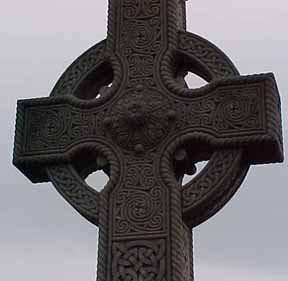
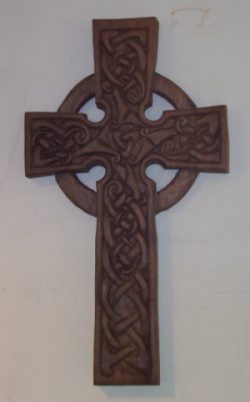
The cross with its characteristic circle is probably the most widely recognized of all Celtic symbols. Large stone crosses, known as "High Crosses" emerged as a major sculptural tradition in Ireland, Scotland and other Celtic lands from the 9th century or earlier. During the Celtic Revival new monuments in this style were crafted that added a self-conscious message of Celtic heritage to the widely recognized emblem of the Christian faith. The circle is often described as an halo or an eternity symbol. Much has been made of the similarity between the Celtic Cross and pagan sun symbols. There is a mystic tradition among Celtic Christians of interpreting this as a clairvoyant anticipation of the coming Gospel by the pre-Christian Druids. |
 |
| Quizz: True or False 1.) Scholoars have asgined meaning to all knots and sprials. 2.) Nothing changes in time. 3.) Many Celtic designs have been used in every centruy since the Dark Ages. 4.) There is a common folklore that each knot has specific meaning. 5.) Much information is found in a reliable dictionary. |