| Symbolisum Lesson Five |
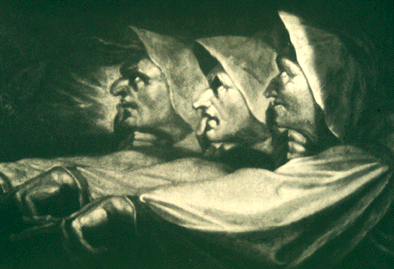
| We continue with the number three...... Three Fates There are lots of trios of women in mythology and in art . . . From the Music of the Spheres, the circles of heaven turned and on each were a siren, each singing a single note. Plato says that on the circles were the three fates, daughters of Necessity, the three sisters that controlled destiny, chanting to the Sirens' music. Lacheses of things past, Clotho of things present, Atropos of things to come, like the three ghosts in Dickens' A Christmas Story. The length of a single thread determined the length of someone�s life. Clotho held the spool, Lachesis pulled the thread, Atropos snipped. Three Witches Recall the famous lines from Macbeth, Double, double, toil and trouble; Fire burn and cauldron bubble. They appear to be making hot soup for lunch, and Shakespeare even gives the recipe, poison'd entrails, selter'd venom, fillet of fenny snake, eye of newt, toe of frog . . . and much more. Why three... Three Furies These three lovelies are sometimes called Resentful, Relentless, and Avenger. Their heads were covered with serpents and they breathed vengeance and pestilence. They were often found in the company of Mars, god of war. |
 |
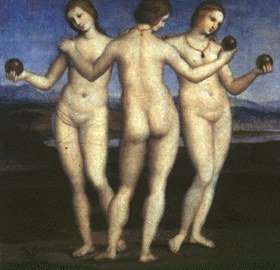 |
| Rapheal's Three Graces |
| Three Graces
A more appealing trio of women is The Three Graces, sometimes called Splendor, Mirth, and Good Cheer, or Beauty, Gentleness, and Friendship. They were often shown with Venus, the nine Muses, and Apollo. The three graces is a very popular art motif, with involved iconography, but might have been just an excuse for artists to portray nude women. |
| Earthly Fours
The number four is associated with the earth in many ways. Four Ages of the World Ovid writes of the Four Ages of the World: * Gold, the first, free of fear and conflict * Silver, the second, where man had to seek shelter * Bronze, the third, aggressive but not yet entirely evil * Iron, the fourth, with treachery, violence, greed deceit, and war. Four Cardinal Virtues Plato, in his Republic mentions four virtues, Prudence (or Wisdom), Fortitude (or Courage), Temperance, and Justice. These are called the four cardinal virtues. Four Winds The invention of the four winds is a simple enough addition. In Jeremiah 49, 36 we read "I bring the four winds from the four quarters of heaven, and will scatter them toward all those winds" From Virgil's Aeneid we have Aeolus, King of the Winds, who lived on an island just north of Sicily, who ruled the four winds: * Boreas, the north wind (Latin, Aquilo) * Zephyr, the west wing (Latin Favonius) * Notus, the south wind (Latin Auster) * Eurus, the east wind (same in Latin) Four Seasons In Greek mythology, the seasons came about when Hades abducted Demeter�s daughter, Persephone to the underworld. There followed an awful flap, too involved to relate here, but they finally cut a deal where Persephone spent half the year in the underworld, which time became autumn and winter, and half above ground, which became spring and summer. The movements of celestial bodies may also have led to four becoming identified with the four directions, toward the sunrise, towards the sunset, and the two directions perpendicular to these. Thus four is the number of the cardinal points, N, S, E, W, and the directions in which a person can move; right, left, forward, back. |
| Quiz: 1.) Who were the Three Fates? 2.) What are the Three Furies called? 3.) The opposite of the Three Furies would be the Three Graces, name them. 4.) We learn that the number four has both earthly meaning, but also celestial. What are the Four Ages of the World? 5.) What are the Four Cardinal Virtues? 6.) What are the �cardinal points�? 7.) In Greek mythology, how did the four seasons come about? |