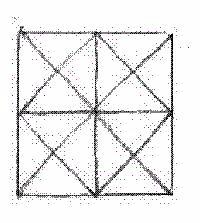
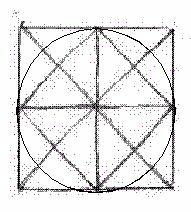
Since a circle is a non-square, irrational shape, the usual way perspective assimilates it into its square, logical world is to deal with it as if it were captured by a square. This is straight line figure traditionally known as "The Majik Square" (right) .
|
|
|
To determine the proper proportion of an elipse representing a circle
situated in space, a Majik Square is drawn where the circle is needed using
already existing vanishing points (those determined by some previously
drawn rectilinear object).
It is essential that the Majik Square appear to represent a square
,not a rectangle!
Then the elipse is drawn in touching the square in all the right places.
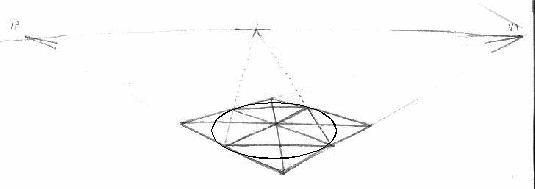
Notice that the center of the square is also the center of the circle.
The center of the elipse is at the intersection of its major and minor
axes and is at a different place. In the above drawing, it is below
the circle's center. Why is this?
Why can the major axis of the elipse never be one of the lines
of the Majik Square or a diameter of the circle?
The Majik Square yields only the proportion of the minor axis to the
major axis: The Majik Square technique is accurate only to the extent that
it represents a square and not a rectangle in the perspective drawing.
Unfortunately, there is no simple way to determine its "squareness" other
than guessing. Furthermore, It is not helpful in drawing the eliptical
curves. The eight points are frequently located asymmetrically on
the eliptical curve and hitting them while drawing a symmetrical elipse
is difficult. It is for these reasons that the "cruciform" technique
is preferred by many artists.
