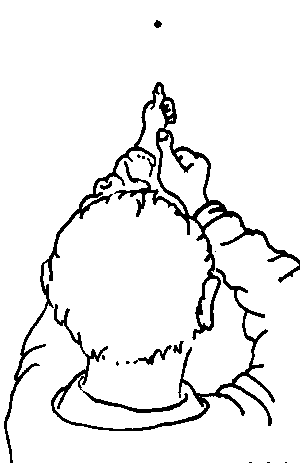
A drawing, painting or traditional photograph is a single image.
Although it is viewed with two eyes, both eyes see the same image. No stereoscopic
feeling of depth is present. Its image, no matter how realistic, will always
have this essential flatness. The second method of contour perception relies
on the phenomena of light. As light illuminates a surface's area, it bounces
off and some of it enters our eyes. If less light illuminates a given area,
less bounces off, and less light enters our eye. Illumination is strongest
when the light's direction is perpendicular to the surface. Less light
illuminates a given area if the surface is at some other angle. 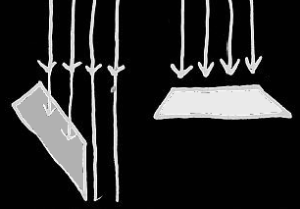 And,
of course, illumination drops greatly when the surface is turn so that
the surface is in shadow. Artists commonly call this "shading."
And,
of course, illumination drops greatly when the surface is turn so that
the surface is in shadow. Artists commonly call this "shading."
Illusions of shading may be produced by coloring, especially light
and dark (value) and are commonly used to create the appearance of contours
and depth in artworks. The third method of seeing form involves edge detection.
For our purposes, there are two types of edges. One type, we call "primary"
edges are seen when the shape and viewpoint conspire to create a horizon,
in other words when the shape disappears behind itself or, in some other
way, ends.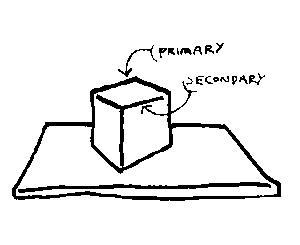
The other type, secondary edges, are boundaries that mark a more
or less abrupt change of direction of a surface, such as the near edge
of a cube seen from a 45 degree view (kitty corner).
Contour Edges.
A contour may end by disappearing behind another contour (of itself
or something else) the way the edge of your fingernail vanishes under the
flesh of your finger or vice versa. Or the way the edge of a finger may
disappear under a ring.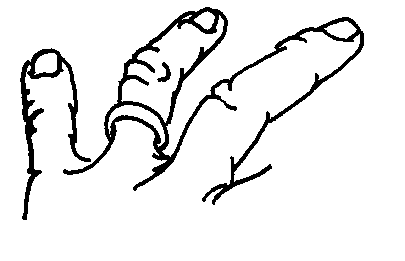
A contour may end because the modulation of the surface diminished
to the point where there is longer any horizon (define).
If you hold your finger in front of your face and point it at your right
ear, you will observe that the bottom contour of your index finger disappears
to the left in this manner.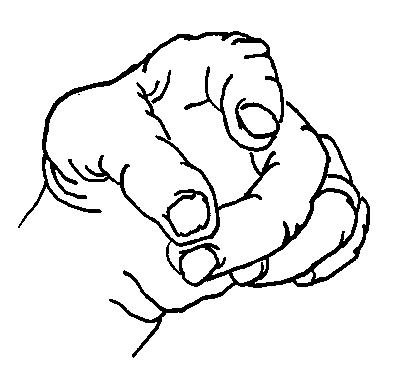
Some objects have contours that have no terminus. An egg's contour
is continous, with no beginning or end. In the case of an egg an artist
would have to start at an arbitrary point.
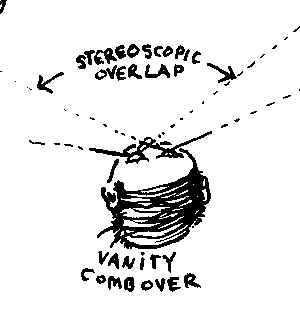 Stereoscopic vision is used by creatures whose two eyes provide overlapping
visual fields. Each eye presents the brain with an image within which the
comparative displacement of objects is directly related to their distance
from the creature.
Stereoscopic vision is used by creatures whose two eyes provide overlapping
visual fields. Each eye presents the brain with an image within which the
comparative displacement of objects is directly related to their distance
from the creature.