
This line of words is the title of the painting shown below that was completed by Paul Gauguin in 1897. These questions are the starting point for the second section of this semester.
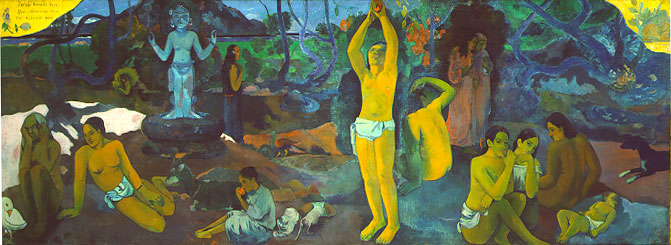
2. Compare the way Genesis describes this ordering with the way Plato described the creation of the universe in the Timaeus.
3. All of the great spiritual books and cultural traditions of peoples are filled with instructions about listening: The Upanishads, the Koran, the Judeo/Christian bibles, for example.
4. Great emphasis is placed on what we can hear, on how to listen, and on forbidden imagery.
1. Formed exactly like an embryo, head down.
2. The organ of Corti, the most important element of hearing, develops out of the skin of the embryo.
3. the Cochlea repeats the shape of the embryo.
a human embryo starts to develo[ rudimentary ears a few days after impregnation, when it is about .9mm long. The embryo gets everything from its mother but still wants to have its own ears. WHY?
4. The organ of hearing, the Cochlea, is completely developed and is full sized just 4.5 months after fertilization (135 days) . What's it up to?
5. The Cochlea (inner ear) is the only one of our senses that never sleeps. It locates us in space, contains balance receptors and measures angular velocity,so that when we wake up in the morning we immediatly know we are lying down. The word Coclea is Latin and translates to "Snail Shell."
6. What does the brain do with sound vibrations? The Interactive Ear
7. When we are asleep we close our eyes and mouth, lose our sense of touch and are unaware of ordinary smells. Our ears stay awake.
8. The world is sound.
9. Hearing involves quantisizing. Our ear measures.
10. How are seeing and hearing different physical experiences?
11. Sound, hearing, transformation to logarithms.
12.Is there a spiritual power in music?
13. Music has two languages: We read it from the complex pictograms of music notation and we calculate it mathematically.
Q? Even if you cannot read music notation, how do you measure sound? Musical example played in class: did you in any way "measure" any element of what you heard?
The Places of Music in Human Life
1. What if there were suddenly nothing musical - no organized sound - when would you miss it the most?
2. How different would religious services be if there was no music, no hymns, and prayers were all spoken in a plain (unmusical) voice?
3. Do you sometimes want to hum or sing? When does that desire occur?
Western Music after the fall of the Roman Empire. NEXT