
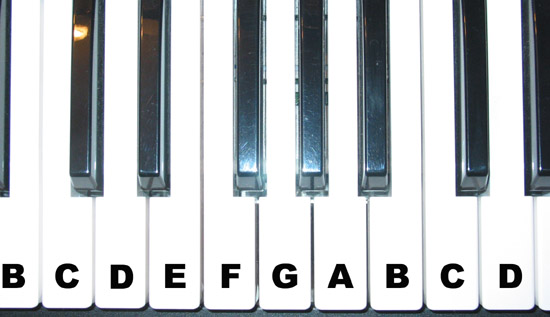
DEMONSTRATION IN CLASS:
If we begin a modal scale on C and play the next 6 white notes in order we have the spacing for a MAJOR scale on C. All major scales will have the same spacing as C Major, but to get them we have to use black notes. The modal scales are the patterns of spacing that occur when you play seven consecutive white notes starting on any letter name. The differences in these patterns give each mode its own character. When you start this pattern on A you are playing a MINOR SCALE. You can play major and minor scales starting on any note by repeating the pattern of spacing.
What do you get after 7 consecutive white notes?
The same note names begin again an octave higher. An octave is a measurable interval - a musical distance between two notes of the same name. If there is no piano in our classroom, let's try the websites for a demo.
Whole and Half Steps, or, Major Seconds and Minor Seconds. Two white notes that have a black note between are MAJOR SECONDS. Two white notes without a black note between are MINOR SECONDS.
So what?
A Major Second is a farther-apart sound than a Minor Second.
What is Harmony?
Two or more different notes are sung or played at the same time. while melody is horizontal, one note at a time, harmony is vertical ( multuiple notes at the same time).
Listen to Chant: Examples will be played in class.
1. Is is SYLLABIC or MELISMATIC?
2. Why is the singing is plain, unemotional?
3. The roots of chant are in the Greek, Jewish and Latin Liturgical music.
4. Are the instruments playing along with the singers?
5. Do you hear harmony?
6. What does the word "monophonic" mean?
Q. Why add notes to one syllable? Why not keep the music completely syllabic?
What is the effect of adding notes to a syllable? what change does that make?
Could this have any effect on the singer and on the purpose of singing prayers?
