
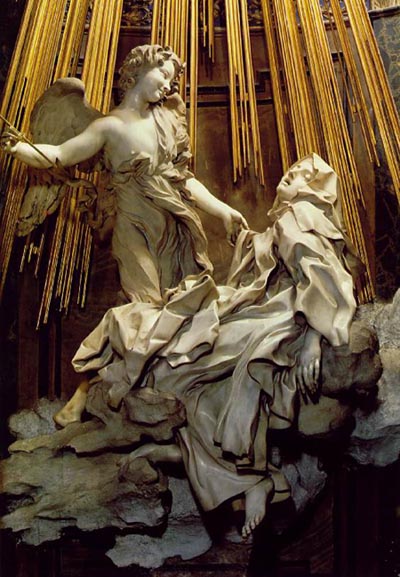
The Catholic Church sought to glorify Rome with artworks as part of the Counter Reformation against Martin Luther and Protestantism. the arts of the Baroque era, from about 1600-1750 express emotion, often deep and intense such as the work pictured above. Bernini's St. Teresa, like his "David" is passionate, intensely active.
The work is dramatic, a theatrical piece embedded in the architecture of the church. There is no sense of linear perspective, of one perfect place to view the work from, bringing the viewer into the drama, into the life of Teresa at her moment of extreme emotion.
Renaissance Art Baroque Art
Horizon line, objects placed on the horizontal Objects placed on diagonals
Light all over the artistic image: Dramatic chiaroscuro
Balance and symmetry, Assymetry, intense action, Calmness in emotional situations Intense emotional Expressions.
GIANLORENZO BERNINI
Coronaro Chapel with Ecstasy of St Teresa, 1645-50
Santa Maria della Vittoria, Rome; Marble
Combines painting, sculpture and architecture
Theatrical space mingling real, painted and sculptured spaces
Erotic form of mysticism showing the moment when St. Teresa falls in ecstasy as her heart is about to be pierced with the divine light of God. The light pours down from a window above, streaming down gold shafts.
Saints become important in the Counter Reformation.
Diego Velazquez (Spain) 1599-1660: Las Meninas
Caravaggio (Italy) 1571-1610: Medussa, The Calliing of St. Matthew
Rembrandt (Netherlands) 1606-1699: Parable of the Rich Man, Nicolaes Tulp's Demonstration of the anatomy of the Arm, the Return of The Prodigal Son, Self Portrait (his last in 1699).
Vermeer (Netherlands) 1632-1675: the Milkmaid, Woman With a Water Jug, Girl With a Pearl Earing.