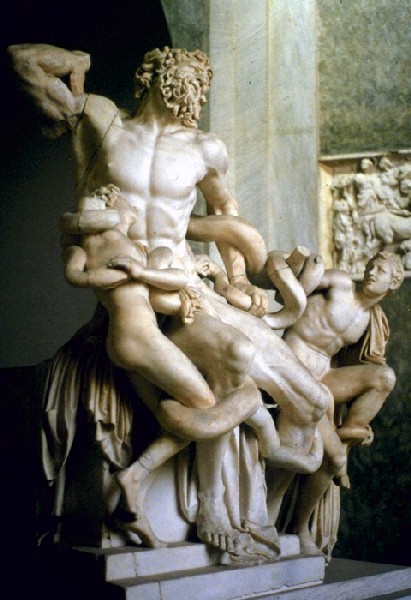
The Laocoon. and his Two Sons. 1st Century CE. Marble. 5' high.
Based on a Greek myth related to the Trojan War, this group shows the priest Laocoon and his sons being punished for defying Poseidon by telling the Trojans about the Trojan Horse strategy.
a. What is very unrealistic about this work?
b. Do the elements of this statue group meet the Classical canons?
c. Are these figures posed in contrapposto?
d. Should we consider this work "Classical," or "Romantic?"
e. If there is an 'action' that is about to happen, what do you think that action will be?
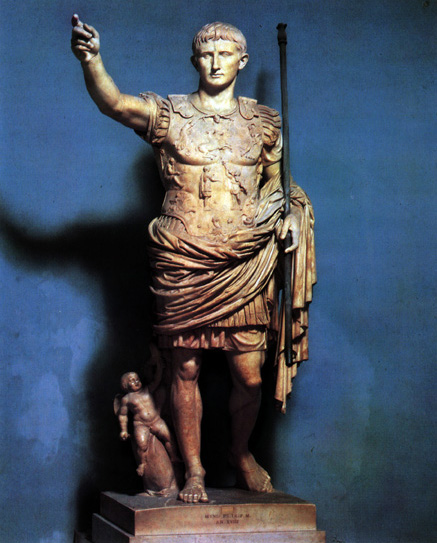
The Roman emperor Augustus of Primaporta (6'8")
1. Describe his posture and expression.
2. Is this figure posed in contrapposto?
3. What, if any, of the Classical values are retained in this work?
4. If this figure is an idealized image, why show him clothed?
5. Is this figure 'Classical' or 'Romantic?'