
2. Their are no straight lines in the entire structure. A system of curves softens the angularity, reduces the way our eyes perceive such a heavy rectangular building.
3. The columns are placed to allow an unrestricted view of the statue. Each column gradually becomes thinner from the middle up.
4. PBS video on the Parthenon at THE ACROPOLIS EXPERIENCE
5. What are the Parthenon (Elgin) Marbles? Where are they now? Are they properly displayed? Should they be returned to Greece?
6. Take a guided tour of the Parthenon friezes known as the Parthenon Marbles and as
as the Elgin Marbles.
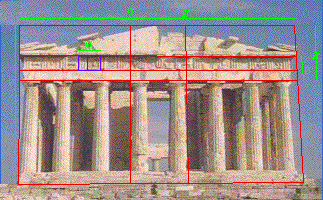
Demonstration of how the Parthenon was constructed using the Golden Mean
proportions: No link at this time 2/21/08
(1)Q. Who was Fibonnaci?
(2)Q. What are the Fibonnaci Numbers?
(3)Q. What is the relationship between the "Golden Mean" and the "Fibonacci Numbers?"
(4)Q. Do the proportions of the Golden Mean apply to the human body?
The Fibonacci Numbers and natural examples of the Golden Mean http://www.mcs.surrey.ac.uk/Personal/R.Knott/Fibonacci/fibnat.html