
The "Master of the Cascade Hairdo": Sculptors of Wood from BaLuba in E. Zaire.
Also referred to as the "Headdress People". The Buli sculptures have distinctive characteristics.
For the 'Buli' people only a woman's body is strong enough to contain the
wisdom of ancestors and the blessings of spirits.
Male rulers are sustained by the enduring grace of the kings before them
whose wisdom and powers are channeled through the women around the
living king. The women are the means for holding the king up and sustaining his memory.
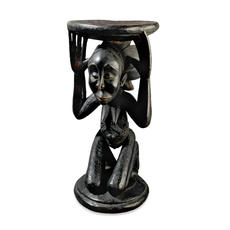
They are the exclusive property of clan heads, chiefs, kings.
The long face, arched eyebrows and an expression of suffering may indicate the figure's knowledge of outside forces that could threaten the leader. While the figures seems frail and emaciated, stooped over, this attests to the inner strength of women.
Facial features are stylized with eyes shaped like coffee beans, elongated hands and figures, angular planes.
Q. How does this figure imply strength?
Q. Describe the Manner in which the artist finished the surface of the work.
The Aesthetics of African art.
African art is considered beautiful and good when it embodies the basic nature, the essence of the subject.
African art expresses dynamic life forces and spirit beings. These forces are brought to life, made visible with powerful symbols from multiple types of materials.
African art is richly textured, multi-dimensional. Masks, costumes, carvings are in full relief, to be seen from any position as the embodiment of life forces.
Materials and medium have mutually agreed on meaning and are recognized in art for the status they impart.
This has been a tiny excursion to an area of the world that has 54 countries, 1,000 languages and nearly 800 million people. Please visit my LINKS page for connections to museums and websites about Africa and the arts of its peoples.