 |
|
|
|
|
|
|
|
|
|
|
|
|
|
|
|
|
| Basic Scientific Description |
|
|
| Normally, we consider matter to have three distinct states: solid, liquid, and gas. However, there are states of matter which do not meet the necessary requirements of any of these three categories. For example, a substances such as mayonnaise is somewhere between a liquid and a solid. |
|
|
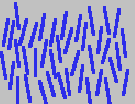
| Liquid crystals are also not quite liquid and not quite solid. Physically, they are observed to flow like liquids, but they have some properties of crystalline solids. Liquid crystals can be considered to be crystals which have lost some or all of their positional order, while maintaining full orientational order. For example, imagine a large number of toothpicks put into a rectangular box and shaken. When you open the box, the toothpicks will be facing in about the same direction, but will have no definite spatial organization. They are free to move, but like to line up in about the same direction. This is a primitive model for nematic liquid crystals. |
|
|
|
 |
|
Nematic Liquid Crystals |
|
|
|
|
| Nematics are polarizable rod-like organic molecules on the order of 20 Angstroms in length. Because of their tendency to organize themselves in a parallel fashion, they demonstrate interesting and useful optical properties; the digital watch you used to wear back in the 80's functioned using nematic liquid crystals. Today, many more useful and interesting properties of nematics are known and exploited. |
|
|
|
 |
|
Smectic Liquid Crystals |
|
|
|
|
| Smectic Liquid crystals are different from nematics in that they have one more degree of orientational order than do the nematics. Smectics generally form layers within which there is a loss of positional order, while orientational order is still preserved. There are several different categories to describe smectics. The two best known of these are Smectic A, in which the molecules align perpendicular to the layer planes, and Smectic C, where the alignment of the molecules is at some arbitrary angle to the normal. |
|
|
|
|
|
|
|
 |
|
|
|
Back |
|
|
|