TThe
greatest future change most people will see will be
in automobiles. They will be smaller, stronger, lighter in
weight, have good performance on the order of what we have now or
better. Will the cars
be "hybrids" with both internal combustion and electric engines with a
huge battery slung under the vehicle? Or, will the fuel cell car
finally emerge from the laboratory where the smallest of such usable cells is
now the size of a refrigerator?
Or, will we use hydrogen as fuel burning it in an internal combustion
engine?
 If economics prevail
we will be driving something more like what we have than not and it
will be something fueled by a liquid we can get at the filling stations
already we have. Electric batteries are very expensive
and last but a few years as they poison themselves with side
reactions.
If economics prevail
we will be driving something more like what we have than not and it
will be something fueled by a liquid we can get at the filling stations
already we have. Electric batteries are very expensive
and last but a few years as they poison themselves with side
reactions.
Hydrogen is gas notoriously hard to compress, contain and keep safe. It burns with a flame invisible in sunlight and is the fireman's worst nightmare. Electric cars have to get the electricity from somewhere and take hours to charge so any pollution saving vanishes at the power plant and always with a bonus of waste due to transmission losses.
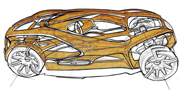 Given these realities and what is
available we expect the car of the future to be made with a composite
shaped space frame like race cars. It will be covered with
panels of carbon fiber sealed in plastic of the
kind now used to make Formula I race cars. These
are very strong and can be designed to crunch in ways that protect
the passengers. The final vehicle will weigh 1/3 to 1/2 what
today's cars and get two to three times the fuel mileage as a
result.
Given these realities and what is
available we expect the car of the future to be made with a composite
shaped space frame like race cars. It will be covered with
panels of carbon fiber sealed in plastic of the
kind now used to make Formula I race cars. These
are very strong and can be designed to crunch in ways that protect
the passengers. The final vehicle will weigh 1/3 to 1/2 what
today's cars and get two to three times the fuel mileage as a
result.
The car will be powered by a small turbocharged Diesal engine that can burn almost anything, but will most likely be running on butanol. This is the four carbon alcohol that can be made from wood chips and waste, brush and leaf cuttings, corn stalks and just about anything that has ever been a green plant. We have a bacteria that consumes waste and exudes butanol in exchange. Butanol is 100 octane fuel naturally, it has more energy per pound than gasoline. It is not as volatile, flammable or dangerous.
Butanol can be put into existing pipelines, which ethanol cannot and it uses what we have been burning, burying and wasting up to now. It will not force the price of corn up astronomically as will current ethanol fuel plans and where the source material is waste the only cost of that is collecting, chopping, much of which is done now in preparation for landfills. We know that we already have enough source material to power the nation with butanol when we build the plants for making it and that is not the case for corn.

The car of the future could be modular with the original design in the "hatchback" format. Removing the hatch window and the rear panel would allow an insert converting the vehicle to a small truck. These inserts could be rented for special occasions or purchased by the frequent user. A larger, longer version with an additional wheel or two could make the temporary truck a larger capacity unit for hauling lumber and building supplies for the weekend warrior, moving or buying furniture, change the add-on body parts, click on the "Performance" chip and go racing.
If economics prevail
we will be driving something more like what we have than not and it
will be something fueled by a liquid we can get at the filling stations
already we have. Electric batteries are very expensive
and last but a few years as they poison themselves with side
reactions.
Hydrogen is gas notoriously hard to compress, contain and keep safe. It burns with a flame invisible in sunlight and is the fireman's worst nightmare. Electric cars have to get the electricity from somewhere and take hours to charge so any pollution saving vanishes at the power plant and always with a bonus of waste due to transmission losses.
Given these realities and what is
available we expect the car of the future to be made with a composite
shaped space frame like race cars. It will be covered with
panels of carbon fiber sealed in plastic of the
kind now used to make Formula I race cars. These
are very strong and can be designed to crunch in ways that protect
the passengers. The final vehicle will weigh 1/3 to 1/2 what
today's cars and get two to three times the fuel mileage as a
result.The NatroX™ System
Carbon
dioxide will be collected with a Natrox™ system. In an
automobile it is little more than a light metal box about the size of
two or three mufflers loaded from the top with a proprietary compound
that captures and chemically compresses every cubic foot of carbon dioxide down to
a salt with a volume of 1.5 ounces. The box is unloaded and
reloaded every time the fuel tank is filled the charge is modest as the
active chemical is recovered as well the carbon sequestered.
The car will be powered by a small turbocharged Diesal engine that can burn almost anything, but will most likely be running on butanol. This is the four carbon alcohol that can be made from wood chips and waste, brush and leaf cuttings, corn stalks and just about anything that has ever been a green plant. We have a bacteria that consumes waste and exudes butanol in exchange. Butanol is 100 octane fuel naturally, it has more energy per pound than gasoline. It is not as volatile, flammable or dangerous.
Butanol can be put into existing pipelines, which ethanol cannot and it uses what we have been burning, burying and wasting up to now. It will not force the price of corn up astronomically as will current ethanol fuel plans and where the source material is waste the only cost of that is collecting, chopping, much of which is done now in preparation for landfills. We know that we already have enough source material to power the nation with butanol when we build the plants for making it and that is not the case for corn.
The car of the future could be modular with the original design in the "hatchback" format. Removing the hatch window and the rear panel would allow an insert converting the vehicle to a small truck. These inserts could be rented for special occasions or purchased by the frequent user. A larger, longer version with an additional wheel or two could make the temporary truck a larger capacity unit for hauling lumber and building supplies for the weekend warrior, moving or buying furniture, change the add-on body parts, click on the "Performance" chip and go racing.