The
Virtual Classroom Project
“Rethinking and Improving Distance Education”
A Joint Project by:
California State University Sacramento
For more information
The Virtual Classroom Project
A highly effective and inexpensive answer to traditional distance learning…
Introduction
We’re all familiar with distance education, right? Either it’s a difficult text-based system with dropout rates as high as 80%, or it means watching a classroom on the local cable-television system and getting busy signals when you try to telephone in a question. Global Training Partners introduces true distance education that does not sacrifice the immediacy and interactivity of the traditional classroom.
In December 2000, eight accounting students approached Dr. Kent Meyer about teaching an “off-track” tax course during the four-week intercession between the Fall and Spring Semester. One student, a single parent residing outside the Sacramento region, asked whether this course could be delivered via the Internet so that he would not have to make the long commute.
We are entering a new era of higher education, where both the student and the instructor will be freed from the limitations of the traditional classroom. – Dr. Meyer
Intrigued by this challenge, Dr. Meyer approached several individuals with high-tech backgrounds and began looking for a way to deliver this course while maintaining the key elements of the traditional classroom setting:
1. The course must be available at little or no extra costs to the students;
2. The course must be interactive and in real-time; and
3. The course cannot require any extraordinary training or additional preparation time for the instructor.
When informed that other universities had tried and failed, Dr. Meyer refused to accept that such a course would be too expensive to deliver and require months of set-up time. Instead, Dr. Meyer enlisted the help of Rolando Cabiles, a former student and the Assistant Chief Financial Officer of a small start-up company. With a shared propensity to think “outside the box”, the two began looking for a means to deliver the course via the Internet without sacrificing the key elements. Despite neither one having a technology background (or perhaps because of it), they succeeded and the Virtual Classroom Project was born.
I would definitely consider taking another course delivered this way. I enjoy being able to sit in the comfort of my home while watching the lecture. – Jaime Breen, student.
Recognizing a Current Need for the VCP. As enrollments increase at the majority of California’s colleges and universities , the current need for the VCP becomes obvious. Students can no longer be viewed as young, unmarried adults without children. Some are single parents, working professionals returning for a second degree, and others can only attend class on campus with great difficulty. The VCP can reach all of these students without increasing the burden on an overcrowded infrastructure.
As a single of parent of 2 children, I am very thankful for courses like this. CSUS needs to consider the needs of ALL college students, not just the ones who have the ability to attend on a conventional schedule. – John Russell, student.
Because the VCP uses the Internet, live interactive courses can be delivered simultaneously to residences, offices and other universities. This allows for:
· The elimination of commuting to campus and eases the parking situation;
· A more diverse group of students, including working professionals and homebound individuals; and
· Increased opportunities for students to take “off-track” courses.
· Truly global educational partnerships with other public universities and private organizations.
“Guerilla” Education
To minimize costs and training, the VCP utilizes programs familiar to most students and available free of charge. They include:
1. An Internet browser (such as Microsoft Internet Explorer or Netscape Navigator), with a RealPlayer media plug-in;
2. Yahoo Messenger; and
3. An email program (such as Microsoft Office or Netscape Communicator).
In addition to the necessary basic programs, we developed a highly effective teaching methodology.
Our Track Record
Since January of 2001, we have successfully delivered five courses using the VCP to over 65 students. Courses included not only Federal Taxation of Corporations, Partnerships, Estates and Trusts, but also International Accounting. Our students tend to have higher levels of participation and motivation than the traditional classroom students.
I liked being able to come home from work, changing into something comfortable and sitting down in front of my computer and watching the class. – Darrin Gutierrez, student.
What We Do
We deliver live, real-time streaming media to the students. At the same time, we create a private text conference for the students to comment or ask questions.
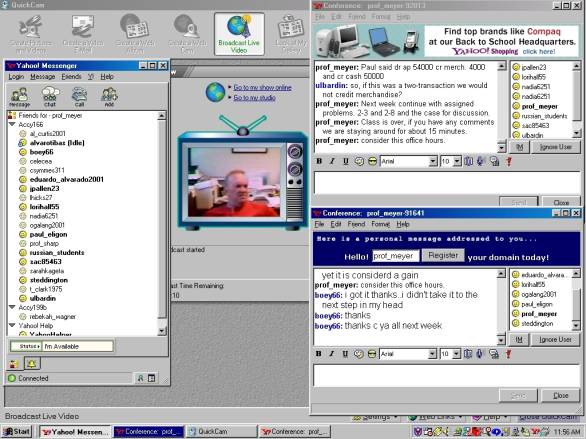
Conclusion The immediate need for the VCP includes overcrowding,
“off-track” courses, and reaching non-traditional students. Future applications will include
international participation, most likely Russia and Australia, and corporate
partnerships. With soon-to-be-available
wireless technology, the opportunities are limitless.
Who We Are
Global Training Partners, a California Partnership, was formed in October 2000, to provide educational and business training consulting.
Dr. Meyer, PhD, MBA, JD, LLM, has been an accounting professor since 1978, bringing over 20 years of domestic and international business experience. In addition to being an adjunct professor at McGeorge School of Law, he has been the CFO of a software development company. He is available as a consultant and can be reached at (916) 425-2748 or [email protected]
Mr. Cabiles, JD(Tax), BA, has been the ACFO of a start-up software company, a tax/business consultant, and has published in the areas of estate and business planning. He is available as a tax and business-planning consultant by email at: [email protected]
What Others Are Saying
Joint Press Release from Logitech, Inc. and Spotlife, Inc.