Key Concepts
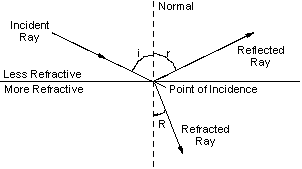
Refraction is the bending of light that takes place at a boundary between two materials having different indices of refraction. Refraction is due to a change in the speed of light as it passes from one medium to another. The boundary is the region where one medium meets another medium.
At a boundary, an incident ray can undergo partial reflection or, in certain situations, total internal reflection.
No bending of the incident ray occurs if it strikes the boundary along the normal.
The incident ray is the ray approaching the boundary. It strikes the boundary at the point of incidence. The refracted ray is the ray leaving the boundary through the second medium.
The reflected ray is the ray undergoing partial (or total) reflection at the boundary. The normal is a construction line drawn perpendicular to the boundary at the point of incidence.
The angle of incidence (i) is the angle between the incident ray and the normal. The angle of reflection (r) is the angle between the normal and the reflected ray.
The angle of refraction (R) is the angle between the normal and the refracted ray.
Laws of Refraction
- The ratio of sines of the angles of incidence and refraction is a constant. (Snell's Law) (The ratio is constant for a particular wavelength and a particular set of materials.)
- The incident and refracted rays are on opposite sides of the normal at the point of incidence.
- The incident ray, the normal, and the refracted ray are coplanar.
In geometric optics one often makes the assumption that light travels from one point to another along the path requiring the least time. That is, light will always seek the path of minimal time from point A to point B. This fact is often referred to as Fermat's Principle of Least Time. Note that the path of minimal time need not be the path of minimal distance between points A and B.
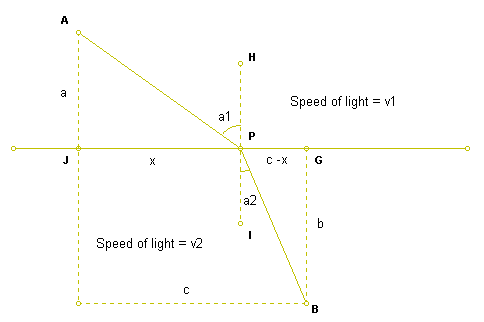
- If the speed of a particle is constant, then the distance it travels is given by the familiar formula d = st (distance equals speed times time). Equivalently, the time is found by dividing the distance traveled by the speed.
The time it takes a light particle to travel from point A to point B along the path APB is given by the formula
T = [sqrt(a2+x2)]/v1 + [sqrt(b2 + (c - x)2)]/v2
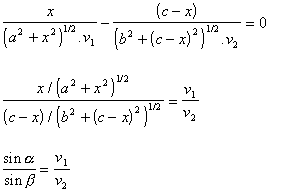
- The next step is to minimize the time it takes a particle of light to travel the path from A to P to B. A standard result from differential calculus requires that any miminum value of T will occur at a critical value.
Write dT/dx and set dT/dx equal to zero.
|