 |
|
Participating Media
Participating media is important for outdoor scenes. Landscape painters have known about ‘aerial perspective’ for centuries, objects can be made to appear distant by giving then a bluish cast. The glow of the sunset, blue skies, shafts of light in a dusty room are all phenomena caused by scattering occuring in participating media . Participating media is also important for rendering translucent surfaces like marble, milk, skin.
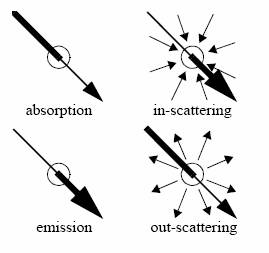
When photons pass through a medium they are either scattered or absorbed. Along an eye ray path, one may observe a gain in radiance due to emission by the medium, or due to light fro other directions getting scattered in the direction of the eye ray. One may also observe a loss in radiance due to out scattering and absorption. Some past approaches to model participating media involved assuming that multi scattering does not occur, thus any in scattered light must have come from the light source itself. Other approaches have used Spherical Harmonics and Finite Element methods. Recently, Shirley (2003) has proposed a closed form approximation to the Volume Rendering equation (given some constraints) and Scattering Maps have been proposed to model sea water (Iwasaki , 2003). Volume photon maps was proposed by Jensen and Per H Christiansen in 1998 to approximate the in scattering from other particles.
Scattering and Phase Functions
The following parameters are needed to descrive effects of participating media:
Absorption coefficient σa(x)
Scattering coefficient σs(x)
Phase function p(x, w, w’)
extinction coefficient k(x): σa(x) + σs(x) gives net loss in radiance
Albedo: Λ = σs(x) / ( σa(x) + σs(x) )
A Phase functions gives the probability of a photon scattering in a certain direction. This can be isotropic or anisotropic, even wavelength dependent
(as in Rayleigh scattering, where blue light scatters the most, making the sunsets golden). Mie scattering involves scattering with a strong component in the forward direction.
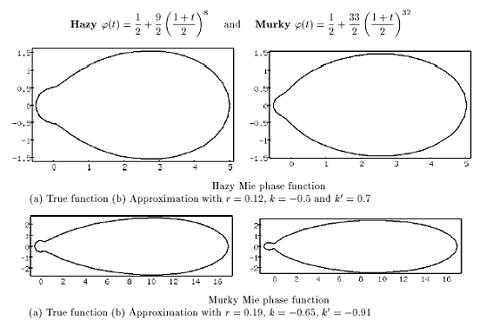
Some common phase functions are :
1) Heyney-Greenstein Phase Function
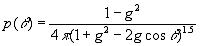
2) Rayleigh
3) Schlick's approximation of Heyney-Greenstein.It is easy to importance sample Schlick's phase function.

It is possible to approximate a complex scatter phase functions by a weighted sum
of several Heyney-Greenstein (or Schlick ) functionsThe Volume Rendering Equation
By integrating the change in radiance over a path of length s,accounting for scattering, absorption and emission, we get the volume rendering equation:
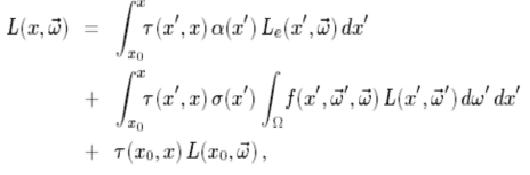
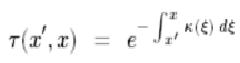
The equation cannot be solved analytically. It is solved by ray marching, dividing the ray path into steps.Within a step, the incoming light, absorption coefficient and scattering coefficient are constant. The direct light contribution can be estimated by ray marching shadow rays to the light sources through the medium. The multiple scattering contribution for a step can be estimated using volume photon mapping. The radiance of the step is attenuated based on total transarency from the eye point and added to the total radiance(note: this is for forward marching).
There are two ways to do ray marching- forwards or backwards. In this renderer, forward marching is used as it is possible to abandon the randiance computation once the atmosphere is found to be opaque enough to block light coming from behind it.

Backward ray marching starts from the far clip plane and moves towards the eye.
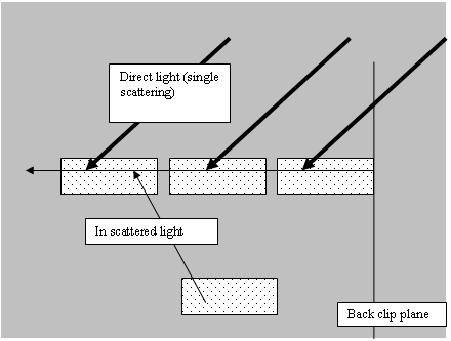
Backward ray marching
Estimating Multiple Scattering
If the volume photon map stores photons that have been scattered at least once, then the estimate for radiance caused by photons from neighbouring particles is given by:
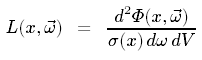
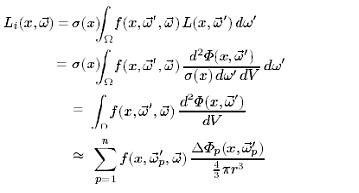
Tracing photons
Photons move through a medium until scattered or absorbed. Average distance moved before next interaction, d= 1/ st(x) where st(x) is the extinction coefficient. This distance traveled can be importance sampled so that the energy distribution of photons remains the same. We store photon at the next event (whether scattering or absorption) and use Russian roulette to decide if the photon is scattered or absorbed:
Let x1 be a random number between [0,1] If xi < albedo , the photon is scattered, else absorbed.
We also importance sample phase function to decide scattering direction.
| Send feedback regarding this page to [email protected] |
Last Modified: 11/10/2003 |